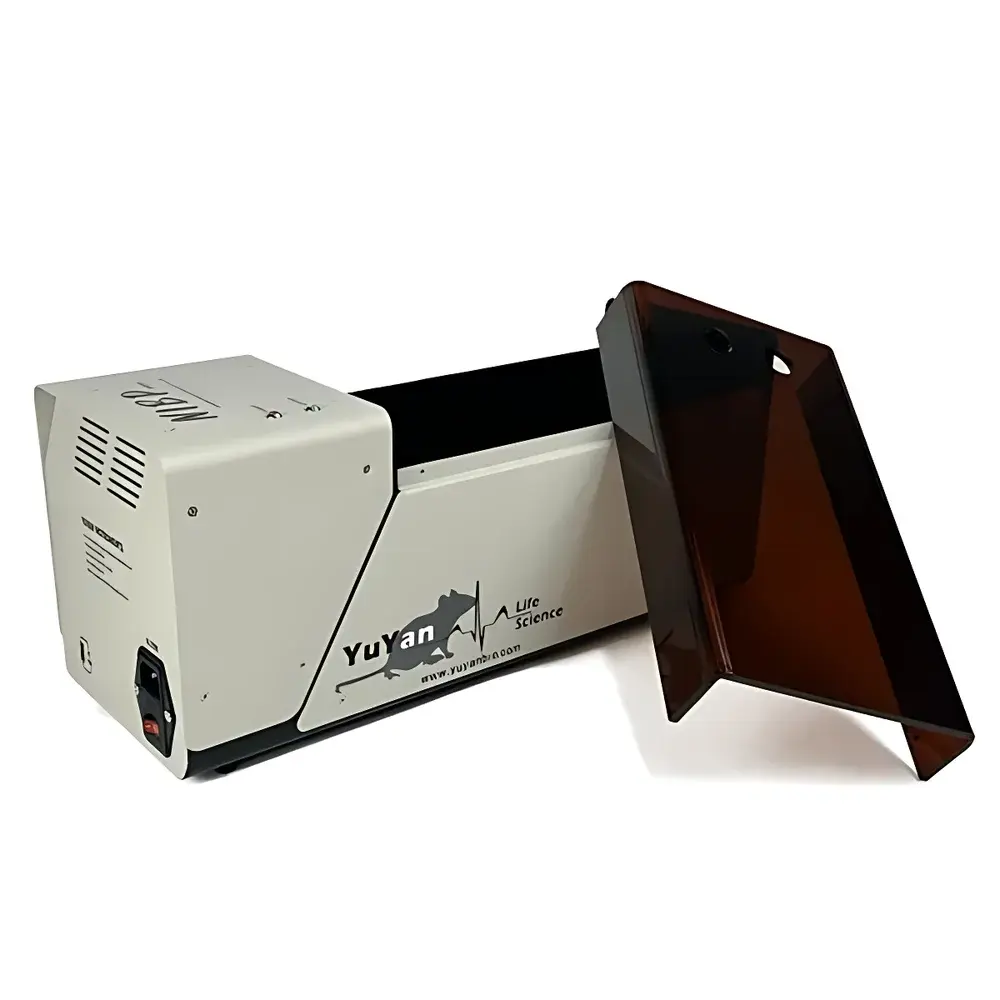
YUYANBIO NIBP-M1 Automated Non-Invasive Blood Pressure Measurement System for Mice and Rats
| Brand | YUYANBIO |
|---|---|
| Origin | Shanghai, China |
| Manufacturer | YUYANBIO Instrument Co., Ltd. |
| Model | NIBP-M1 (Single-Channel) / NIBP-MR4 (4-Channel) |
| Measurement Principle | Oscillometric + Infrared Photoplethysmography |
| Temperature-Controlled Warming Platform | Yes |
| Output Parameters | Systolic BP (SBP), Diastolic BP (DBP), Mean Arterial Pressure (MAP), Heart Rate (HR) |
| Data Export Format | Raw binary + CSV/Excel |
| Software Compliance | Audit trail-capable data logging, timestamped acquisition, user-access control |
| Channel Capacity | 1–4 simultaneous rodents (mouse or rat) |
| Animal Compatibility | Mouse (20–35 g) and Rat (200–500 g) with interchangeable tail-cuff adapters |
| Regulatory Context | Designed for preclinical GLP-compliant cardiovascular phenotyping |
Overview
The YUYANBIO NIBP-M1 and NIBP-MR4 systems are fully automated, non-invasive blood pressure measurement platforms engineered for longitudinal cardiovascular assessment in murine and rat models. These systems employ a dual-signal acquisition methodology combining oscillometric pressure waveform analysis with infrared photoplethysmographic (PPG) detection at the tail base—enabling robust, real-time quantification of systolic blood pressure (SBP), diastolic blood pressure (DBP), mean arterial pressure (MAP), and heart rate (HR) without surgical intervention. Unlike invasive catheter-based methods requiring terminal or chronic implantation, the NIBP platform delivers high-reproducibility hemodynamic data across repeated sessions, supporting chronic study designs compliant with ARRIVE 2.0 guidelines and NIH animal welfare standards. The system’s core architecture integrates a precision pneumatic control module, temperature-regulated warming platform (maintaining tail skin at 32–34 °C to ensure optimal vasodilation), and synchronized analog-to-digital signal processing at ≥1 kHz sampling rate—ensuring fidelity in pulse contour morphology and beat-to-beat variability analysis.
Key Features
- Validated correlation >99% with intra-arterial gold-standard measurements under controlled thermoregulatory conditions
- Oscillometric + PPG dual-modality sensing eliminates motion artifact and improves detection sensitivity in low-perfusion states
- Integrated thermostatic platform with PID-controlled heating (±0.3 °C stability) minimizes physiological stress and standardizes peripheral vascular tone
- Modular cuff design: Interchangeable mouse- and rat-specific tail cuffs (diameter range: 2.5–8.0 mm) mounted on a single universal sensor carriage
- Scalable channel architecture: NIBP-M1 supports one rodent per session; NIBP-MR4 enables concurrent monitoring of up to four animals with independent cuff pressurization and signal isolation
- Embedded real-time signal processor performs on-device filtering (0.5–30 Hz bandpass), peak detection, and beat classification prior to host transmission
Sample Compatibility & Compliance
The system is validated for use with C57BL/6, BALB/c, SD, and Wistar strains across standard weight ranges: mice (18–35 g) and rats (200–500 g). Tail-cuff positioning follows IACUC-recommended protocols, with acclimatization routines embedded in the software workflow to reduce handling-induced hypertension. All hardware components comply with IEC 61000-6-3 (EMC emissions) and IEC 61000-6-2 (immunity). Data management architecture supports audit-trail generation per FDA 21 CFR Part 11 requirements—including electronic signatures, immutable timestamps, and role-based access control—making it suitable for GLP-regulated toxicology and pharmacodynamics studies. Calibration traceability is maintained via NIST-traceable pressure transducers (accuracy ±0.5 mmHg) and factory-certified thermal sensors.
Software & Data Management
The proprietary NIBP Analysis Suite (v4.2+) runs on Windows 10/11 and provides a modular GUI with three operational layers: Acquisition Console (real-time waveform overlay, auto-cuff inflation sequencing), Processing Engine (adaptive noise suppression, arrhythmia flagging, pulse transit time calculation), and Reporting Module (customizable templates for SBP/DBP trends, HRV spectral analysis, group-wise ANOVA-ready exports). Raw data are stored in vendor-neutral HDF5 format with embedded metadata (animal ID, session timestamp, ambient temperature, operator ID). Batch export to CSV or Excel preserves full temporal resolution (1 ms binning), enabling downstream integration with MATLAB, Python (via h5py), or commercial PK/PD modeling tools. Software validation documentation (IQ/OQ/PQ protocols) is available upon request for regulated environments.
Applications
- Longitudinal evaluation of antihypertensive drug efficacy in spontaneously hypertensive rats (SHR) and DOCA-salt models
- Cardiovascular phenotyping in transgenic mouse lines (e.g., ACE2-KO, eNOS−/−)
- Neurocardiovascular coupling studies involving autonomic challenge (e.g., restraint stress, cold exposure)
- Toxicology screening for off-target hemodynamic effects during IND-enabling safety pharmacology (ICH S7A)
- Metabolic syndrome research linking insulin resistance, obesity, and arterial stiffness progression
- Validation of wearable telemetry alternatives via parallel cohort comparison studies
FAQ
How does the NIBP system ensure measurement consistency across repeated sessions?
Consistency is achieved through standardized thermal preconditioning (32 °C tail warming for ≥5 min), automated cuff sizing based on pre-scan diameter estimation, and algorithmic rejection of motion-contaminated cycles using cross-correlation between pressure and PPG waveforms.
Can the system differentiate between acute stress-induced hypertension and true pathological elevation?
Yes—the software includes an integrated acclimatization protocol (3–5 min baseline recording pre-inflation) and calculates within-session coefficient of variation (CV%) for SBP; CV >12% triggers operator alert for potential stress artifact.
Is raw waveform data accessible for custom algorithm development?
Yes—full-resolution binary streams (pressure + PPG + temperature) are exported alongside metadata in HDF5 format, with documented API hooks for third-party script integration.
What regulatory documentation is provided for GLP compliance?
Deliverables include Factory Acceptance Test (FAT) report, calibration certificates (NIST-traceable), software validation summary (including 21 CFR Part 11 conformance testing), and instrument qualification protocols (IQ/OQ).