
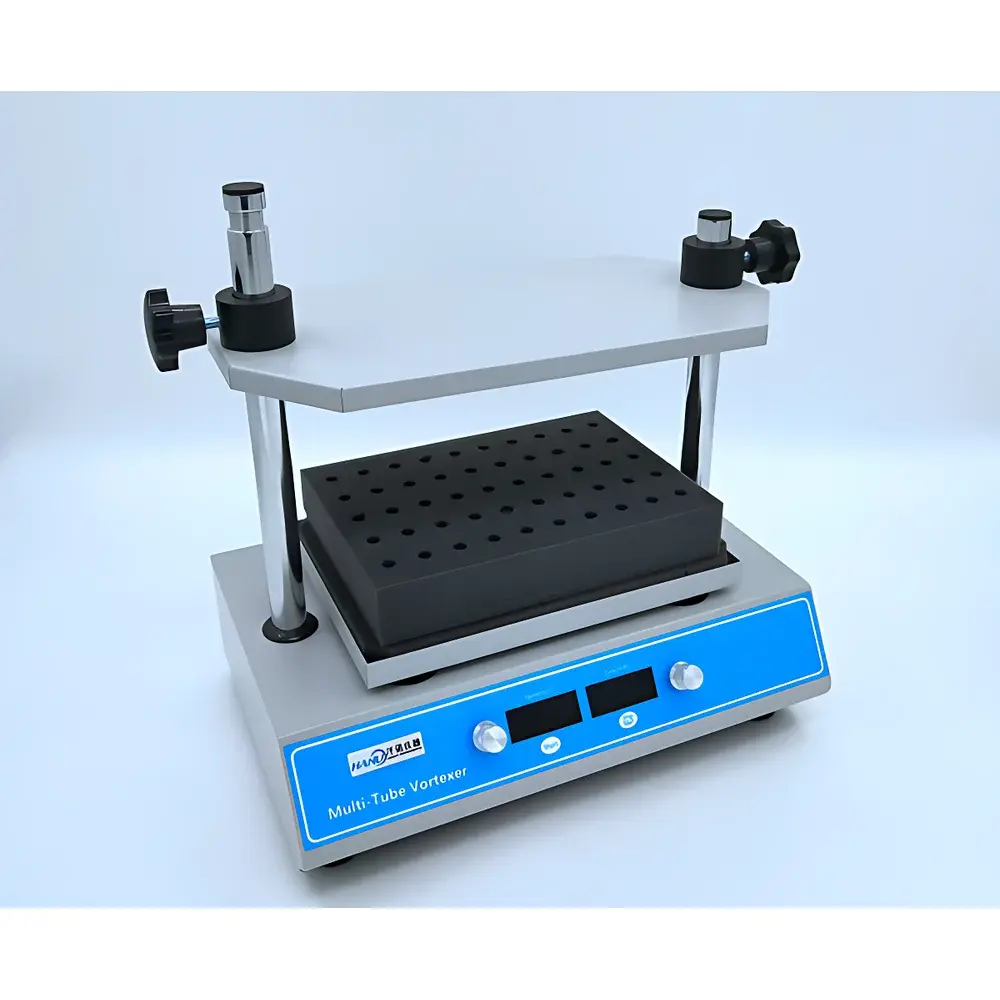
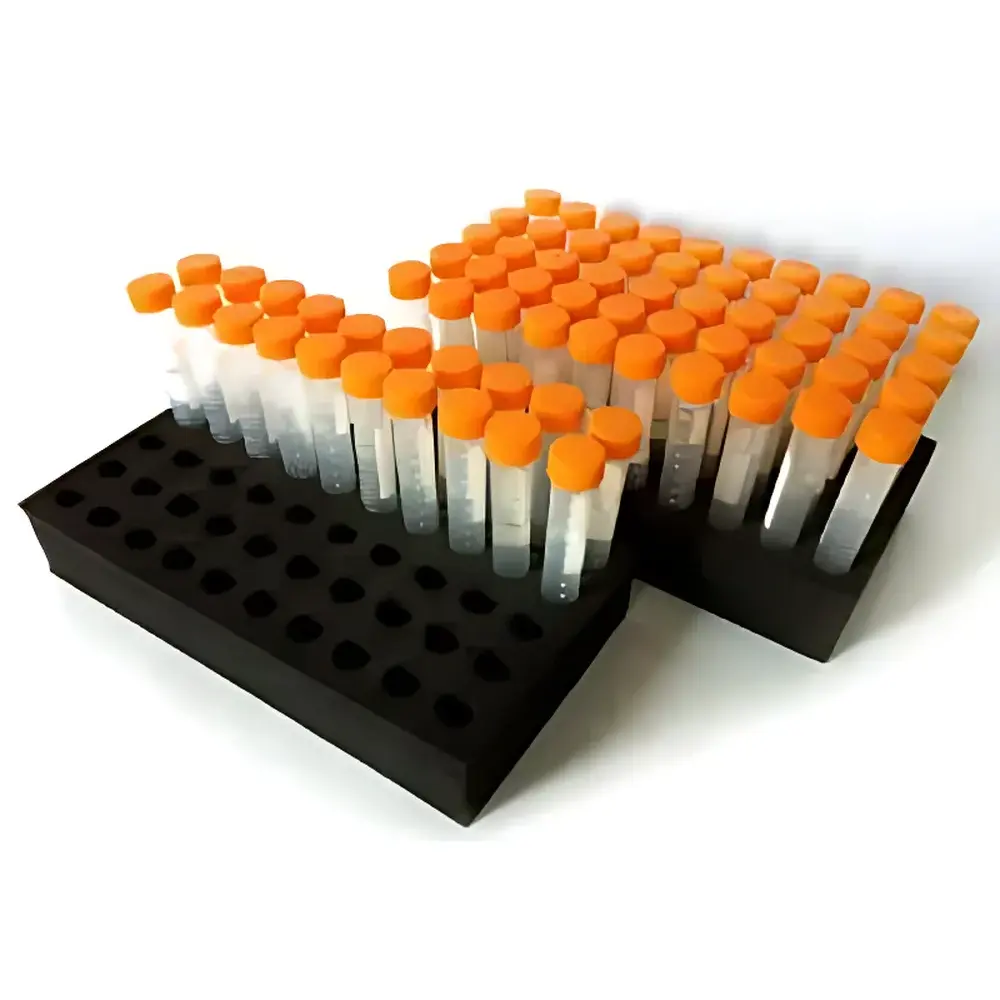
Hanuo HND-2500 Multi-Tube Vortex Mixer
| Brand | Hanuo |
|---|---|
| Model | HND-2500 |
| Speed Range | 500–2500 rpm |
| Speed Accuracy | ±50 rpm (at 2500 rpm) |
| Orbit Diameter | 4 mm |
| Max Load Capacity | 5 kg |
| Timer Range | 1 min – 99 h 59 min |
| Display | LED digital speed & time |
| Drive Type | Brushless DC motor |
| Vibration Mode | Horizontal orbital motion |
| Platform Dimensions | 311 × 184 mm |
| Overall Dimensions | 426 × 250 × 480 mm |
| Net Weight | 21.5 kg |
| Power Supply | 100–230 V, 50/60 Hz |
| Power Consumption | 60 W |
| Housing Material | Metal frame with polymer composite panels |
| Standard Accessories | 12 mm foam tube rack, tray pad |
| Optional Racks | Φ10/Φ12/Φ13/Φ16/Φ25/Φ29 mm foam racks (50 or 15 positions), replaceable upper & lower tray pads |
Overview
The Hanuo HND-2500 Multi-Tube Vortex Mixer is an engineered solution for high-throughput sample homogenization in life science and clinical laboratories. Utilizing horizontal orbital motion with a precisely controlled 4 mm orbit diameter, the instrument generates consistent, reproducible vortexing across multiple tubes simultaneously—without requiring individual tube activation. Its brushless DC motor delivers stable rotational torque across the full 500–2500 rpm range, eliminating carbon brush wear and ensuring long-term operational reliability under continuous use. Designed for integration into standardized workflows, the HND-2500 supports both timed and momentary (‘pulse’) mixing modes, enabling precise control over shear exposure—critical for preserving cell viability, enzyme activity, or nucleic acid integrity during sample preparation.
Key Features
- Simultaneous processing of up to 50 tubes (depending on rack configuration), significantly reducing batch processing time in QC, biobanking, and diagnostic labs.
- Microprocessor-based control system with LED display showing real-time speed (rpm) and remaining timer duration—enabling traceable, repeatable operation.
- Dual-mode operation: programmable timer (1 minute to 99 hours 59 minutes) and instant ‘touch’ mode for rapid, hands-free activation without interrupting workflow.
- Soft-start acceleration profile minimizes initial inertial shock, preventing splashing, foaming, or cap loosening—especially critical for low-volume or volatile samples.
- Modular rack system with interchangeable foam inserts (Φ10–Φ29 mm) accommodates common tube formats including microcentrifuge tubes (1.5–2.0 mL), 15 mL conical tubes, and 50 mL centrifuge tubes—ensuring compatibility across assay development, ELISA, PCR setup, and microbial suspension protocols.
- Robust mechanical architecture: aluminum-reinforced chassis, vibration-damped base, and thermally stable motor housing ensure minimal noise emission (<55 dB(A)) and positional stability even at maximum speed.
Sample Compatibility & Compliance
The HND-2500 is validated for use with standard polypropylene, polycarbonate, and glass tubes commonly employed in ISO 15189-accredited clinical laboratories and GLP-compliant research environments. Its non-contact orbital motion avoids cross-contamination risks associated with probe-based mixers and eliminates the need for sterilizable accessories. The device complies with IEC 61010-1:2010 safety standards for laboratory electrical equipment and meets EMC requirements per EN 61326-1:2013. While not certified for sterile manufacturing environments (e.g., ISO 5 cleanrooms), it is routinely deployed in pre-analytical sample preparation zones aligned with CLSI GP45-A4 and USP guidelines for analytical instrument qualification.
Software & Data Management
The HND-2500 operates as a standalone hardware platform with no embedded firmware-based data logging or network connectivity. All operational parameters—including set speed, timer value, and elapsed run time—are locally displayed and manually recorded. For laboratories requiring audit trails, integration with Laboratory Information Management Systems (LIMS) is achieved via external process documentation: users may log instrument ID, rack configuration, and run conditions in electronic lab notebooks (ELN) or paper-based SOP records. The absence of internal memory or remote access interfaces ensures compliance with data integrity principles outlined in FDA 21 CFR Part 11 when used within documented, controlled procedures.
Applications
- High-volume reagent resuspension and dilution series preparation in molecular diagnostics labs.
- Uniform bacterial or yeast suspension generation for colony-forming unit (CFU) enumeration (ASTM E2694, ISO 4833-1).
- Cell pellet resuspension prior to flow cytometry staining or RNA extraction—minimizing aggregation and improving assay reproducibility.
- Homogenization of immunoassay plates during wash steps or antigen-antibody incubation phases.
- Pre-analytical mixing of whole blood, serum, or plasma samples prior to centrifugation in clinical chemistry workflows.
- Supporting automated liquid handling systems by standardizing sample consistency before robotic aspiration.
FAQ
What tube sizes are supported out-of-the-box?
The unit ships with a 12 mm foam rack (50-position), compatible with standard 1.5 mL microcentrifuge tubes. Additional foam inserts—from Φ10 mm to Φ29 mm—are available as optional accessories.
Can the HND-2500 be used for viscous solutions like glycerol stocks or agarose gels?
Yes—its high-torque brushless motor maintains consistent speed across viscosities up to ~500 mPa·s when using appropriately sized tubes and optimized fill volumes (recommended ≤75% capacity).
Is calibration required, and does it support third-party verification?
Speed accuracy is factory-verified against NIST-traceable tachometers (±50 rpm at 2500 rpm). Users may perform periodic verification using handheld optical tachometers; no user-serviceable calibration routine is provided.
Does the instrument include overload or thermal protection?
Yes—the motor controller incorporates current-limiting circuitry and thermal cut-off at ≥85°C, automatically halting operation until cooldown.
What maintenance is recommended for long-term reliability?
No scheduled maintenance is required. Wipe the platform and rack surfaces with 70% ethanol after each use; inspect foam inserts for compression fatigue every 6 months and replace if deformation exceeds 20% of original thickness.
Related Products



