
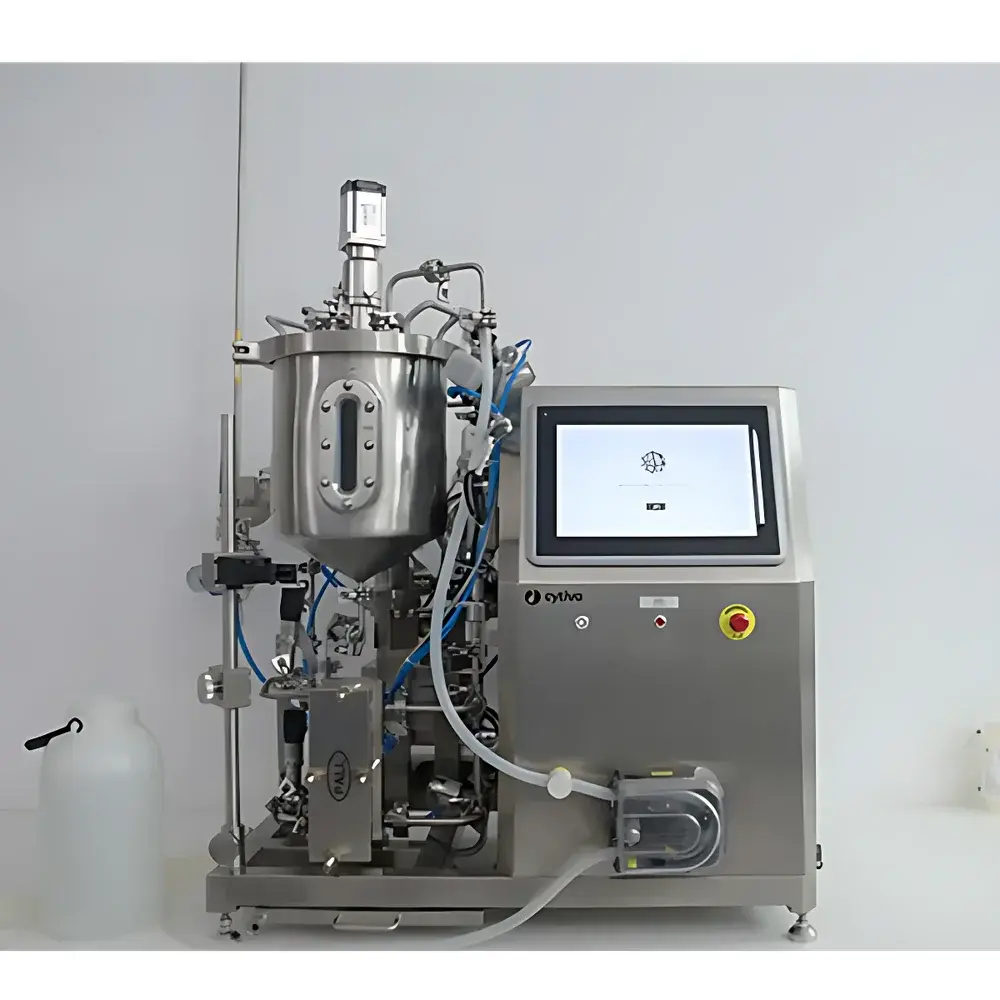
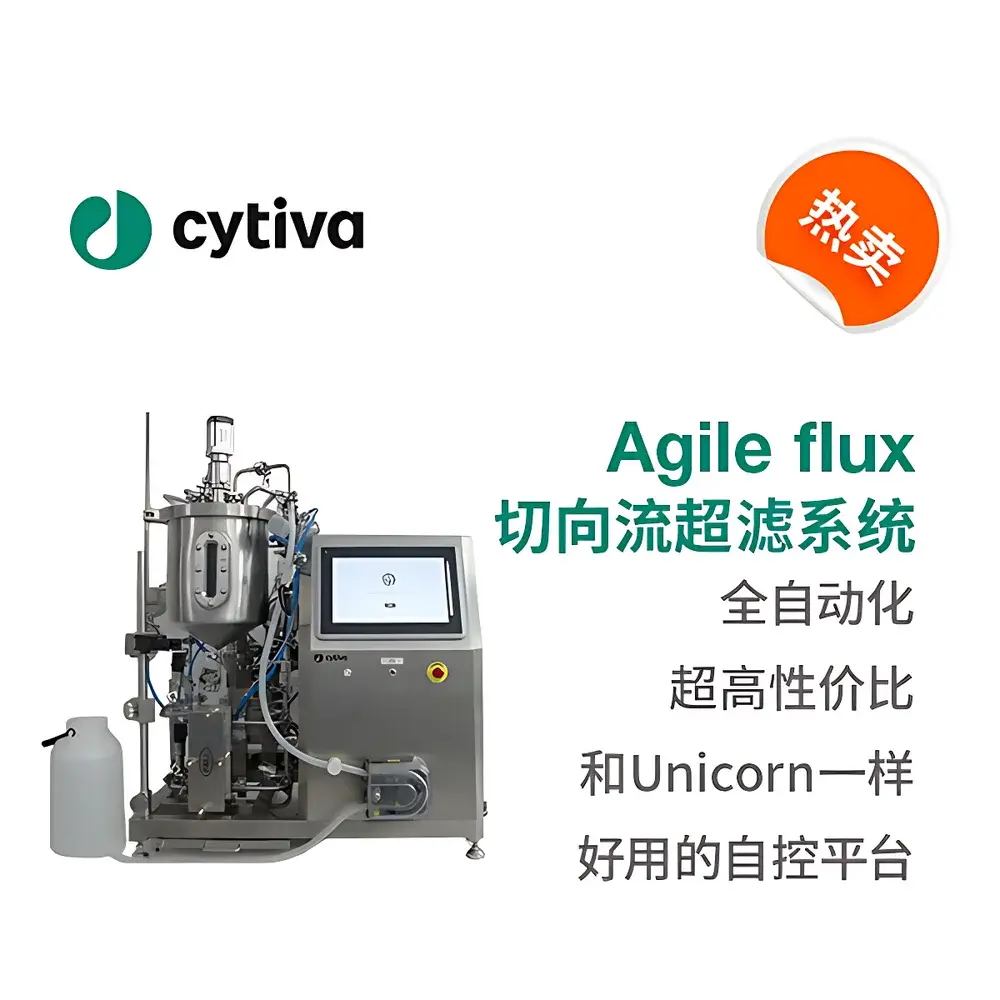
Cytiva Agile flux Tangential Flow Filtration (TFF) System
| Brand | Cytiva |
|---|---|
| Origin | Manufactured in China under Cytiva’s global quality system |
| Manufacturer Type | Authorized Distributor |
| Model | Agile flux TFF Systems |
| Pricing | Available upon request |
Overview
The Cytiva Agile flux Tangential Flow Filtration (TFF) System is an engineered platform for scalable, automated biomolecule concentration and buffer exchange across process development and small-scale GMP manufacturing. Based on the well-established principles of tangential flow filtration—where feed stream flows parallel to the membrane surface to minimize fouling and maintain consistent flux—the Agile flux system delivers reproducible performance across a wide range of bioprocessing applications. Designed for integration into early- to mid-stage biomanufacturing workflows, it supports seamless transition from lab-scale optimization to clinical batch production without requalification of core unit operations. Its modular architecture enables deployment in both non-GMP R&D environments and regulated settings compliant with current Good Manufacturing Practice (cGMP) requirements.
Key Features
- Scalable membrane compatibility: Supports single-use TFF cassettes (0.1–2.5 m² effective filtration area) and hollow-fiber modules across multiple configurations, enabling direct scale-up from 10 mL to >10 L process volumes.
- Pre-validated operational sequences: Five embedded standard protocols—including ultrafiltration/diafiltration (UF/DF), normal water permeability (NWP) testing, clean-in-place (CIP), water rinse, and alkaline hold—execute with deterministic timing, pressure control, and flow monitoring.
- Regulatory-ready automation: PLC-based control system with audit trail logging, user access levels (admin/operator), and electronic signature capability aligned with FDA 21 CFR Part 11 and EU Annex 11 expectations.
- Integrated sensor suite: Real-time monitoring of transmembrane pressure (TMP), differential pressure (ΔP), retentate and permeate flow rates, temperature, and conductivity—data logged at configurable intervals for traceability.
- Modular hardware expansion: Optional add-ons include integrated pH probe ports, conductivity-controlled diafiltration, automated inlet valve sequencing, and external pump synchronization for multi-step polishing trains.
Sample Compatibility & Compliance
The Agile flux system is validated for processing diverse biologics including monoclonal antibodies (mAbs), recombinant proteins, plasmid DNA, viral vectors (AAV, lentivirus), vaccines (subunit, mRNA-LNP formulations), and plasma-derived therapeutics. All wetted materials comply with USP Class VI and EP 3.1.9 biological safety standards. The system’s design adheres to ISO 13485:2016 for medical device quality management systems, and software architecture follows IEC 62304 for medical device software lifecycle processes. For GMP use, documentation packages—including Design Qualification (DQ), Installation Qualification (IQ), Operational Qualification (OQ), and Performance Qualification (PQ) templates—are available upon request to support site-specific validation efforts.
Software & Data Management
The Agile flux Control Software provides intuitive graphical interface navigation with drag-and-drop protocol editing, real-time trend visualization, and exportable CSV/Excel reports. All process data—including timestamps, setpoints, actual values, alarms, and operator actions—are stored locally with optional network backup. Audit trails are immutable and timestamped, meeting ALCOA+ principles (Attributable, Legible, Contemporaneous, Original, Accurate, Complete, Consistent, Enduring, Available). Data integrity safeguards include password-protected configuration changes, role-based permissions, and automatic session timeout. Integration with enterprise MES or SCADA systems is supported via OPC UA and Modbus TCP protocols.
Applications
- Downstream process development: Rapid UF/DF screening across buffer compositions, membrane types, and operating conditions (e.g., TMP, crossflow rate, diafiltration volume).
- Clinical manufacturing: Robust execution of GMP-compliant UF/DF steps for Phase I–II drug substance batches, including viral vector purification and mRNA formulation finishing.
- Process characterization studies: Generation of kinetic data for membrane fouling behavior, protein aggregation propensity under shear, and scalability modeling between benchtop and pilot-scale TFF units.
- Quality control support: Routine NWP verification, post-CIP integrity confirmation, and end-of-run permeate clarity assessment using integrated conductivity and pressure decay logic.
- Technology transfer: Reproducible execution of identical protocols across geographically distributed sites using standardized firmware and parameter libraries.
FAQ
Is the Agile flux system qualified for use in GMP manufacturing environments?
Yes—when deployed with appropriate IQ/OQ/PQ documentation, configured user access controls, and enabled audit trail functionality, the system meets fundamental regulatory expectations for automated bioprocessing equipment under ICH Q5A, Q5D, and FDA Guidance for Industry: Process Validation.
Can third-party TFF cassettes or hollow-fiber modules be used with the Agile flux platform?
The system is mechanically and hydraulically compatible with industry-standard cassette housings and fiber cartridges; however, full performance validation—including flux stability, yield consistency, and cleaning efficacy—is only guaranteed when using Cytiva-certified consumables.
What level of software validation support is provided by Cytiva?
Cytiva supplies a comprehensive Software Lifecycle Documentation Package (SLDP), including risk assessments (FMEA), traceability matrices, test scripts, and summary reports compliant with IEC 62304 and GAMP 5 classifications.
Does the Agile flux system support remote monitoring or cloud-based data archival?
Local data export and network-connected backup are supported; cloud integration requires customer-owned infrastructure and must comply with organizational cybersecurity policies and regional data residency requirements (e.g., GDPR, HIPAA).
How frequently does the system require calibration or preventive maintenance?
Pressure and flow sensors are factory-calibrated and do not require routine recalibration under normal operation; annual preventive maintenance—performed by Cytiva-certified field service engineers—is recommended to verify mechanical integrity, seal performance, and firmware version compliance.



