
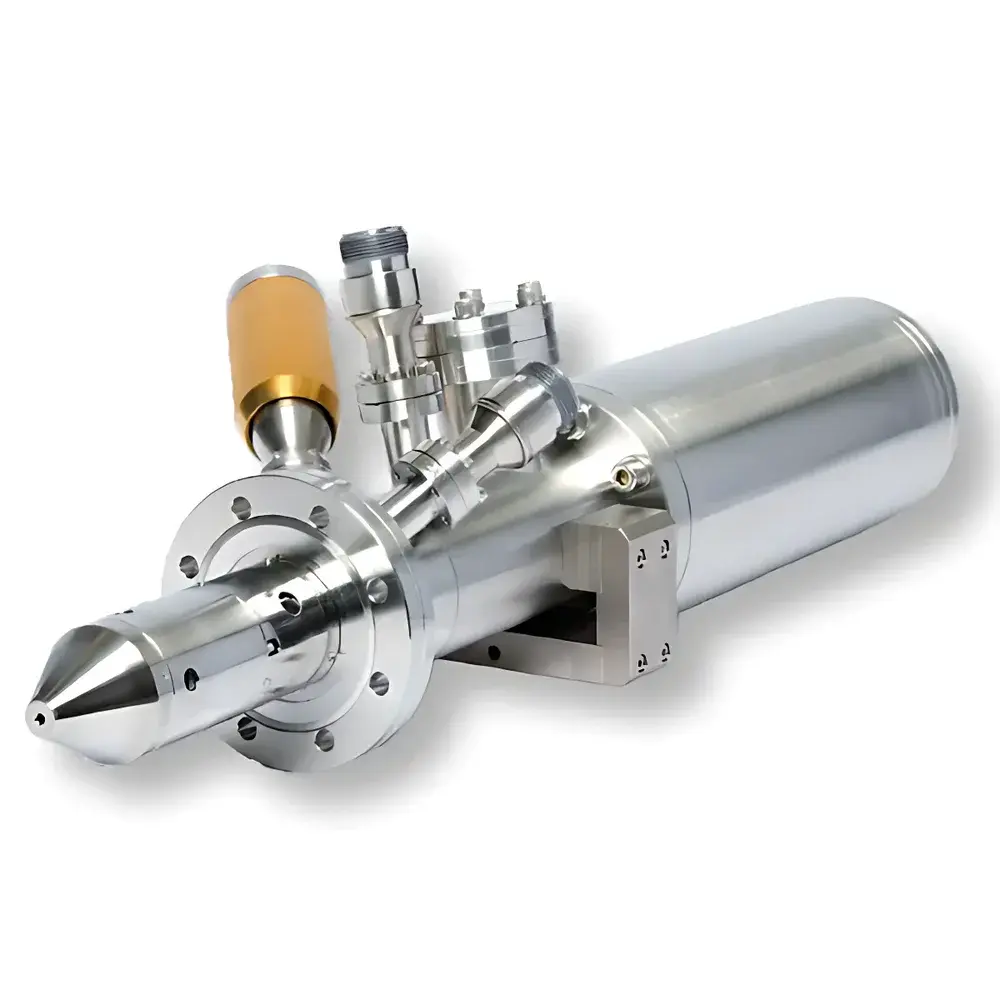
Shuyun C60-20S Cluster Ion Source System
| Brand | Shuyun |
|---|---|
| Origin | United Kingdom |
| Model | C60-20S |
| Operating Voltage Range | 5–20 kV |
| Beam Current | 50 nA |
| Spot Size | 100 µm |
| Scan Area | 4 × 4 mm |
| Source-to-Head Distance | 142 mm |
| Recommended Working Distance | 50 mm |
| Power Supply | 3U 19″ rack-mountable unit |
| Input Power | 110–240 VAC, 13 A, 50/60 Hz |
| Software Platform | Windows 10 or later |
| Integration Flange | NW 63 CF |
| Valve Type | Integrated gate valve |
Overview
The Shuyun C60-20S Cluster Ion Source System is a high-performance, ultra-low-damage sputtering source engineered for surface preparation in advanced surface analysis applications. Unlike conventional monatomic ion beams (e.g., Ar⁺, Xe⁺, Ga⁺), the C60-20S generates focused, mass-selected C₆₀⁺ molecular cluster ions via cold cathode ionization and electrostatic acceleration. This enables highly efficient, non-destructive material removal through collective energy deposition—where kinetic energy is distributed across 60 carbon atoms upon impact, minimizing subsurface lattice disruption and preserving chemical integrity. Designed for integration into ultra-high vacuum (UHV) chambers (≤1×10⁻⁸ mbar), it operates at accelerating voltages from 5 to 20 kV with precise current control up to 50 nA. Its compact 142 mm source-to-head length and standardized NW 63 CF flange ensure compatibility with commercial XPS, AES, and SIMS instrumentation from Thermo Fisher, Physical Electronics, and ION-TOF.
Key Features
- High-current-density C₆₀⁺ beam (up to 50 nA) enabling rapid sputter rates—up to 50× faster than 15 keV Ar⁺ under equivalent conditions
- Sub-100 µm spot size with programmable 4 × 4 mm raster scanning for localized, spatially resolved depth profiling
- Integrated gate valve for rapid source isolation and maintenance without breaking main chamber vacuum
- Robust, long-lifetime ion source architecture with stable emission over >2,000 hours of cumulative operation
- Rack-mountable 3U power supply unit supporting universal AC input (110–240 VAC, 50/60 Hz) and full remote control via RS-232 or Ethernet
- Minimal chemical modification: TRIM simulations and experimental XPS validation confirm negligible bond scission or oxidation in polymers (e.g., PTFE) compared to monatomic beams
Sample Compatibility & Compliance
The C60-20S delivers uniform sputter yields across diverse materials—including insulators (SiO₂, Al₂O₃), organics (PMMA, PET), semiconductors (Si, GaAs), and crystalline metals—without requiring charge compensation or conductive capping layers. Its consistent etch rate versus crystallographic orientation eliminates channeling artifacts common in monatomic ion milling. The system complies with CE marking requirements for electromagnetic compatibility (EMC Directive 2014/30/EU) and low-voltage safety (LVD Directive 2014/35/EU). When integrated into analytical UHV systems, it supports GLP-compliant workflows per ISO/IEC 17025:2017 and facilitates audit-ready data traceability when paired with validated software environments meeting FDA 21 CFR Part 11 requirements.
Software & Data Management
Control and monitoring are executed via a native Windows 10+ application supporting real-time beam current/voltage logging, scan pattern definition (raster, spiral, line), and interlock status visualization. All operational parameters—including timestamped voltage ramps, current setpoints, and valve actuation events—are stored in encrypted SQLite databases with SHA-256 checksums. Export options include CSV, HDF5, and vendor-neutral XML formats compatible with Igor Pro, MATLAB, and CasaXPS. Remote access is enabled via TLS-secured HTTP API, allowing integration into centralized laboratory information management systems (LIMS) and automated metrology workflows.
Applications
- Depth profiling of organic thin films and multilayer polymer stacks with preserved functional group integrity
- High-resolution SIMS imaging of biological tissue sections (e.g., lipid distribution in frozen-hydrated samples)
- Pre-analysis cleaning of oxide-sensitive catalyst surfaces prior to XPS quantification
- Damage-free sputtering of perovskite photovoltaic layers for interface chemistry characterization
- Calibration reference generation for quantitative ToF-SIMS using certified SRM materials (NIST SRM 2483, 2484)
FAQ
What vacuum level is required for optimal C60-20S operation?
The source requires a base pressure ≤5×10⁻⁹ mbar in the ion optics region; chamber pressure during sputtering should remain below 2×10⁻⁷ mbar to prevent beam scattering and cluster fragmentation.
Can the C60-20S be retrofitted onto existing XPS systems?
Yes—provided the host system features an available NW 63 CF port and compatible UHV feedthroughs for high-voltage and signal lines; mechanical and electrical integration kits are supplied with full dimensional drawings and wiring schematics.
Is beam alignment performed manually or automatically?
Beam centering and focus are adjusted via three-axis electrostatic deflectors controlled through the software interface; alignment verification is achieved using a phosphor-coated Faraday cup and live current mapping.
Does the system support pulsed operation for time-of-flight applications?
Yes—the power supply includes TTL-triggered gating with <100 ns rise time and adjustable pulse width (100 ns–10 ms), enabling synchronization with ToF-SIMS extraction pulses.
What maintenance intervals are recommended?
Source cleaning and cathode inspection are advised every 500 hours of operation; full refurbishment—including extractor lens replacement—is scheduled at 2,000-hour intervals, with lifetime consumables documented in the maintenance logbook.



