
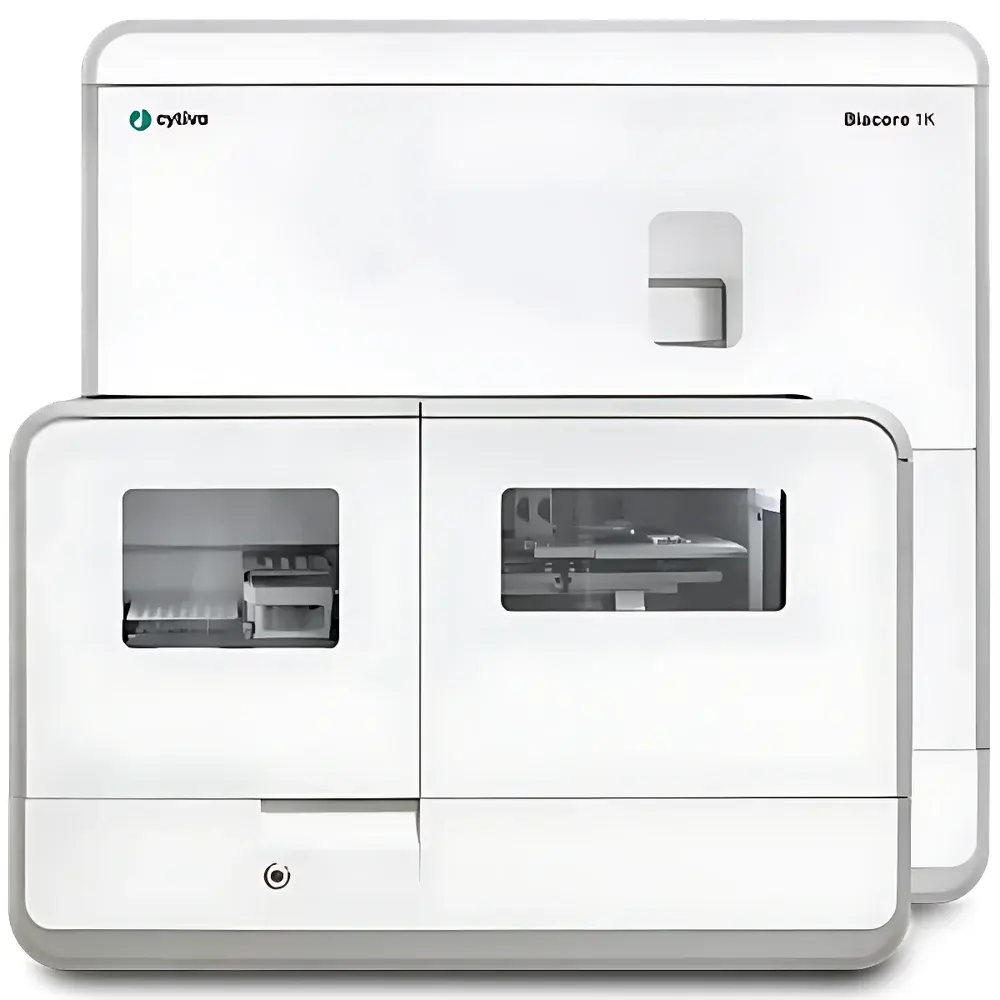
Cytiva Biacore 1K Surface Plasmon Resonance Molecular Interaction Analyzer
| Brand | Cytiva |
|---|---|
| Origin | Sweden |
| Model | Biacore 1K SPR System |
| Configuration | Single-injection needle, six-flow-cell platform |
| Regulatory Readiness | Optional GxP-compliant software package (21 CFR Part 11 audit trail enabled) |
| Software | Biacore Insight™ v3.x |
| Service Support | OptiRun™ lifecycle service program |
| Upgrade Path | Compatible with Biacore 1K+ expansion module for enhanced ligand multiplexing and sample throughput |
Overview
The Cytiva Biacore 1K Surface Plasmon Resonance (SPR) Molecular Interaction Analyzer is a benchtop, single-channel SPR platform engineered for robust, reproducible label-free analysis of biomolecular interactions in real time. Leveraging the physical principle of surface plasmon resonance—where changes in refractive index at a gold sensor surface are quantified upon binding-induced mass accumulation—the system delivers quantitative kinetic (ka, kd) and affinity (KD) parameters without fluorescent or enzymatic labeling. Designed for early-stage drug discovery and protein characterization labs, the Biacore 1K employs a single precision injection needle coupled with a six-flow-cell sensor chip architecture, enabling both sequential and paired flow-cell referencing to minimize bulk refractive index artifacts and enhance data fidelity. Its compact footprint, integrated temperature-controlled sample compartment (4–40 °C), and compatibility with standard microtiter plates (96-well) and reagent racks support walk-away operation across diverse experimental workflows—from fragment screening to antibody-antigen affinity maturation.
Key Features
- Six independent flow cells per sensor chip: Enables internal referencing, duplicate injections, and simultaneous evaluation of multiple ligands or analytes under identical buffer conditions.
- Single-injection needle architecture: Reduces carryover risk, simplifies fluidic maintenance, and improves long-term baseline stability compared to multi-needle systems.
- Automated queue-based method execution: Supports unattended overnight runs with preloaded assay sequences, including regeneration cycles, buffer equilibration, and concentration series.
- Modular thermal control: Maintains precise sample and chip temperature (±0.1 °C) across the entire operating range (4–40 °C), critical for thermodynamic profiling and low-affinity interaction studies.
- GxP-ready configuration option: Includes Biacore Insight™ software with full 21 CFR Part 11 compliance—electronic signatures, role-based access control, and immutable audit trails for regulated environments (e.g., GLP, GMP).
- Seamless method transferability: Assay methods developed on the Biacore 1K are directly portable to higher-throughput Biacore 1 Series and Biacore 8K platforms, ensuring scalability without protocol revalidation.
Sample Compatibility & Compliance
The Biacore 1K accommodates a broad spectrum of analytes and ligands—including small molecules (<500 Da), peptides, proteins, antibodies, nucleic acids, and virus-like particles—without requirement for covalent modification. Crude lysates, serum, cell culture supernatants, and purified fractions can be analyzed directly, provided particulate matter is removed via centrifugation or filtration (0.22 µm). Sensor chip surfaces (CM5, SA, NTA, C1, etc.) support amine coupling, streptavidin-biotin capture, Ni-NTA immobilization, and hydrophobic adsorption strategies. The system complies with ISO/IEC 17025:2017 for testing laboratories and supports alignment with ICH Q5E (comparability of biotechnological/biological products) and USP (biomolecular interaction analysis). Optional IQ/OQ/PQ documentation packages are available for installation and operational qualification in regulated facilities.
Software & Data Management
Biacore Insight™ software provides end-to-end workflow automation—from experimental design and instrument control to global fitting, statistical validation, and report generation. Built-in templates for kinetic analysis, steady-state affinity determination, and specificity screening reduce manual parameter optimization. Raw sensorgrams are stored in vendor-neutral .bic format; export options include CSV, Excel, and XML for integration with third-party modeling tools (e.g., KinExA, Scrubber). All processing steps are logged with timestamps, user IDs, and versioned algorithm settings. Audit trail functionality meets FDA 21 CFR Part 11 requirements when the GxP software package is activated, ensuring traceability for regulatory submissions.
Applications
- Fragment-based drug discovery: Quantitative ranking of weak-binding fragments (KD up to mM range) using high-sensitivity detection and reference subtraction.
- Antibody engineering: Epitope binning, off-rate screening, and thermal stability assessment under physiological buffer conditions.
- Protein-protein interaction mapping: Validation of co-immunoprecipitation hits and stoichiometric binding models.
- Biosimilarity assessment: Comparative kinetic profiling of innovator and biosimilar monoclonal antibodies against shared targets.
- Quality control of conjugated reagents: Real-time monitoring of labeling efficiency and functional activity post-conjugation.
FAQ
Can the Biacore 1K analyze unpurified biological samples such as cell lysates or serum?
Yes—provided samples are clarified by centrifugation (14,000 × g, 10 min) and filtered (0.22 µm), the system tolerates moderate levels of contaminants without clogging or non-specific signal drift.
Is sensor chip reuse supported?
Certain chips (e.g., CM5, SA) allow regeneration via low-pH or high-salt pulses for up to 50–100 cycles, depending on ligand stability and regeneration stringency.
What level of technical support is included during the instrument lifecycle?
OptiRun™ service plans offer tiered coverage—including remote diagnostics, priority on-site response, preventive maintenance, and application specialist consultation—tailored to lab throughput and regulatory requirements.
How does the Biacore 1K handle mass transport limitation artifacts?
The system’s low-flow-rate capability (0.5–10 µL/min), combined with optimized flow-cell geometry and optional mass transport correction algorithms in Biacore Insight™, mitigates diffusion-limited binding effects in high-affinity or low-diffusivity interactions.
Is method validation support available for GxP environments?
Yes—Cytiva provides validated IQ/OQ protocols, change control documentation (CCN subscription), and training materials aligned with ALCOA+ data integrity principles.




