
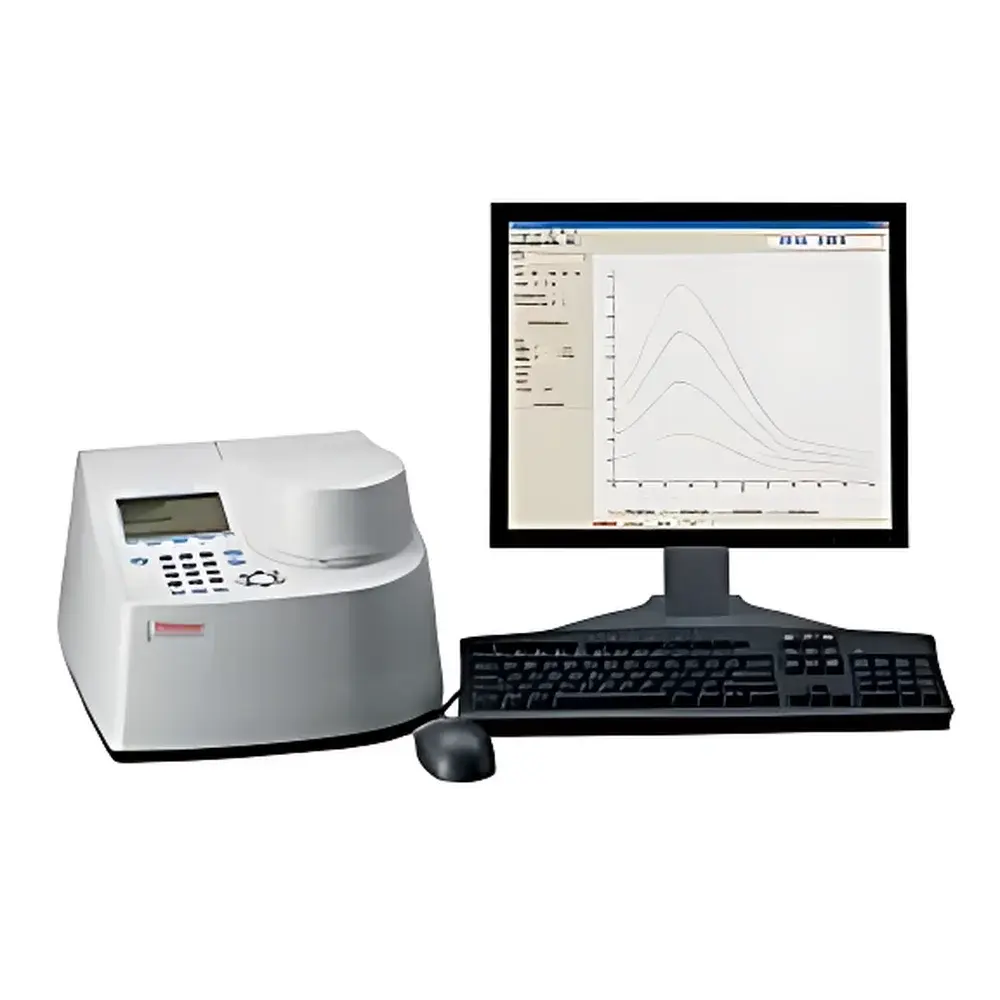
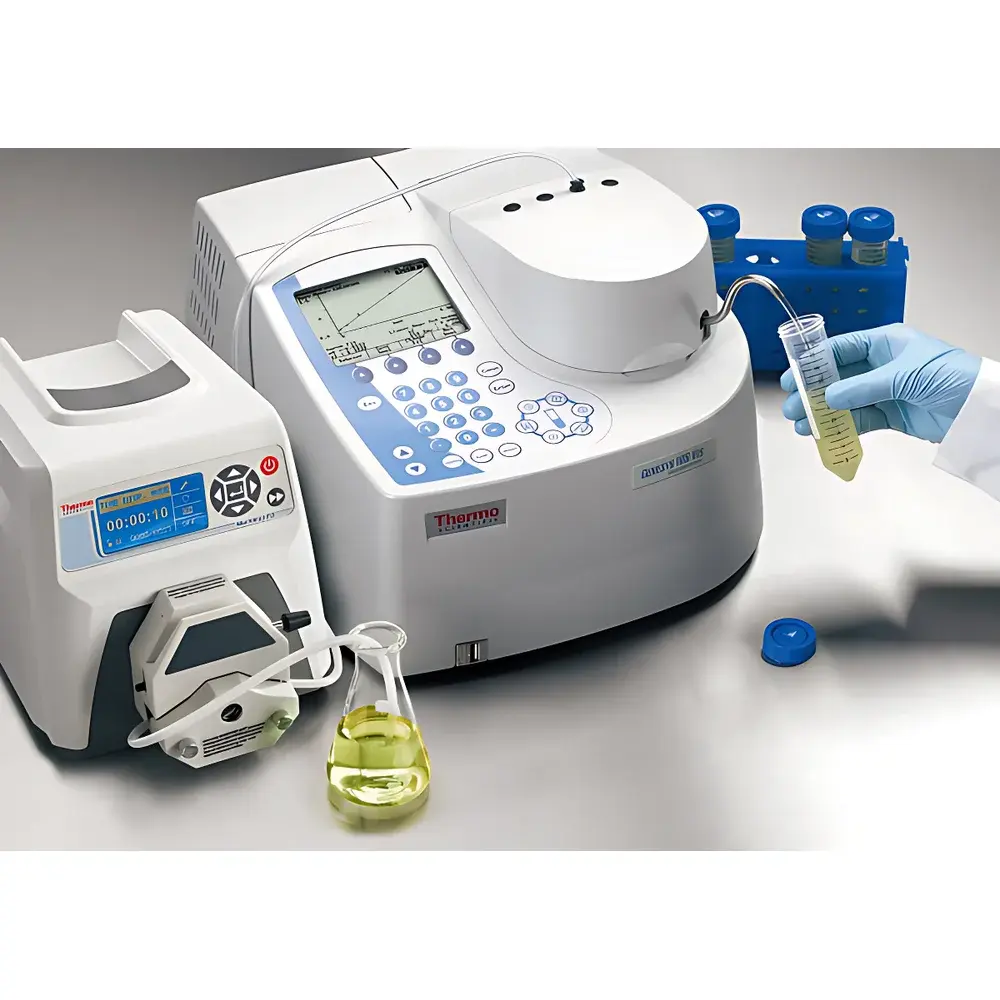
Thermo Scientific Genesys 10s UV-Vis Spectrophotometer
| Brand | Thermo Fisher |
|---|---|
| Origin | USA |
| Manufacturer Type | Original Equipment Manufacturer (OEM) |
| Import Status | Imported |
| Model | Genesys 10s |
| Instrument Architecture | Double-beam |
| Detector Type | Photodiode Array (PDA) |
| Wavelength Range | 190–1100 nm |
| Wavelength Scanning Speed | Up to 4200 nm/min |
| Spectral Bandwidth | 1.8 nm |
| Wavelength Accuracy | ±0.3 nm |
| Stray Light | <0.05% T at 220 nm and 340 nm |
| Light Source | Pulsed Xenon Flash Lamp (3-year warranty) |
| Grating | Holographic Master Grating |
| Cuvette Changer | Integrated 6-position Auto-Changer |
| Data Storage | USB flash drive support |
| Compliance | Designed to support USP <85>, EP 2.2.25, and JP 17 UV-Vis validation protocols |
| Software Options | GENESYS Instrument Control Software (PC-based), optional FDA 21 CFR Part 11-compliant audit trail module |
Overview
The Thermo Scientific Genesys 10s UV-Vis Spectrophotometer is a double-beam, scanning spectrophotometer engineered for precision, stability, and operational efficiency in regulated and non-regulated laboratory environments. It employs a pulsed xenon flash lamp as its light source — eliminating continuous thermal load on the sample compartment while delivering high-intensity illumination across the full 190–1100 nm spectral range. Unlike conventional deuterium/tungsten lamp systems, the xenon flash lamp activates only during data acquisition, minimizing photodegradation of light-sensitive analytes and ensuring consistent baseline stability over extended measurement sequences. The instrument utilizes a holographic master grating and a photodiode array detector to achieve high wavelength reproducibility and rapid spectral acquisition — up to 4200 nm/min — without mechanical slit adjustment or lamp switching. Its double-beam optical design continuously compensates for source intensity drift and environmental fluctuations, enabling high photometric accuracy (<±0.002 A at 1.0 A) and long-term measurement repeatability.
Key Features
- Double-beam optics with real-time reference beam correction for enhanced photometric accuracy and baseline stability
- Pulsed xenon flash lamp (3-year limited warranty) — zero warm-up time, no filament degradation, and negligible heat emission into the sample chamber
- 1.8 nm spectral bandwidth optimized for resolution/sensitivity balance in routine and research applications
- Integrated 6-position cuvette changer supporting standard 10 mm pathlength cells, enabling unattended multi-sample analysis
- USB-native data export — direct saving of spectra, methods, and reports to removable flash storage without PC dependency
- Onboard method library with pre-validated protocols aligned with USP , EP 2.2.25, and JP 17 requirements for pharmaceutical absorbance testing
- Wavelength accuracy certified to ±0.3 nm (NIST-traceable verification available via optional calibration kit)
Sample Compatibility & Compliance
The Genesys 10s accommodates standard quartz, glass, and plastic cuvettes (10 mm pathlength), with optional accessories enabling microvolume measurements (e.g., 2 µL capillary cells), solid-sample reflectance (integrating sphere), and kinetic assays (temperature-controlled cell holders). Its optical architecture meets the minimum performance criteria specified in ISO 17025-accredited laboratories for UV-Vis instrumentation. For GxP environments, optional software modules provide full 21 CFR Part 11 compliance — including electronic signatures, role-based access control, and immutable audit trails for all method edits, calibration events, and result exports. Routine operation supports GLP/GMP documentation workflows through customizable report templates and metadata tagging (operator ID, timestamp, instrument serial number, calibration status).
Software & Data Management
The Genesys 10s operates in two primary modes: standalone via intuitive front-panel interface or PC-connected via USB 2.0 using Thermo’s GENESYS Instrument Control Software. The software provides advanced data processing capabilities — including first- and second-derivative spectroscopy, multi-component quantitation (up to 5 analytes), and kinetic time-scan modeling. All raw absorbance, transmittance, and %T data are stored in vendor-neutral CSV format. Audit trail functionality (when enabled) logs every user action — from wavelength calibration to curve-fitting parameter modification — with tamper-proof timestamps and operator attribution. Data integrity is further reinforced by automatic checksum validation upon file transfer and write-protection for archived methods.
Applications
- Pharmaceutical quality control: assay of active pharmaceutical ingredients (APIs), excipient identification, dissolution testing, and cleaning validation
- Academic and industrial research: enzyme kinetics, protein quantification (Bradford/Lowry/BCA), nucleic acid purity assessment (A260/A280 ratio), and ligand-binding studies
- Environmental analysis: nitrate/nitrite, phosphate, and heavy metal speciation (e.g., Cr(VI) via diphenylcarbazide method)
- Food and beverage: colorimetric determination of antioxidants (DPPH assay), anthocyanin content, and preservative concentration (e.g., sulfites)
- Chemical manufacturing: reaction monitoring, polymer characterization (e.g., conjugated diene quantification), and catalyst activity profiling
FAQ
Does the Genesys 10s require lamp alignment or warm-up before use?
No. The xenon flash lamp requires zero warm-up time and contains no moving parts or consumable filaments. Alignment is factory-set and mechanically locked.
Can the instrument be validated per pharmacopeial standards?
Yes. Pre-loaded validation protocols cover wavelength accuracy, photometric linearity, stray light, and resolution per USP , EP 2.2.25, and JP 17. Optional NIST-traceable calibration kits support IQ/OQ/PQ documentation.
Is the 6-position cuvette changer compatible with non-standard cell geometries?
The changer accepts standard 12.5 × 12.5 mm square cuvettes and 16 mm round cells. Custom adapters are available for 5 mm and 50 mm pathlength cells, though automatic position recognition is limited to the native 6-slot configuration.
How is data security managed in regulated environments?
With the optional Compliance Pack, all data modifications are logged in an encrypted, read-only audit trail compliant with FDA 21 CFR Part 11 and EU Annex 11 requirements.
What maintenance is required beyond lamp replacement?
None. The xenon lamp is rated for ≥10⁹ flashes (typically >5 years under normal usage). Optical surfaces are sealed and do not require cleaning; only routine external wipe-down and annual performance verification are recommended.






