
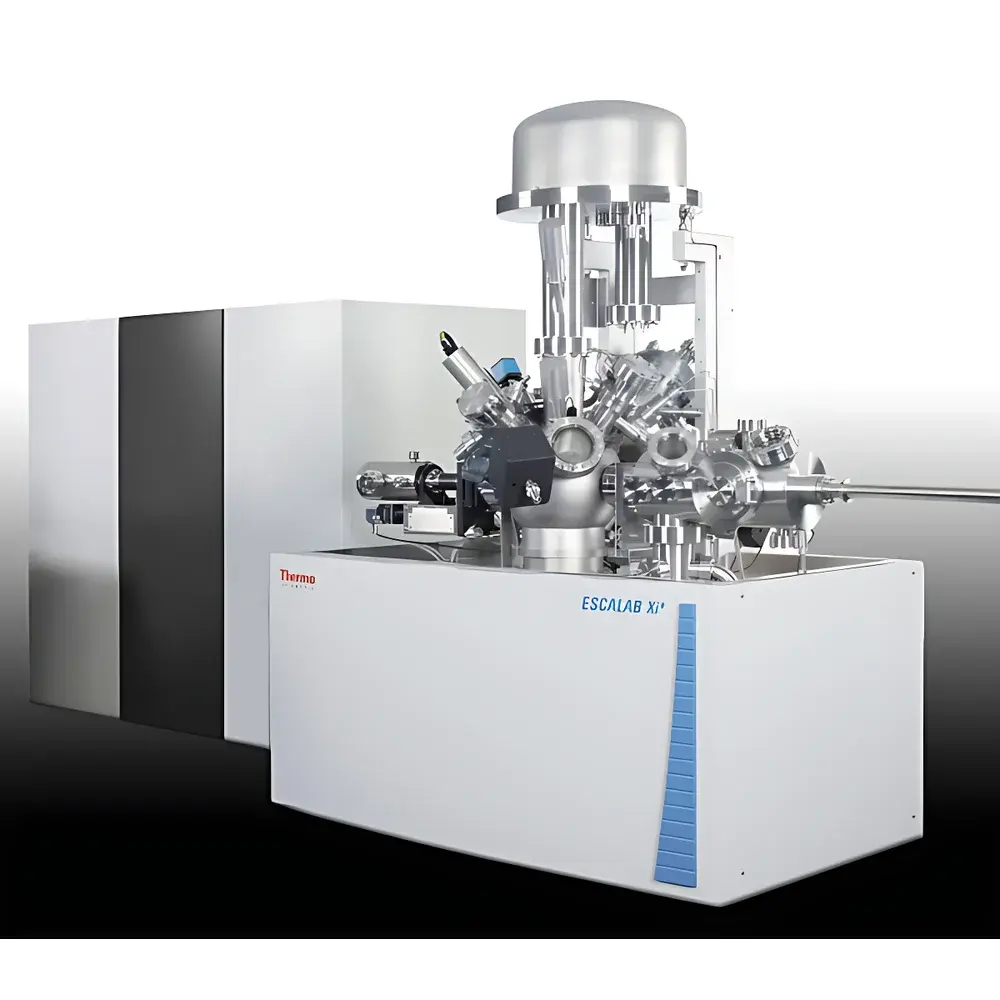
Thermo Fisher Scientific ESCALAB Xi+ X-ray Photoelectron Spectrometer
| Brand | Thermo Fisher Scientific |
|---|---|
| Origin | United Kingdom |
| Manufacturer Type | Original Equipment Manufacturer (OEM) |
| Product Category | Imported Instrument |
| Model | ESCALAB Xi+ |
| Pricing | Available Upon Request |
Overview
The Thermo Fisher Scientific ESCALAB Xi+ is a next-generation X-ray Photoelectron Spectrometer (XPS) engineered for high-precision surface chemical analysis at the nanoscale. Building upon the proven architecture of the ESCALAB 250Xi, the Xi+ integrates advanced hardware modularity with multi-technique analytical capability—enabling simultaneous or sequential acquisition of XPS, Angle-Resolved XPS (ARXPS), Ultraviolet Photoelectron Spectroscopy (UPS), Reflection Electron Energy Loss Spectroscopy (REELS), Ion Scattering Spectroscopy (ISS), and optional Auger Electron Spectroscopy (AES), Energy-Dispersive X-ray Spectroscopy (EDS), Scanning Electron Microscopy (SEM), and Scanning Auger Microscopy (SAM). Its core measurement principle relies on the photoelectric effect: monochromatic Al Kα X-rays (1486.6 eV) irradiate the sample surface, ejecting photoelectrons whose kinetic energy is measured by a hemispherical electron energy analyzer. This enables quantitative elemental identification, chemical state determination (via binding energy shifts), depth profiling (with ion sputtering), and lateral chemical mapping with sub-micrometer spatial resolution.
Key Features
- Monochromated micro-focused X-ray source with continuously adjustable analysis spot size (20–900 µm), delivering exceptional energy resolution (<0.45 eV FWHM at Ag 3d5/2) and high sensitivity (≥106 cps/nA for C 1s).
- Dual-detector architecture: hybrid configuration combining a high-gain electron multiplier for conventional XPS spectroscopy and a continuous resistive-anode detector (RAD) for high-resolution parallel imaging—achieving true 1 µm spatial resolution in XPS imaging without detector background artifacts or post-acquisition background subtraction.
- Automated dual-beam charge neutralization system with independent control over low-energy electron and Ar+ flood gun parameters—ensuring stable, reproducible charge compensation across insulating, heterogeneous, or topographically complex samples.
- Integrated argon gas cluster ion beam (Ar-GCIB) and conventional monoatomic Ar+ ion source for controlled depth profiling of organic, polymeric, and multilayer inorganic structures with minimized interface mixing.
- Fully motorized goniometer enabling precise, software-controlled angular positioning (±0.1° repeatability) for ARXPS measurements—supporting quantitative thickness modeling of ultra-thin films (0.3–5 nm) and interfacial layer characterization.
- Standard multi-technique chamber configuration including ISS, REELS, and UPS; optional integration with EDS, AES, SEM, and SAM via shared vacuum infrastructure and synchronized stage control.
Sample Compatibility & Compliance
The ESCALAB Xi+ accommodates a broad range of solid-state samples—including conductive metals, semiconductors, oxides, polymers, biomaterials, catalysts, and thin-film devices—without requiring conductive coating. Its modular load-lock and multi-function sample preparation chamber support in-situ treatments such as sputter cleaning (Ar+), thermal annealing (−180 °C to +500 °C), evaporation, and high-pressure reaction (up to 1 bar). The system complies with ISO/IEC 17025 requirements for testing laboratories and supports GLP/GMP workflows through audit-trail-enabled Avantage software. All data acquisition and processing adhere to ASTM E1520 (Standard Guide for XPS Data Reporting) and ISO 18118 (Surface Chemical Analysis — XPS — Calibration of Energy Scale).
Software & Data Management
The Avantage digital data system provides fully integrated instrument control, real-time spectral visualization, automated calibration routines (work function, Fermi edge, C 1s referencing), and comprehensive post-processing tools. It includes an extensive reference database of >15,000 high-resolution XPS spectra, compound identification libraries, peak-fitting algorithms with Shirley/Tougaard background models, quantification based on Scofield sensitivity factors, and layer-thickness modeling for ARXPS datasets. Data export conforms to VAMAS and NIST SRD formats. The software supports 21 CFR Part 11-compliant user authentication, electronic signatures, and immutable audit trails—meeting regulatory requirements for pharmaceutical, medical device, and aerospace quality assurance environments.
Applications
- Quantitative surface composition and oxidation state analysis of catalysts, battery electrodes, and corrosion-resistant coatings.
- Nanoscale depth profiling of gate dielectrics, high-k/metal gate stacks, and OLED multilayer architectures.
- Chemical mapping of polymer blends, functionalized nanoparticles, and bio-interface surfaces with ≤1 µm lateral resolution.
- Work function and valence band structure determination via UPS for semiconductor band alignment studies.
- Interface chemistry characterization in heterostructures using ARXPS-derived concentration-depth profiles.
- Charge trapping analysis in insulating thin films using combined XPS/REELS measurements.
FAQ
What vacuum conditions are maintained during XPS analysis?
The main analysis chamber operates at ≤2 × 10⁻⁹ mbar, while the sample preparation chamber maintains ≤5 × 10⁻⁸ mbar—ensuring minimal surface contamination and high signal-to-noise ratio.
Is the ESCALAB Xi+ compatible with in-situ gas-phase reactions?
Yes—the optional high-pressure reaction cell enables controlled exposure to reactive gases (O2, H2, CO, NH3) up to 1 bar, facilitating operando surface chemistry studies.
How is energy calibration performed and verified?
Automatic calibration uses the Fermi edge of a clean Au reference sample; routine verification employs Ag 3d5/2 (368.26 eV) and Cu 2p3/2 (932.67 eV) standards—with traceability to NIST-certified references.
Can the system perform automated batch analysis of multiple samples?
Yes—Avantage supports script-driven workflows for unattended analysis of up to 24 samples via programmable stage navigation, auto-focus, and conditional data acquisition logic.
What level of technical support and service coverage is available globally?
Thermo Fisher offers factory-certified installation, application training, preventive maintenance contracts, and remote diagnostics—supported by regional service centers across North America, EMEA, and APAC.
Related Products





