
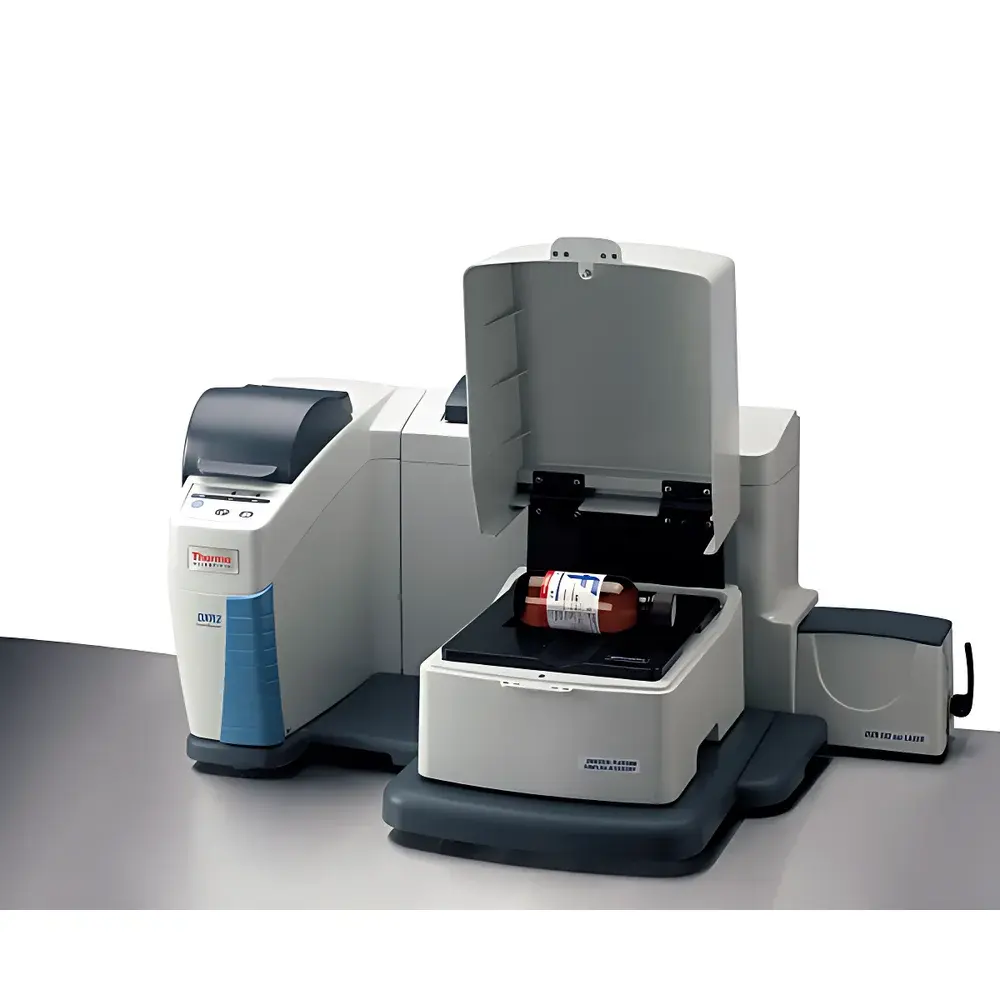
Thermo Scientific DXR3 Smart Raman Spectrometer
| Brand | Thermo Fisher |
|---|---|
| Origin | USA |
| Manufacturer | Thermo Fisher Scientific |
| Product Type | Imported |
| Model | DXR3 Smart |
| Instrument Category | Confocal Micro-Raman Spectrometer |
| Spectral Range | 50–3500 cm⁻¹ |
| Spectral Resolution | 1 cm⁻¹ |
| Spatial Resolution | 350 nm |
| Minimum Wavenumber | 50 cm⁻¹ |
| Spectral Reproducibility | ±0.1 cm⁻¹ |
Overview
The Thermo Scientific™ DXR3 Smart Raman Spectrometer is a fully automated, confocal micro-Raman system engineered for high-throughput, routine analytical laboratories requiring robust performance, spectral fidelity, and operational simplicity. Based on confocal laser Raman spectroscopy—where monochromatic laser light induces inelastic scattering from molecular vibrational modes—the DXR3 delivers chemically specific, non-destructive fingerprint spectra with minimal sample preparation. Its optical architecture integrates triple-stage Czerny–Turner spectrograph design, patented automatic alignment (SmartAlign™), and dynamically adjustable point scanning (VDPS) to ensure consistent spectral shape, peak integrity, and wavelength accuracy across the full 50–3500 cm⁻¹ range. Designed for regulatory-compliant environments, the instrument meets Class 1 laser safety standards (IEC 60825-1) and supports full traceability under FDA 21 CFR Part 11 via OMNIC™ D/S software.
Key Features
- Confocal optical design with 350 nm lateral spatial resolution and depth discrimination for layered or heterogeneous samples
- Single-shot CCD acquisition covering the full 50–3500 cm⁻¹ spectral range without stitching artifacts
- Automated fluorescence subtraction, intensity normalization, and multi-point wavenumber calibration for inter-instrument comparability
- Variable Dynamic Point Scanning (VDPS) enabling adjustable measurement areas from 10 µm to 5 mm
- SmartLock™ laser modules with embedded calibration profiles—interchangeable between instruments without manual recalibration
- Real-time laser power monitoring and closed-loop energy stabilization across laser lifetime and replacement cycles
- Patented cosmic ray rejection and dark-current compensation algorithms for artifact-free spectra
- De-polarized excitation optics to mitigate orientation-dependent spectral bias in anisotropic materials
- One-touch GO button operation with stored acquisition–processing–reporting workflows executed entirely from the instrument panel
- Fully automated SmartAlign™ collimation and calibration routines initiated via software—no user intervention required
Sample Compatibility & Compliance
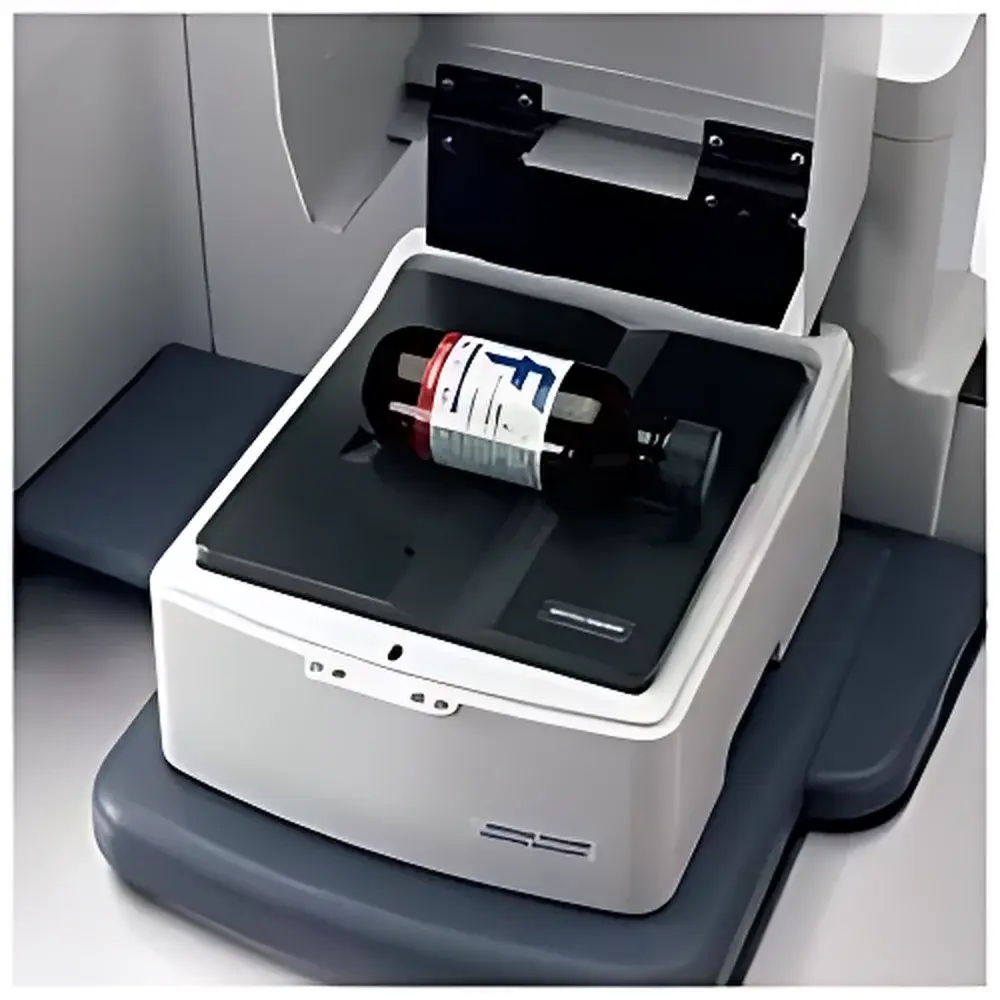
The DXR3 accommodates diverse sample formats without physical contact or extensive preparation: transmission through glass vials, amber bottles, plastic bags, and polymer films; reflection-mode analysis of tablets, powders, and bulk solids; and fiber-optic remote probing for oversized or immobile specimens. Optional accessories include motorized XYZ stages, temperature-controlled cells (−196 °C to +600 °C), electrochemical flow cells, and high-throughput autosamplers for 96-/384-well plates and tablet arrays. All hardware and firmware comply with ISO/IEC 17025 requirements for testing laboratories and support full GxP validation pathways—including documented DQ/IQ/OQ/PQ protocols, audit trails with timestamped parameter logging, and electronic signature capability per 21 CFR Part 11.
Software & Data Management
OMNIC™ Specta software provides integrated spectral acquisition, multivariate mixture deconvolution, and library search against a curated database of >16,000 reference compounds. Its algorithm prioritizes Raman-specific spectral matching—accounting for peak width, asymmetry, and baseline curvature—rather than generic correlation-based methods. The macro programming environment enables reproducible automation of complex sequences (e.g., focus–acquire–analyze–export–report). OMNIC Array supports synchronized acquisition across multi-position sample holders, while built-in spectral preprocessing tools include Savitzky–Golay smoothing, vector normalization, and derivative transformation. All processing steps are recorded in immutable audit logs, including detector exposure settings, grating position, laser power, and background correction parameters—ensuring full data provenance for GLP/GMP audits.
Applications
- Pharmaceutical QA/QC: Polymorph identification, crystallinity assessment, API-excipient interaction mapping, and content uniformity verification in solid dosage forms
- Forensic Science: Rapid, non-destructive identification of illicit substances, explosives residues, and counterfeit pharmaceuticals—complementary to FTIR for courtroom-admissible evidence
- Materials Science: Characterization of carbon nanotubes, graphene layers, semiconductor defects, and stress/strain distribution in thin films
- Geoscience & Gemology: Discrimination of natural vs. synthetic diamonds, origin determination of colored gemstones, and mineral phase quantification in geological samples
- Academic Research: In situ monitoring of catalytic reactions, protein conformational changes, and live-cell metabolic profiling using low-power, water-compatible excitation
FAQ
Is the DXR3 compliant with FDA 21 CFR Part 11?
Yes—OMNIC D/S software includes electronic signatures, role-based access control, and immutable audit trails for all acquisition and processing events.
Can I use the same laser module across multiple DXR3 instruments?
Yes—SmartLock™ lasers store calibration and alignment metadata; the instrument auto-recalls optimal parameters upon installation.
What is the minimum detectable wavenumber shift reproducibility?
Spectral reproducibility is ±0.1 cm⁻¹ across repeated measurements under identical conditions, verified using NIST-traceable polystyrene standards.
Does the system require external cooling or vacuum pumping?
No—the back-thinned CCD detector operates at thermoelectrically stabilized −70 °C; no liquid nitrogen or mechanical pump is needed.
How does the VDPS feature improve quantitative analysis of heterogeneous samples?
By expanding the laser spot from 10 µm to 5 mm while maintaining confocality, VDPS ensures statistically representative sampling across particle agglomerates, coatings, or composite surfaces.





