
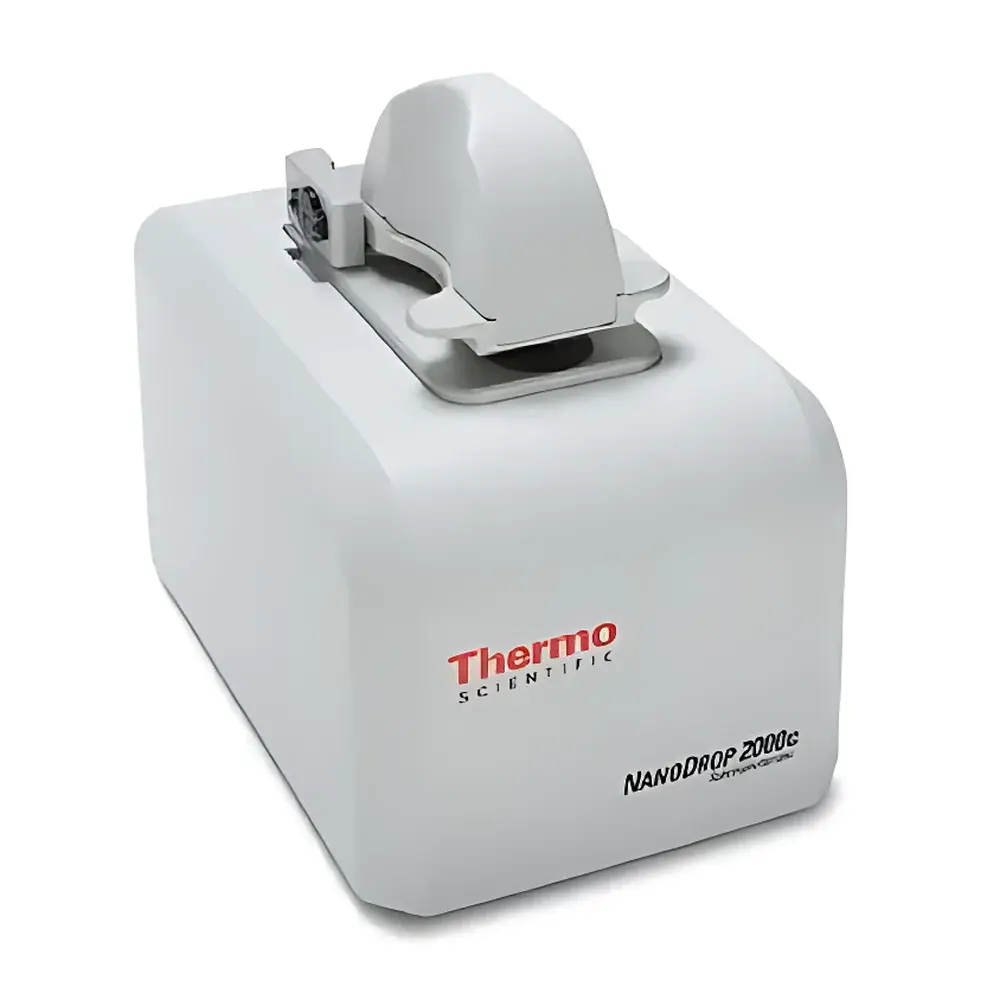
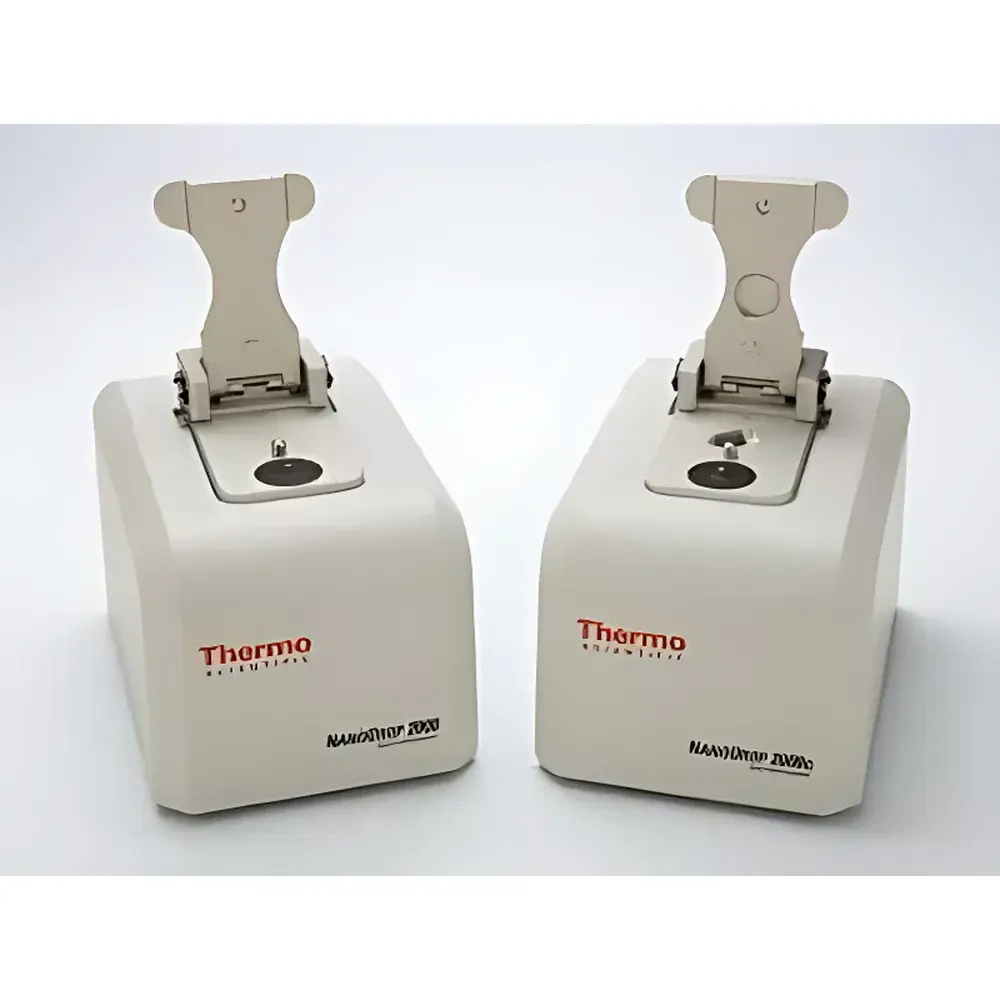
Thermo Fisher NanoDrop 2000/2000c UV-Vis Spectrophotometer
| Brand | Thermo Fisher |
|---|---|
| Origin | USA |
| Manufacturer | Thermo Fisher Scientific |
| Product Type | Imported Instrument |
| Model | NanoDrop 2000/2000c |
| Optical Design | Dual-Beam |
| Sample Volume | 0.5–2.0 µL |
| Measurement Time | <5 s (NanoDrop 2000), <3 s (NanoDrop 2000c cuvette mode) |
| Cuvette Temperature Control | 37 °C ±0.5 °C |
| Cuvette Stirring Speed | 150–850 rpm |
| Cuvette Dimensions | 12.5 mm × 12.5 mm × up to 48 mm |
| Pathlength Options | 10, 5, 2, and 1 mm |
| Absorbance Range (Cuvette Mode) | 0.008–1.5 AU |
| Base Unit Weight | 2.1 kg |
| Compliance | CE, FCC, RoHS |
Overview
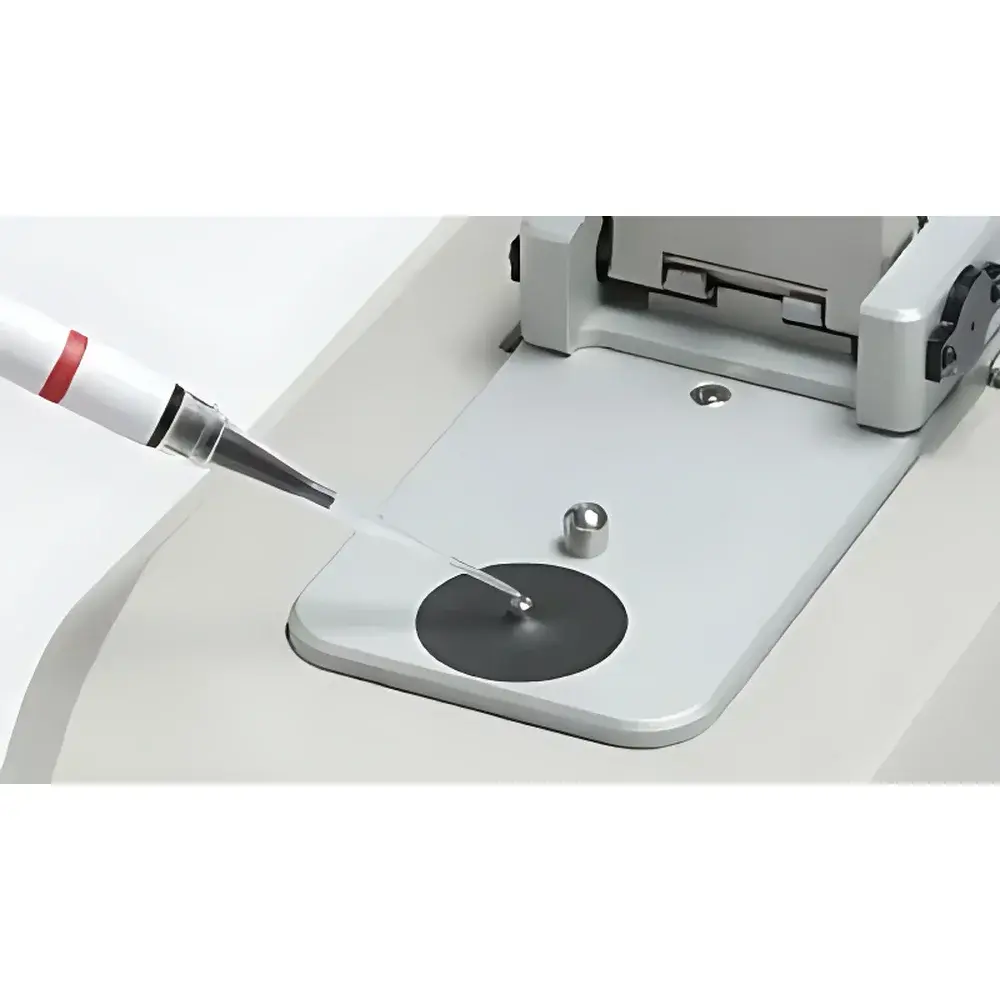
The Thermo Fisher NanoDrop 2000/2000c UV-Vis Spectrophotometer is an engineered solution for rapid, microvolume nucleic acid, protein, and small molecule quantification in research and quality control laboratories. Based on the principle of surface tension–mediated microvolume measurement, the instrument eliminates the need for traditional quartz cuvettes or capillary cells. In the base mode, a 0.5–2.0 µL sample is deposited directly onto a fixed optical pedestal, where capillary forces and surface tension maintain the liquid column between two vertically aligned quartz fiber optics—forming a defined, reproducible pathlength without physical containment. This patented Microvolume Sample Retention System enables direct spectrophotometric analysis across 190–850 nm with high photometric accuracy and inter-instrument reproducibility. The NanoDrop 2000c extends this architecture by integrating a thermally regulated, motorized cuvette compartment capable of kinetic assays, temperature-controlled OD600 monitoring, and variable-pathlength measurements—making it a dual-mode platform compliant with both microvolume screening and conventional cuvette-based workflows.
Key Features
- Microvolume quantification using only 0.5–2.0 µL sample—no dilution required even for highly concentrated DNA (>5000 ng/µL) or protein solutions (up to 500 mg/mL)
- Dual-beam optical design with xenon flash lamp source and CCD array detector ensures spectral stability and minimizes drift during extended use
- Integrated cuvette module (NanoDrop 2000c only) with precise temperature control (37 °C ±0.5 °C), programmable stirring (150–850 rpm), and Z-height adjustment (8.5 mm) for consistent cell positioning
- Four selectable fixed pathlengths (10, 5, 2, and 1 mm) in cuvette mode to extend dynamic absorbance range from 0.008 to 1.5 AU
- Optimized optical geometry with shielded cuvette holder to reduce stray light and improve signal-to-noise ratio in low-absorbance applications
- Compact footprint (20.3 cm × 22.9 cm × 15.2 cm) and lightweight chassis (2.1 kg) suitable for benchtop deployment in biosafety cabinets or shared instrumentation cores
Sample Compatibility & Compliance
The NanoDrop 2000/2000c supports a broad range of biological and chemical samples—including dsDNA, ssDNA, RNA, oligonucleotides, purified proteins (A280, A205), Bradford/Lowry-compatible assay mixtures, and small-molecule UV-active compounds. Its microvolume base mode is compatible with viscous or particulate-containing samples when applied with calibrated pipetting technique; cuvette mode accommodates turbid suspensions (e.g., bacterial cultures for OD600) and kinetic reaction mixtures. The system conforms to international regulatory expectations for analytical instrumentation: CE-marked per Directive 2014/30/EU (EMC) and 2011/65/EU (RoHS); FCC Class B certified; and designed to support GLP/GMP environments through audit-ready software logging. While not inherently 21 CFR Part 11–compliant, the instrument’s data export architecture (CSV, XML, PDF) and method versioning enable integration into validated LIMS or electronic lab notebook (ELN) systems meeting FDA and ISO 17025 requirements.
Software & Data Management
Controlled via NanoDrop Software v3.x (Windows-based), the platform provides intuitive workflow navigation, customizable method templates, and embedded calculation libraries for nucleic acid purity ratios (A260/A280, A260/A230), protein concentration (using extinction coefficients or standard curves), and molar absorptivity derivation. All measurements are timestamped, user-tagged, and stored with full spectral metadata—including lamp intensity, baseline correction status, and pathlength selection. Raw absorbance spectra and processed results can be exported in multiple formats for downstream statistical analysis or regulatory submission. The software supports password-protected user accounts, method locking, and audit trail generation—facilitating traceability in regulated QC labs. No cloud dependency: all data resides locally unless explicitly exported.
Applications
- Routine quantification and purity assessment of extracted nucleic acids prior to NGS library preparation or qPCR
- High-throughput protein concentration determination in structural biology pipelines and biopharmaceutical process development
- Real-time monitoring of enzyme kinetics and ligand-binding reactions using cuvette-based time-scan mode
- Cell density profiling in microbial fermentation and mammalian cell culture via OD600 measurements with thermal stabilization
- Verification of dye labeling efficiency (e.g., Cy3/Cy5) and small-molecule extinction coefficient validation
- Educational laboratory instruction in spectroscopic fundamentals, Beer–Lambert law application, and experimental error analysis
FAQ
Does the NanoDrop 2000/2000c require routine calibration with NIST-traceable standards?
Yes. While factory-calibrated at manufacture, Thermo Fisher recommends annual verification using supplied quartz reference standards (e.g., holmium oxide filter for wavelength accuracy, neutral density filters for photometric linearity). Internal self-tests run at startup assess lamp output and detector response.
Can the instrument measure samples with high absorbance beyond 1.5 AU in cuvette mode?
No. The specified absorbance range of 0.008–1.5 AU applies to cuvette measurements using the 10 mm pathlength. Higher concentrations must be diluted or measured using shorter pathlengths (e.g., 1 mm yields effective range up to 15 AU, assuming linear detector response).
Is the pedestal surface resistant to common solvents such as ethanol, isopropanol, or 0.1 M NaOH?
The fused silica pedestal is chemically inert to aqueous buffers, alcohols, and mild bases. Prolonged exposure to strong acids (e.g., >1 M HCl) or organic solvents like chloroform or DMSO is not recommended and may degrade surface hydrophobicity over time.
How does the NanoDrop 2000c ensure temperature uniformity during kinetic assays?
The cuvette compartment uses Peltier-based heating with closed-loop feedback control and a precision thermistor adjacent to the sample position. Thermal equilibrium is achieved within ±0.5 °C of setpoint across the full 37 °C operating range, verified per ASTM E2251–21 guidelines for thermal performance of laboratory instruments.
What file formats are supported for data export and third-party integration?
CSV (tabular absorbance/concentration), XML (structured spectral metadata), PDF (formatted reports with embedded spectra), and proprietary .nd2 files for full software reprocessing. No proprietary database lock-in—raw spectral data is fully accessible and interoperable with Python (NumPy/Pandas), MATLAB, or commercial analytics platforms.




