
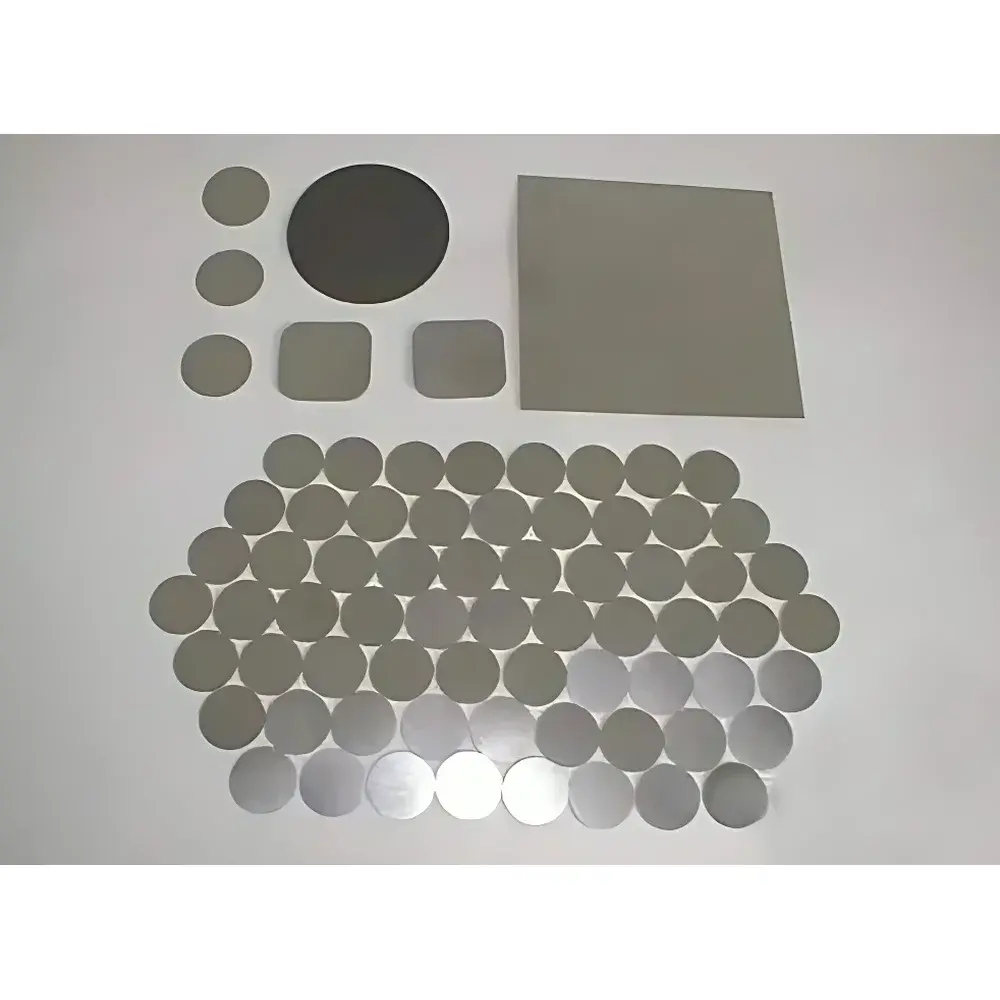
Beryllium Foil for Quartz Crystal Microbalance (QCM) Sensors
| Brand | Hefei Kejing |
|---|---|
| Origin | Anhui, China |
| Manufacturer Type | Authorized Distributor |
| Origin Classification | Domestic |
| Model | Be Foil |
| Price Range | USD 1–999 |
Overview
Beryllium foil is a high-purity, ultra-thin metallic substrate engineered for use as an electrode or sensing layer in quartz crystal microbalance (QCM) systems. As a core component in electrochemical and gravimetric sensing platforms, Be foil leverages the exceptional physical properties of beryllium—including its low density (1.84 g/cm³), high elastic modulus (>300 GPa), and excellent thermal stability—to enable precise mass-sensitive detection at nanogram-level resolution. Unlike conventional gold or platinum QCM electrodes, beryllium offers superior acoustic impedance matching with AT-cut quartz crystals and minimal damping under vacuum or inert-gas environments—critical for high-stability oscillation in real-time thin-film deposition monitoring, gas-phase adsorption studies, and surface interaction kinetics.
Key Features
- High-purity beryllium (≥99.5% Be by ICP-MS verified assay), processed under controlled inert atmosphere to prevent oxide formation
- Consistent thickness tolerance: ±5% across standard dimensions (e.g., 20 mm Ø × 0.5 mm; 50 mm × 50 mm × 0.5 mm)
- Surface roughness Ra < 0.2 µm (measured via contact profilometry), optimized for uniform metallization and low interfacial scattering
- Thermally stable up to 1284 °C melting point—enabling compatibility with high-temperature QCM operation and in situ annealing protocols
- Engineered mechanical integrity: tensile strength >320 MPa, yield strength (0.2% offset) >220 MPa, elongation >2%, ensuring resistance to micro-cracking during sputtering or thermal cycling
- Vacuum-compatible packaging: double-bagged in ISO Class 5 (100-grade) cleanroom polyethylene pouches under nitrogen purge, sealed in vacuum for oxide suppression
Sample Compatibility & Compliance
Beryllium foil is compatible with standard 5–10 MHz AT-cut quartz resonators used in commercial QCM-D (dissipation monitoring) and electrochemical QCM (EQCM) instruments. Its low atomic number (Z = 4) and high X-ray transparency make it suitable for synchrotron-based QCM setups requiring simultaneous XRD or XAS characterization. All foils comply with ASTM B472–22 (Standard Specification for Beryllium Metal and Alloys) for compositional limits and mechanical property verification. Handling follows OSHA 29 CFR 1910.1000 and ACGIH TLV® guidelines for beryllium exposure control; material safety data is provided per GHS classification (H334, H350i). Not intended for direct human contact or inhalation of particulates—processing requires certified fume hoods and PPE per ANSI Z87.1.
Software & Data Management
While beryllium foil itself is a passive hardware component, its integration into QCM workflows aligns with industry-standard data acquisition protocols. When used in conjunction with QCM instrumentation from manufacturers such as Biolin Scientific (QSense), SRS (Stanford Research Systems), or KSV NIMA, the foil supports time-resolved frequency (Δf) and dissipation (ΔD) tracking compliant with ISO/IEC 17025–2017 analytical validation requirements. Raw resonance data export formats (e.g., .txt, .csv, .qcm) are fully interoperable with MATLAB, Python (via QCMpy), and OriginLab for Sauerbrey mass calculation, Voigt modeling, and viscoelastic parameter extraction. Audit trails, user access logs, and electronic signatures may be implemented when deployed within FDA 21 CFR Part 11–compliant laboratory information management systems (LIMS).
Applications
- In-situ monitoring of atomic layer deposition (ALD) and physical vapor deposition (PVD) of functional coatings on Be-coated quartz sensors
- Gas-phase hydrogen sorption kinetics in metal hydride research using temperature-controlled QCM cells
- Electrochemical interface studies of lithium-ion battery SEI formation on Be-modified working electrodes
- Real-time biosensing of protein–ligand binding events on functionalized Be surfaces coupled with thiol-based self-assembled monolayers (SAMs)
- Low-background radiation detection substrates in neutron moderation experiments where low-Z materials minimize parasitic scattering
FAQ
Is this beryllium foil suitable for vacuum deposition applications?
Yes—its low vapor pressure, high thermal conductivity, and dimensional stability under vacuum make it ideal as a target backing or sensor electrode in UHV-compatible QCM chambers.
Can custom thicknesses below 0.1 mm be supplied?
Yes—custom rolling and annealing services are available upon request; minimum order quantity applies for non-standard gauges.
Does the foil require surface activation prior to functionalization?
A brief oxygen plasma treatment (50 W, 60 s) is recommended to remove adventitious carbon and enhance hydroxyl group density for silanization or thiol coupling.
Are certificates of analysis (CoA) and traceability documentation provided?
Each batch includes CoA with ICP-OES elemental impurity profile, tensile test report, and cleanroom handling log.
What safety precautions apply during handling?
Always wear nitrile gloves and operate in ventilated enclosures; avoid grinding, sanding, or ultrasonic cleaning without HEPA filtration—beryllium particles pose inhalation hazards per IARC Group 1 carcinogen classification.




