
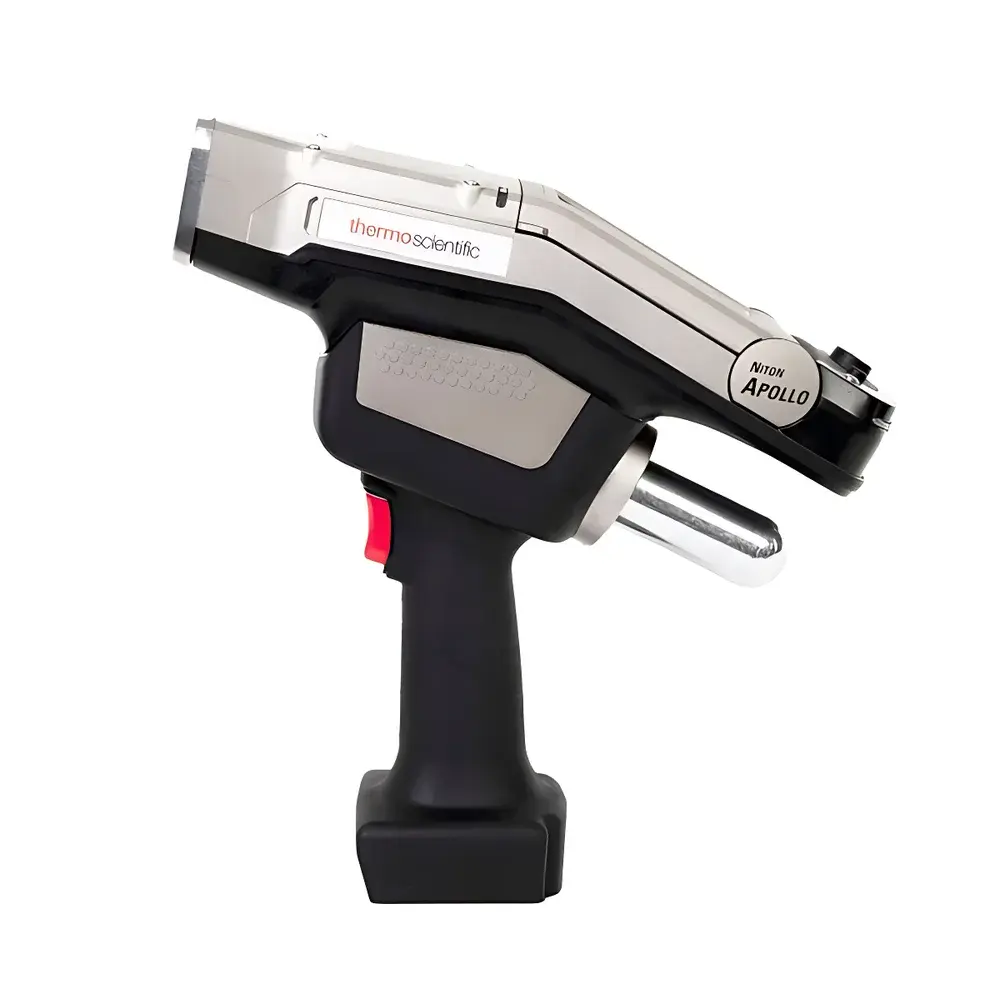
Thermo Scientific Niton Apollo Handheld Laser-Induced Breakdown Spectroscopy (LIBS) Analyzer
| Brand | Thermo Fisher |
|---|---|
| Origin | USA |
| Manufacturer | Thermo Fisher Scientific |
| Product Type | Imported |
| Model | Niton Apollo LIBS |
| Instrument Category | Handheld |
| Integration | All-in-One |
Overview
The Thermo Scientific Niton Apollo Handheld Laser-Induced Breakdown Spectroscopy (LIBS) Analyzer is an industrial-grade, field-deployable elemental analyzer engineered for rapid, non-destructive compositional analysis of metallic and inorganic materials. Operating on the fundamental principle of laser-induced plasma spectroscopy, the Niton Apollo focuses a high-energy pulsed laser onto the sample surface to generate a transient micro-plasma; emitted atomic and ionic spectral lines are collected via a high-resolution Czerny–Turner spectrometer and quantitatively analyzed across the UV-VIS-NIR range (190–850 nm). Unlike traditional spark-OES or XRF systems, LIBS enables direct carbon (C), nitrogen (N), lithium (Li), beryllium (Be), and boron (B) measurement—critical for low-alloy steel grading, carbon equivalent (CE) calculation, and weldability assessment—without vacuum requirements or consumable electrodes. Designed for compliance with ISO 17025-accredited workflows, the Apollo bridges laboratory-grade accuracy with ruggedized portability, delivering trace-level detection limits (sub-100 ppm for C in steel) and repeatable results under variable ambient conditions.
Key Features
- Handheld form factor weighing only 2.9 kg (6.4 lbs), optimized for confined spaces, elevated structures, and pipeline interiors
- Integrated dual-camera system: macro camera for contextual documentation and micro camera for precise targeting of analysis spots ≤ 200 µm
- Triple-redundant laser safety interlock system independently certified to IEC 60825-1:2014 Class 4 laser safety standards—monitoring chamber pressure, spectral acquisition validation, and real-time camera illumination state
- Hot-swappable Milwaukee® Li-ion battery enabling uninterrupted operation during shift changes or extended field campaigns
- IP54-rated enclosure with glove-compatible touchscreen interface and optional tactile keypad for use in PPE-intensive environments
- Onboard argon purge system ensuring stable plasma generation and enhanced signal-to-noise ratio for light-element analysis
- Real-time spectral visualization and dynamic averaging algorithms supporting up to 100 spectra per measurement for improved precision
Sample Compatibility & Compliance
The Niton Apollo accommodates flat, curved, oxidized, painted, or lightly contaminated metal surfaces—including carbon steels, stainless steels, aluminum alloys, nickel-based superalloys, and titanium grades—without mandatory surface preparation. It meets ASTM E2926-22 (Standard Test Method for Determination of Carbon in Steel by LIBS) and supports material verification against ASTM A105, A182, A333, and ASME B16.5 specifications. For regulated industries, firmware includes audit-trail logging compliant with FDA 21 CFR Part 11 requirements, supporting electronic signatures, user access controls, and immutable data export. All calibration models are traceable to NIST SRM reference materials and validated per ISO/IEC 17025 clause 7.7.
Software & Data Management
Powered by Thermo Scientific Niton Connect™ software, the Apollo enables secure over-the-air firmware updates, customizable reporting templates (PDF/CSV/XLSX), and cloud-synced calibration libraries. Wi-Fi 5 (802.11ac) and Bluetooth 5.0 support automated data offloading to enterprise LIMS or ERP platforms. Spectral raw data (.spc) and metadata (including GPS coordinates, operator ID, timestamp, and environmental parameters) are stored locally with AES-256 encryption. The software suite includes CE calculator modules aligned with IIW and AWS D1.1 methodologies, as well as PMI pass/fail logic engines configurable per client-specific material acceptance criteria.
Applications
- Positive Material Identification (PMI) of piping, valves, flanges, and pressure vessels in oil & gas, petrochemical, and power generation facilities
- Carbon equivalent determination for weld procedure qualification and heat-affected zone (HAZ) risk assessment
- Incoming inspection and lot release testing in metal fabrication, foundry, and scrap recycling operations
- Regulatory compliance screening for restricted elements (e.g., Pb, Cd, Cr⁶⁺) per RoHS, REACH, and ELV directives
- Field validation of Material Test Reports (MTRs) and mill certificates against actual chemistry
- Scrap sorting and contamination control to prevent out-of-spec feedstock from entering melt shops
FAQ
Does the Niton Apollo require external gas cylinders for routine operation?
No—the integrated argon reservoir supports ≥ 500 analyses per fill and eliminates dependency on bulky external tanks.
Can the Apollo analyze coated or rusted surfaces without grinding?
Yes—its high peak-power laser ablates thin oxides and organic coatings in situ, though optimal precision is achieved on clean, conductive surfaces.
Is spectral data export compatible with third-party chemometric software?
Yes—raw intensity matrices and calibrated concentration outputs are exportable in open-format ASCII for PCA, PLS regression, or custom model deployment.
How is measurement reproducibility verified during field use?
Built-in QC check standards (e.g., certified steel blocks) enable daily performance verification with automatic drift correction and statistical process control (SPC) charting.
What cybersecurity protocols protect data integrity during wireless transfer?
All Wi-Fi transmissions use WPA3-Enterprise authentication and TLS 1.3 encryption; local storage employs FIPS 140-2 validated cryptographic modules.





