
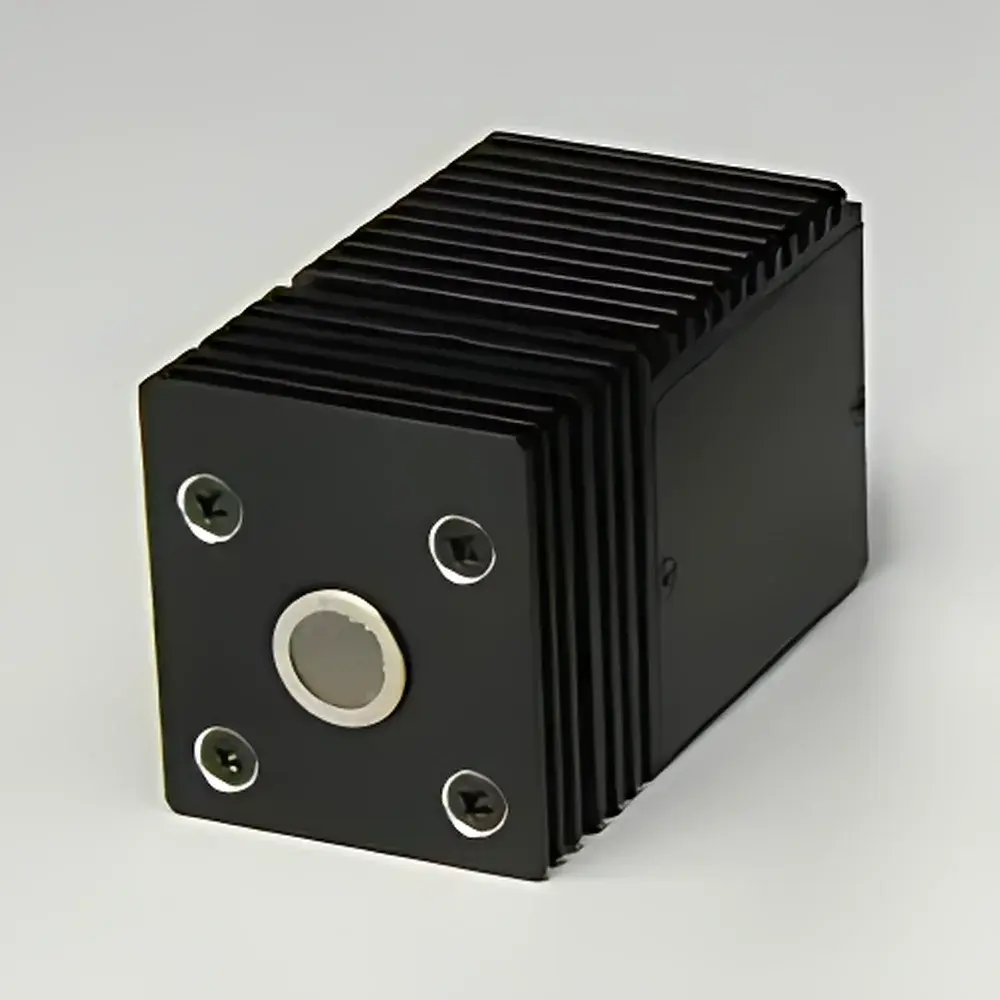
Hamamatsu C12494-210S TE-Cooled InAsSb Infrared Detector Module with Integrated Preamplifier
| Brand | Hamamatsu |
|---|---|
| Origin | Japan |
| Manufacturer Type | Original Equipment Manufacturer (OEM) |
| Import Status | Imported |
| Model | C12494-210S |
| Price Range | USD 1,350 – 2,700 (FOB Yokohama) |
Overview
The Hamamatsu C12494-210S is a compact, thermoelectrically (TE) cooled infrared detector module engineered for high-sensitivity, mid-wave infrared (MWIR) gas sensing applications in environmental monitoring and industrial safety systems. At its core lies a monolithic InAsSb (indium arsenide antimonide) photovoltaic sensor, optimized for spectral detection between 1.0 μm and 5.9 μm, with peak responsivity centered at 4.9 μm — a wavelength region critical for detecting fundamental vibrational absorption bands of key industrial and hazardous gases including CO, CO₂, NO, SO₂, CH₄, and hydrocarbons. Unlike uncooled microbolometers, the integrated two-stage TE cooler maintains the detector junction at a stable, user-defined temperature (typically −20 °C to +10 °C, factory-set), suppressing dark current and enabling superior signal-to-noise ratio (S/N > 5 × 10⁴ at 10 Hz modulation) without requiring liquid nitrogen or external cryogenic infrastructure. The module integrates a low-noise, transimpedance preamplifier directly bonded to the sensor die, minimizing parasitic capacitance and electromagnetic interference—critical for lock-in amplifier–based optical gas analyzers operating under low-light, high-stability conditions.
Key Features
- Integrated TE cooling system with closed-loop temperature stabilization (±0.1 °C stability over 8 hours)
- InAsSb photovoltaic detector with 1 × 1 mm active area, delivering high detectivity (D* > 1 × 10¹⁰ cm·√Hz/W at 4.9 μm, 100 Hz)
- Factory-optimized analog front-end: low-noise JFET-based preamplifier with 10⁶ V/A gain, bandwidth DC–100 kHz, and < 5 nV/√Hz input voltage noise
- Compact hermetically sealed TO-8 metal package (25.4 × 19.0 × 12.5 mm), designed for OEM integration into portable and fixed-mount gas analyzers
- DC-powered operation: single ±15 V supply (±10 % tolerance); no external biasing or timing circuitry required
- Compliant with IEC 61000-6-3 (EMI emission) and IEC 61000-6-2 (immunity) for industrial environments
Sample Compatibility & Compliance
The C12494-210S is compatible with standard non-dispersive infrared (NDIR) and photoacoustic spectroscopy (PAS) optical architectures using broadband thermal sources (e.g., MEMS IR emitters) or tunable quantum cascade lasers (QCLs). Its spectral cutoff at 5.9 μm enables selective detection of gases with strong MWIR absorption features while rejecting ambient thermal background above 6 μm. The module meets RoHS Directive 2011/65/EU and REACH Regulation (EC) No. 1907/2006. For regulated gas monitoring deployments—including EPA Method 320 compliance systems and OSHA-permitted workplace exposure monitors—the detector’s inherent linearity (±0.5 % FS over 4-decade dynamic range) and long-term drift (< 0.1 %/1000 h at constant temperature) support traceable calibration per ISO/IEC 17025 requirements when paired with NIST-traceable reference cells.
Software & Data Management
While the C12494-210S operates as an analog output device (voltage proportional to incident IR flux), it is routinely interfaced with embedded microcontroller units (MCUs) or data acquisition systems supporting IEEE 1451.2 TEDS (Transducer Electronic Data Sheet) protocols via optional digital daughter boards. Hamamatsu provides comprehensive OEM documentation, including SPICE models for circuit simulation, spectral responsivity curves (measured per ISO 11341), and temperature-dependent dark current characterization datasets. Integration into FDA 21 CFR Part 11–compliant gas monitoring platforms is supported through third-party DAQ firmware that implements audit trails, electronic signatures, and data integrity safeguards during raw signal acquisition and post-processing.
Applications
- Fixed and portable NDIR analyzers for continuous emissions monitoring (CEMS) of stack gases in power plants and cement kilns
- Explosive and toxic gas leak detectors for oil & gas refineries, chemical processing facilities, and semiconductor fabrication cleanrooms
- Indoor air quality (IAQ) sensors measuring CO₂ and VOCs in smart HVAC control systems
- Research-grade FTIR spectrometer detector upgrades for laboratory gas-phase reaction kinetics studies
- Multi-gas sensor arrays utilizing wavelength-selective optical filters and differential measurement techniques
FAQ
Does the C12494-210S require external temperature control circuitry?
No. The module incorporates a fully integrated two-stage TE cooler and PID temperature controller; only ±15 V DC power is required for full operation.
What is the recommended modulation frequency for optimal S/N in NDIR configurations?
For maximum detectivity with minimal 1/f noise contribution, Hamamatsu specifies 10–50 Hz square-wave or sine-wave modulation; performance degrades above 1 kHz due to thermal time constants.
Can this detector be used with optical choppers?
Yes. The detector’s fast rise time (< 1 µs) and low capacitance (< 15 pF) make it compatible with standard 5–500 Hz mechanical choppers and solid-state modulators.
Is the spectral responsivity calibrated per unit?
Each production lot undergoes spectral calibration at Hamamatsu’s ISO/IEC 17025-accredited facility; individual unit calibration certificates (including D* vs. λ curves) are available upon request.
What is the expected lifetime under continuous operation at rated cooling setpoint?
Rated MTTF exceeds 50,000 hours at Ta = 25 °C and Tsensor = −10 °C, validated per Telcordia GR-468-CORE reliability testing protocols.
Related Products







