
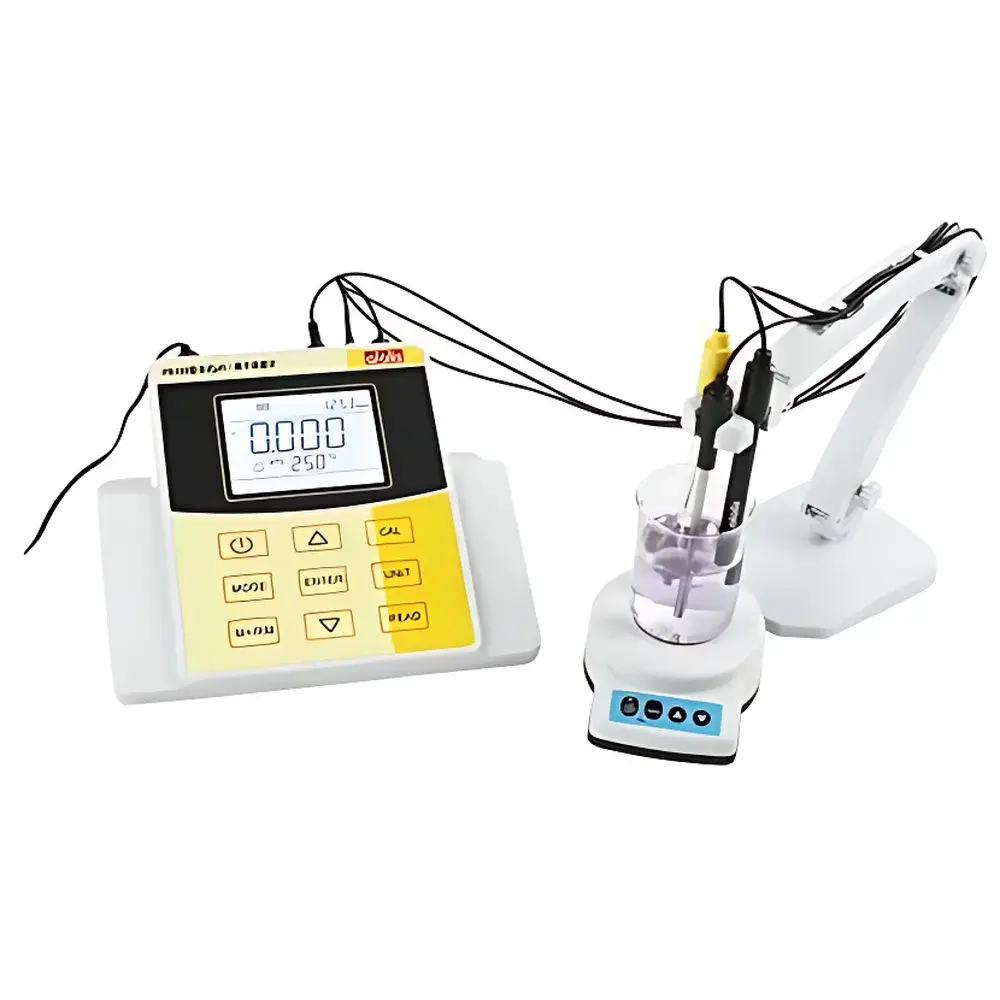
Alalis PI5100-CL Benchtop Chloride Ion Concentration Meter
| Brand | Alalis |
|---|---|
| Model | PI5100-CL |
| Type | Benchtop Ion Concentration Meter |
| Measurement Range | 0.00–14.00 pX |
| Detection Limit | 0.01 ppm |
| Response Time | 1 s |
| Accuracy | ±0.01 pX (for monovalent ions) |
| Temperature Range | −10 to 110 °C |
| Resolution | 0.01 pX / 0.01 mol/L / 0.01 mg/L / 0.01 ppm |
| pH Range | −2.000–19.999 pH |
| mV Range | −1999.9 to +1999.9 mV |
| Temperature Compensation | Automatic/manual (0–60.0 °C for ion mode |
| Data Storage | 1000 sets (manual & auto) |
| Interface | USB |
| Display | 90 × 68 mm LCD with white backlight and real-time clock |
| Protection Rating | IP54 |
| Compliance | GLP-compliant data management |
Overview
The Alalis PI5100-CL is a high-precision benchtop chloride ion concentration meter engineered for reliable, trace-level quantification of Cl⁻ in aqueous environmental, industrial, and laboratory samples. It operates on the principle of potentiometric ion-selective electrode (ISE) measurement, utilizing a solid-state or liquid-membrane chloride-selective electrode coupled with a stable reference electrode to generate a Nernstian potential response proportional to the logarithm of chloride activity. Designed specifically for compliance-driven water quality monitoring, the instrument delivers metrological rigor aligned with standard methods such as ASTM D4192 (Standard Test Method for Determination of Chloride Ion in Water by Ion-Selective Electrode) and ISO 10304-1 (Water quality — Determination of dissolved anions by liquid chromatography of ions — Part 1: Determination of fluoride, chloride, nitrite, orthophosphate, bromide, nitrate and sulfate). Its 0.01 ppm detection limit and ±0.01 pX accuracy (for monovalent ions) support regulatory reporting under EPA Method 300.0 and EU Directive 2000/60/EC (Water Framework Directive) requirements.
Key Features
- Potentiometric ISE platform with dedicated chloride-selective electrode (R2223 reference + chloridized silver/silver chloride sensing element), optimized for low-interference performance in complex matrices including wastewater, cooling water, desalination brine, and drinking water.
- Multi-parameter capability: simultaneous measurement of chloride concentration (pX, mol/L, mg/L, ppm), pH (−2.000–19.999), redox potential (−1999.9 to +1999.9 mV), and temperature (−10 to 110 °C).
- Advanced calibration architecture: 2–5 point ion calibration with automatic slope verification and error diagnostics; 1–5 point pH calibration with built-in guidance and NIST/China/Custom buffer recognition.
- Intelligent temperature compensation: dual-range auto-compensation—0–60.0 °C for ion mode (optimized for Nernst equation correction); 0–100.0 °C for pH mode—ensuring thermodynamic consistency across variable thermal conditions.
- GLP-compliant data handling: time-stamped storage of 1000 measurement records (including electrode ID, calibration history, temperature, and user notes); audit-ready export via USB to PC using included software.
- Rugged industrial design: IP54-rated enclosure with sealed electrode ports, rubber protective caps, and wide-view backlit LCD (90 × 68 mm) supporting real-time clock display and unit-switching between pX, mol/L, mg/L, and ppm.
Sample Compatibility & Compliance
The PI5100-CL is validated for use with natural waters (surface, groundwater, seawater dilutions), treated effluents, boiler feedwater, pharmaceutical rinse solutions, and food processing brines. Ionic strength adjustment (via supplied 500 mL ionic strength adjuster) ensures activity-to-concentration conversion fidelity per ISO 17025-accredited practices. The instrument supports trace chloride analysis in ultra-pure water applications through dedicated high-purity pH and ammonia-added water modes, minimizing junction potential drift. All calibrations and measurements adhere to Good Laboratory Practice (GLP) principles—including full traceability of standards (0.1 mol/L Cl⁻ certified reference material), electrode history logging, and electronic signature-capable data export. Optional validation documentation aligns with FDA 21 CFR Part 11 readiness when paired with secure networked software deployment.
Software & Data Management
The bundled PC software enables bidirectional USB communication for real-time data streaming, batch calibration report generation, and customizable certificate-of-analysis templates. Raw datasets include metadata fields: measurement timestamp, operator ID, electrode serial number, temperature, slope (%), offset (mV), and calibration point residuals. Export formats include CSV, Excel (.xlsx), and PDF reports compliant with ISO/IEC 17025 clause 7.8.2 (Reporting of results). Audit trail functionality logs all configuration changes, calibration events, and data deletions—meeting minimum requirements for GMP-regulated environments where instrument qualification (IQ/OQ/PQ) is mandated.
Applications
- Environmental monitoring: compliance testing of chloride discharge limits in municipal wastewater treatment plants (e.g., NPDES permits).
- Power generation: corrosion control in steam-cycle condensate and feedwater systems (ASTM D4582).
- Pharmaceutical manufacturing: TOC and conductivity correlation studies; cleaning validation of chloride residues on stainless-steel equipment (USP ).
- Food & beverage QA: salt content verification in brined products, dairy processing water, and brewing liquor.
- Academic research: kinetic studies of chloride-mediated corrosion, ion exchange equilibrium modeling, and sensor development benchmarking.
FAQ
What chloride-selective electrode is compatible with the PI5100-CL?
The instrument ships with the R2223 reference electrode and a dedicated chloride ISE; it also supports third-party ISO-standard Ag/AgCl-based chloride electrodes with BNC connectors and 3.5 mm pin compatibility.
Does the PI5100-CL meet ISO/IEC 17025 requirements for accredited labs?
Yes—when used with documented calibration procedures, certified reference materials, and the included GLP-compliant software, it satisfies metrological traceability and record-keeping clauses of ISO/IEC 17025:2017 section 7.7.
Can the instrument measure chloride in seawater without dilution?
Direct measurement is possible up to 14.00 pX (~0.1 mol/L); for full-strength seawater (~0.5 mol/L Cl⁻), a 1:5 dilution with deionized water and appropriate ionic strength adjustment is recommended to maintain Nernstian response linearity.
Is temperature compensation mandatory during chloride measurement?
Yes—temperature directly affects electrode potential and activity coefficients; the PI5100-CL requires either manual entry or automatic input via the T2132 temperature probe to apply the correct Nernst slope correction per ISO 10304-1 Annex A.
How is data integrity ensured during USB transfer?
All exported files contain embedded digital signatures and checksums; the software enforces write-once archival mode to prevent post-acquisition modification—supporting ALCOA+ (Attributable, Legible, Contemporaneous, Original, Accurate, Complete, Consistent, Enduring, Available) data governance principles.
Related Products







