
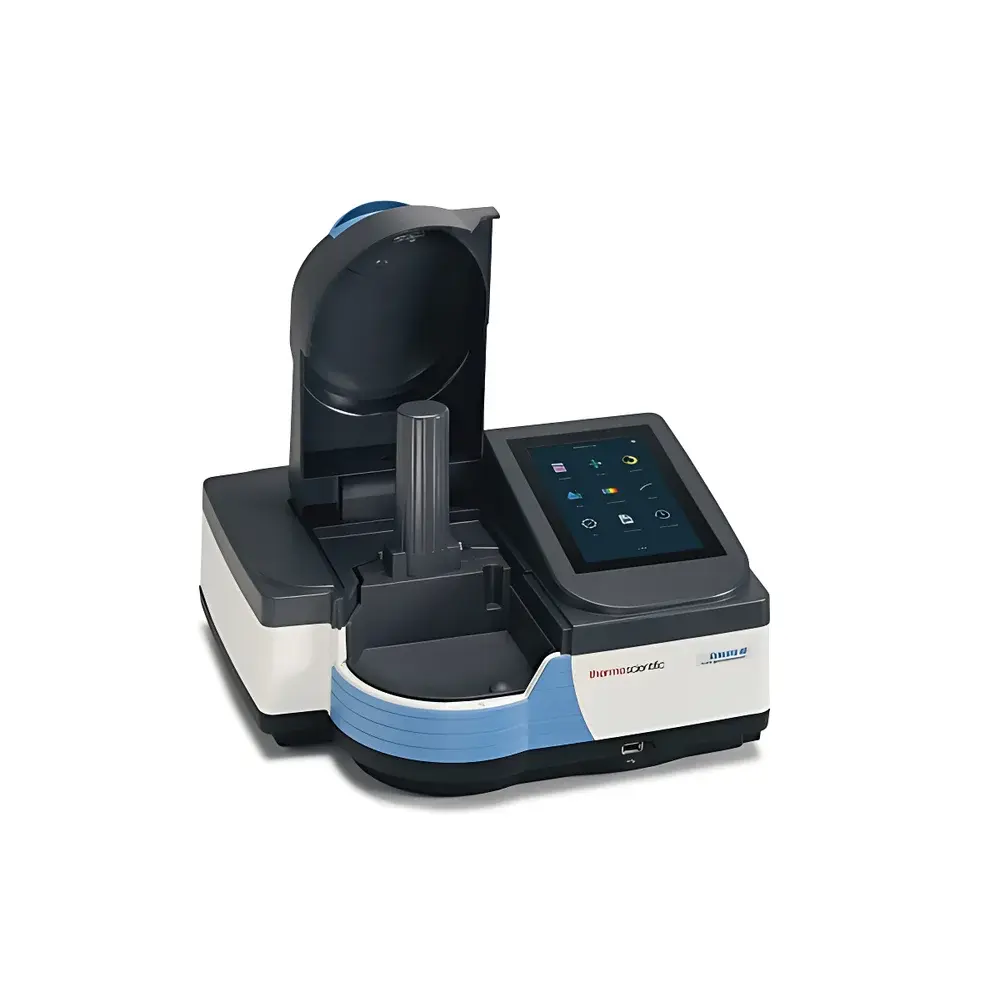
Thermo Fisher GENESYS 40 UV-Vis Spectrophotometer
| Brand | Thermo Fisher |
|---|---|
| Origin | USA |
| Manufacturer | Thermo Fisher Scientific |
| Instrument Type | Imported Dual-Beam UV-Vis Spectrophotometer |
| Model | GENESYS 40 |
| Optical Detector | Photodiode Array |
| Wavelength Range | 325–1100 nm |
| Wavelength Selection | Manual |
| Spectral Bandwidth | 5 nm |
| Wavelength Accuracy | ±0.5 nm |
| Stray Light | <0.05% T at 340 nm and 400 nm |
Overview
The Thermo Fisher GENESYS 40 UV-Vis Spectrophotometer is a dual-beam, benchtop absorption spectrometer engineered for precision, reliability, and ease of use in undergraduate teaching laboratories, quality control environments, and routine analytical workflows. Operating on the principle of Beer–Lambert law-based absorbance measurement, it compares sample and reference beam intensities simultaneously using a fixed optical path geometry and a stable photodiode array detector. Its 325–1100 nm wavelength coverage supports quantitative analysis across the near-UV, visible, and near-infrared regions—enabling applications ranging from dye concentration assays and enzyme kinetics to water quality monitoring and pharmaceutical excipient verification. Designed with robust mechanical architecture and thermally stabilized optics, the GENESYS 40 delivers high reproducibility without requiring frequent recalibration or environmental isolation.
Key Features
- Dual-beam optical design ensures real-time compensation for lamp intensity drift and solvent background fluctuations, enhancing measurement stability over extended acquisition periods.
- High-resolution 7-inch capacitive touchscreen interface provides intuitive navigation, context-sensitive prompts, and direct access to preconfigured methods—eliminating reliance on external PCs for basic operation.
- Large, accessible sample compartment accommodates standard 10 mm square cuvettes, round test tubes (up to 25 mm diameter), and optional accessories including micro-volume adapters and temperature-controlled holders.
- Removable and autoclavable interior liner simplifies decontamination between samples—critical for educational labs handling diverse chemical reagents or biological matrices.
- Smart Start functionality enables one-touch launch of instructor-defined analytical protocols (e.g., “Protein A280”, “Nitrate UV Scan”, “Kinetic Reaction Monitor”), reducing procedural errors and training time for new users.
- Fixed 5 nm spectral bandwidth balances resolution and signal-to-noise ratio for routine quantitation tasks while maintaining compliance with common method validation requirements (e.g., USP <857>, ASTM E275).
Sample Compatibility & Compliance
The GENESYS 40 accepts a broad range of liquid-phase samples in quartz, glass, or plastic cuvettes (pathlengths 1–50 mm). Its optical design tolerates moderate turbidity and minor particulate suspension—making it suitable for crude extracts, cell culture supernatants, and industrial process streams. While not intended for GMP-regulated release testing, its performance characteristics align with ISO/IEC 17025 technical competence criteria for routine laboratory equipment. The instrument meets IEC 61010-1 safety standards and complies with electromagnetic compatibility (EMC) directives per EN 61326-1. Data integrity is supported via timestamped, non-editable measurement logs stored locally on internal flash memory—facilitating basic GLP documentation in academic and contract research settings.
Software & Data Management
Instrument control and data handling are fully integrated into the onboard firmware; no external software license or installation is required. All spectra, absorbance/time traces, and calibration curves are saved in CSV format for seamless import into spreadsheet or statistical analysis platforms (e.g., Excel, JMP, R). Method templates—including multi-point calibration, kinetic scan parameters, and wavelength-scan ranges—are editable directly via the touchscreen and can be exported/imported via USB drive. Audit trail functionality records operator ID (if enabled), date/time stamps, and parameter changes—supporting traceability requirements under FDA 21 CFR Part 11 when paired with institutional user authentication policies.
Applications
- Quantitative analysis of nucleic acids, proteins, and small molecules using standardized extinction coefficients.
- Verification of reagent purity and lot-to-lot consistency in chemistry teaching labs.
- Monitoring reaction progress in undergraduate organic and biochemistry experiments (e.g., hydrolysis kinetics, redox titrations).
- Environmental testing including nitrate, phosphate, and COD determination per APHA Standard Methods.
- Pharmaceutical formulation development—excipient screening, dissolution profile verification, and stability-indicating assays.
- Vitamin and pigment quantification in food science curricula (e.g., β-carotene in vegetable extracts, anthocyanins in fruit juices).
FAQ
Is the GENESYS 40 compliant with FDA 21 CFR Part 11?
It supports core elements such as electronic signatures, audit trails, and secure data storage—but full Part 11 compliance requires site-specific validation, documented SOPs, and administrative controls beyond the instrument’s native capabilities.
Can it perform kinetic measurements?
Yes—time-based absorbance monitoring is supported at user-defined intervals (1–999 seconds), with up to 1,000 data points per run.
What cuvette materials are recommended for UV-range measurements?
Quartz cuvettes are required below 350 nm; fused silica or high-quality UV-grade quartz is recommended for measurements below 325 nm.
Does the instrument support wavelength scanning?
Yes—full spectral scans from 325 nm to 1100 nm are available with adjustable data point density (1–5 nm step size) and smoothing options.
Is remote operation possible via Ethernet or Wi-Fi?
No—the GENESYS 40 lacks network connectivity; all operation and data export occur through the local touchscreen and USB port.
Related Products





