
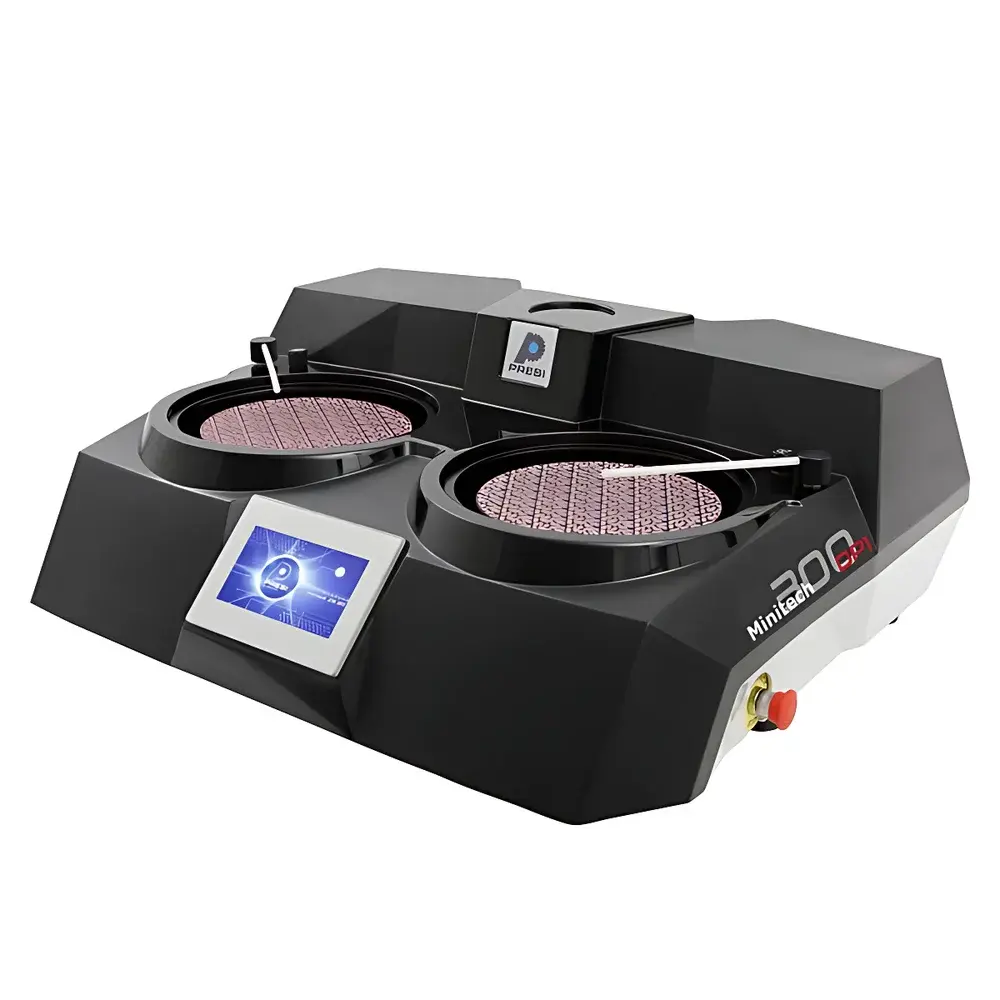
PRESI MINITECH 300 DP1 Manual Dual-Disc Grinding and Polishing System
| Brand | PRESI |
|---|---|
| Origin | France |
| Model | MINITECH 300 DP1 |
| Disc Quantity | 2 |
| Disc Diameter | 250–300 mm |
| Speed Range | 20–700 rpm |
| Dimensions (L×W×D) | 330 × 620 × 875 mm |
| Motor Power | 900 W |
| Display | 7-inch color LCD touchscreen |
| Compliance | CE, EN 61000-6-2/-6-4, EN ISO 12100 |
Overview
The PRESI MINITECH 300 DP1 is a precision-engineered manual dual-disc grinding and polishing system designed for reproducible metallographic and materialographic sample preparation in research laboratories, quality control facilities, and failure analysis centers. Based on proven mechanical principles of controlled abrasive contact under adjustable normal force, the system enables consistent surface planarization, material removal, and final polishing across diverse specimen types—including ferrous and non-ferrous metals, ceramics, composites, and geological specimens. Its core architecture integrates vector-controlled frequency conversion, real-time manual load monitoring, and ergonomic human-machine interaction to bridge the gap between fully automated systems and operator-dependent manual techniques. Unlike semi-automatic or single-disc units, the MINITECH 300 DP1 supports simultaneous or independent operation of two 250–300 mm diameter discs—allowing concurrent grinding and polishing, or twin-stage polishing with different abrasives—while maintaining full tactile control over applied pressure and dwell time.
Key Features
- 900 W high-torque AC motor with vector-frequency inverter ensures stable rotational speed and torque delivery across the full 20–700 rpm range—even under variable load conditions typical of coarse grinding or hard-material polishing.
- Real-time manual load feedback system displays instantaneous downward force (in kgf or N) applied by the operator via the sample holder, enabling quantitative repeatability in manual protocols and facilitating SOP-based training and audit readiness.
- 7-inch full-color LCD touchscreen interface provides intuitive navigation for setting disc rotation direction (CW/CCW), speed, water valve activation, timer duration, and multi-step program recall—all accessible from the front panel without tools or software installation.
- Multi-level password-protected software architecture allows lab managers to define, lock, and version-control standardized preparation methods—ensuring compliance with internal QA procedures and external regulatory frameworks such as ISO/IEC 17025 or ASTM E3-22.
- Ergonomically optimized base design features a 5° forward tilt for efficient coolant drainage, elevated main shaft bearings to prevent liquid ingress, and an integrated splash ring that minimizes aerosol generation and cross-contamination between discs.
- Removable high-molecular-weight polyethylene sample bowl resists chemical corrosion, prevents rust accumulation, and simplifies cleaning and maintenance—critical for labs processing aggressive electrolytes or acidic polishing suspensions.
- Integrated disc spin-dry function automatically rotates discs at 500 rpm for 15 seconds post-cycle to remove residual slurry, water, and abrasive particles—extending consumable life and reducing downtime between samples.
- Dual emergency stop buttons (left/right) meet EN ISO 13850 requirements; full electrical safety certification includes CE marking, electromagnetic compatibility per EN 61000-6-2 and -6-4, and mechanical risk assessment per EN ISO 12100.
Sample Compatibility & Compliance
The MINITECH 300 DP1 accommodates specimens up to Ø50 mm and 40 mm height using standard quick-clamp holders, and supports both rigid mounting (e.g., hot-pressed mounts) and free-hand manual positioning. It is routinely deployed in accordance with ASTM E3-22 (Standard Guide for Preparation of Metallographic Specimens), ISO 15510 (Metallographic polishing), and EN 10365 (Steel—Macrostructure evaluation). The system’s load feedback capability supports GLP-compliant documentation when paired with external data logging; its parameter-locking software aids in meeting FDA 21 CFR Part 11 requirements for electronic records integrity where validated workflows are implemented.
Software & Data Management
While the MINITECH 300 DP1 operates as a standalone instrument without mandatory PC connectivity, its embedded firmware supports export of cycle logs (via USB port) containing timestamped entries for speed, duration, direction, water activation, and average applied load. These logs may be imported into LIMS or ELN platforms for traceability. Firmware updates are delivered via encrypted USB stick and include revision history, change logs, and calibration verification prompts—supporting laboratory accreditation audits under ISO/IEC 17025 Clause 6.4.2.
Applications
- Metallographic preparation of aluminum alloys, stainless steels, titanium, and superalloys for microstructural analysis (SEM/EDS, optical microscopy).
- Polishing of sintered carbides and ceramic matrix composites prior to hardness testing (Vickers, Knoop) or fracture toughness evaluation.
- Surface conditioning of geological thin sections and mineralogical samples for polarized light microscopy.
- Routine QC preparation of weld joints, castings, and additive-manufactured parts in aerospace and power generation sectors.
- Teaching laboratories requiring robust, serviceable equipment for hands-on instruction in materials science fundamentals.
FAQ
Is the MINITECH 300 DP1 compatible with consumables from other manufacturers?
Yes—it accepts standard 250 mm and 300 mm grinding/polishing discs, cloths, and holders conforming to ISO 6474 and ASTM E779 dimensional specifications.
Does the system support automatic step sequencing?
No—it is manually operated with programmable parameters per step; however, up to 10 user-defined multi-step protocols can be saved and recalled via the touchscreen interface.
What maintenance intervals are recommended?
Bearing lubrication every 1,000 operating hours; belt tension check every 500 hours; splash ring and bowl inspection before each shift; full calibration verification annually or after major component replacement.
Can the load sensor be calibrated in-house?
Yes—using the built-in calibration routine and certified test weights (not supplied); full procedure documented in the English-language service manual provided with shipment.
Is remote diagnostics supported?
Not natively; however, error codes displayed on the touchscreen (e.g., E01 = overload, E05 = water flow fault) enable rapid troubleshooting, and PRESI’s global service network offers on-site technical support within 72 hours in most OECD countries.



