
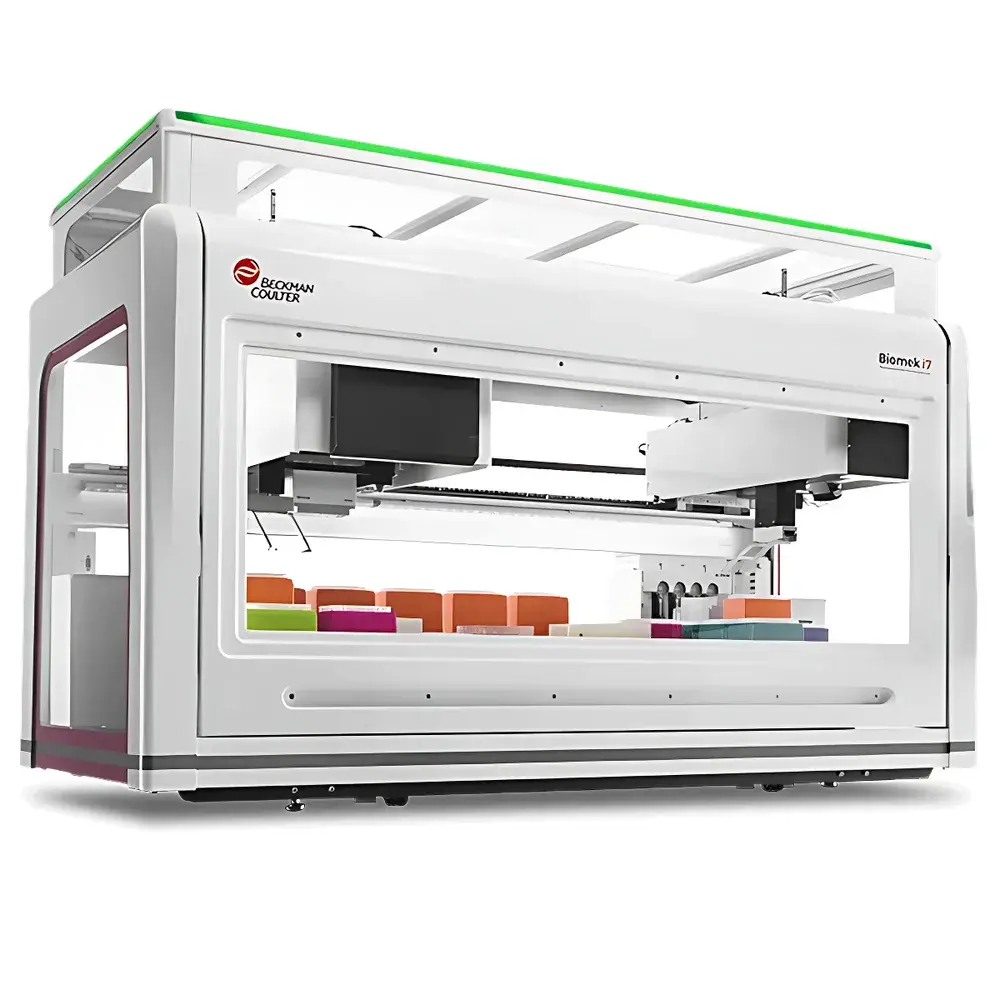
Beckman Coulter Biomek i7 Liquid Handling Workstation
| Brand | Beckman Coulter |
|---|---|
| Origin | Jiangsu, China |
| Manufacturer Type | Original Equipment Manufacturer (OEM) |
| Regional Classification | Domestic (China-Made) |
| Model | Biomek i7 (Localized Version) |
| Plate Positions | 45 standard ANSI/SLAS-compliant deck positions |
| Pipetting Accuracy | 1 µL with CV < 7% |
| Pipetting Range | 0.5–5,000 µL |
| Sample Throughput | Up to 96 or 384 samples per run |
| Dimensions (L×W×H) | 170 × 81 × 112 cm |
Overview
The Beckman Coulter Biomek i7 Liquid Handling Workstation is an engineered platform for mid-to-high-throughput laboratory automation, designed to execute complex, reproducible liquid transfer protocols across genomics, drug discovery, and cell-based research workflows. Built upon Beckman Coulter’s legacy in precision fluidics and robotic integration, the Biomek i7 implements a modular Cartesian coordinate architecture with dual independent pipetting arms—supporting both fixed-tip and disposable-tip configurations—and integrates real-time liquid level sensing, adaptive deck calibration, and multi-axis motion control. Its core functionality adheres to principles of volumetric accuracy, positional repeatability, and protocol traceability—critical for environments operating under GLP, GMP, or ISO/IEC 17025 frameworks. The system operates natively on Windows 10 and supports audit-trail-enabled method execution compliant with FDA 21 CFR Part 11 requirements when configured with appropriate software licensing and user access controls.
Key Features
- Open-deck architecture accommodating up to 45 ANSI/SLAS-standard plate positions—including microplates (96-, 384-, 1536-well), tubes (1.5–50 mL), reservoirs, and custom labware
- Dual pipetting options: a high-precision 8-channel flexible arm with independent channel calibration and liquid-level detection, plus a parallel 96-/384-channel or pin-tool head for parallel processing
- Extended volume range from 0.5 µL to 5,000 µL with validated accuracy (CV < 7% at 1 µL) and linearity across full dynamic range
- Integrated Automated Labware Positioner (ALP) enabling autonomous plate orientation recognition and precise positional alignment without manual intervention
- Real-time onboard camera system with time-stamped video capture, error-triggered recording, and live streaming capability for remote monitoring
- Infrared light curtain safety interlock system meeting IEC 61508 SIL 2 functional safety standards
- Modular 4D integration capability—supporting third-party peripherals including centrifuges, incubators, readers, and thermal cyclers via standardized API interfaces
- Multi-color status LED array and guided setup wizard for rapid commissioning and routine maintenance verification
Sample Compatibility & Compliance
The Biomek i7 accepts a broad spectrum of consumables conforming to ANSI/SLAS dimensional specifications, including PCR plates, deep-well plates, tube racks, filter plates, and custom labware with defined fiducial markers. It supports viscous, volatile, foaming, and low-retention liquids through optimized aspiration/dispense parameters and surface-tension-aware pipetting algorithms. Regulatory compliance includes alignment with ISO 8655-6 (volumetric performance of piston-operated instruments), ASTM E2758 (standard guide for validation of automated liquid handlers), and USP (analytical instrument qualification). When deployed with Biomek Method Studio and optional eLogbook modules, the system enables full electronic record integrity per ALCOA+ principles and facilitates inspection readiness for FDA, EMA, or MHRA audits.
Software & Data Management
Biomek Method Studio provides a drag-and-drop graphical interface for method development, supporting nested subroutines, conditional logic, and parameterized variables. All methods are version-controlled, digitally signed, and linked to instrument logs and environmental metadata (e.g., ambient temperature, humidity, operator ID). Integration with LIMS and ELN systems occurs via HL7, RESTful APIs, or ODBC connectivity. Data export formats include CSV, XML, and PDF reports with embedded QC metrics (e.g., tip leakage checks, volume deviation heatmaps, cycle time histograms). Audit trails record every user action—including method edits, run initiations, and calibration events—with immutable timestamps and role-based access restrictions.
Applications
The Biomek i7 delivers validated performance in applications requiring stringent volumetric fidelity and process consistency. In genomics, it automates NGS library preparation (Illumina, PacBio, Oxford Nanopore), DNA/RNA extraction and purification, qPCR master mix assembly, and targeted panel enrichment workflows. In drug discovery, it supports HTS assay setup, hit confirmation, dose-response curve generation, 3D spheroid dispensing, and compound dilution series with serial dilution error minimization. For cell biology, the platform enables automated passaging, transfection reagent addition, co-culture setup, and high-content screening plate formatting. Additional use cases span metabolomics sample prep, synthetic biology construct assembly, and clinical assay harmonization across multi-site laboratories.
FAQ
Does the Biomek i7 support 1536-well plate handling?
Yes—the open deck design and ALP module enable reliable positioning and pipetting into 1536-well plates when used with compatible tips and calibrated protocols.
Can the system be integrated into a cleanroom environment?
Optionally—by installing the certified laminar flow enclosure and HEPA-filtered external ventilation, the Biomek i7 meets ISO Class 5 cleanroom operational requirements.
Is method validation documentation provided?
Beckman Coulter supplies IQ/OQ documentation templates and application notes aligned with ASTM E2758 and USP , supporting customer-led PQ execution.
What level of cybersecurity is implemented?
The workstation complies with NIST SP 800-53 controls for embedded systems, including encrypted data-at-rest, TLS 1.2+ for network communications, and Windows Defender Application Control policies.
How frequently does the system require recalibration?
Automatic deck calibration occurs at startup and after any physical reconfiguration; volumetric calibration is recommended quarterly or after tip type change, following ISO 8655-6 verification procedures.



