
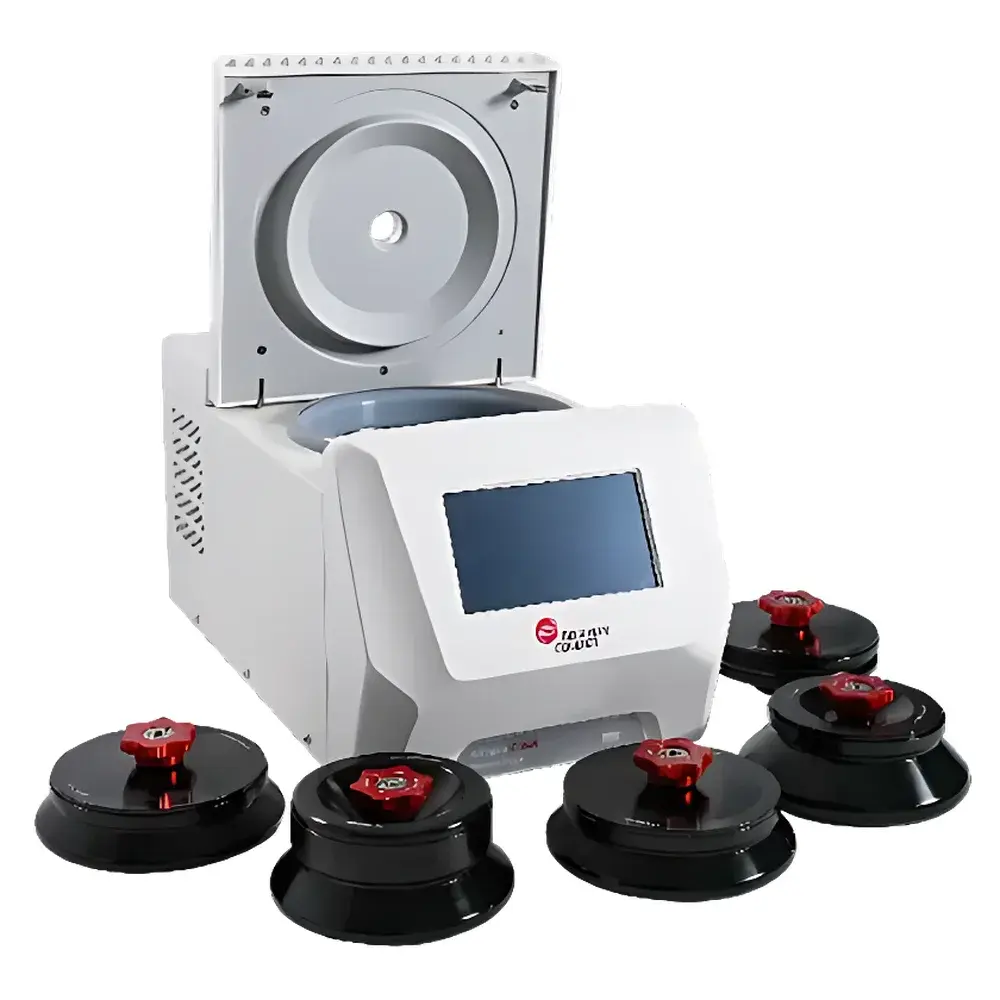
Beckman Coulter Allegra C-24R Microcentrifuge with Refrigeration
| Brand | Beckman Coulter |
|---|---|
| Origin | Shanghai, China |
| Manufacturer Type | Original Equipment Manufacturer (OEM) |
| Regional Classification | Domestic (China-manufactured) |
| Model | Allegra C-24R |
| Instrument Type | Benchtop Refrigerated Microcentrifuge |
| Maximum Speed | 16,000 rpm |
| Temperature Range | –11°C to 40°C |
| Noise Level | ≤52 dBA |
| Display | 7-inch capacitive touchscreen |
| Rotor Compatibility | 5 dedicated rotors for 0.2 mL–5 mL tubes |
| Safety Compliance | IEC 61010-2-020, MCA-certified |
| Software Features | Audit trail support, three-tier user permissions, one-click PDF report export |
Overview
The Beckman Coulter Allegra C-24R is a benchtop refrigerated microcentrifuge engineered for precision, reproducibility, and operational continuity in demanding life science laboratories. Designed specifically for low-volume sample processing—ranging from nucleic acid purification and plasmid isolation to protein precipitation and small-volume cell pellet recovery—the instrument employs a brushless DC motor with variable-frequency drive (VFD) technology to achieve rapid acceleration (0–16,000 rpm in ≤15 seconds) and stable rotational control under dynamic load conditions. Its refrigeration system utilizes an inverter-driven compressor enabling rapid pre-cooling (reaching 4°C setpoint in ≤7 minutes) and maintaining tight thermal stability (±2°C deviation between setpoint and actual sample temperature across the full operating range of –11°C to 40°C). The unit’s compact footprint and integrated thermal management architecture support high-density lab layouts without compromising cooling performance or rotor integrity.
Key Features
- Variable-frequency drive motor delivering consistent torque and extended service life; motor shaft features IPX4-rated waterproof sealing, reducing failure incidence by ≥30% versus conventional designs
- Real-time imbalance detection with automatic deceleration and static rotor recognition—validated per IEC 61010-2-020 and certified under Mechanical Certification Authority (MCA) safety protocols
- 7-inch capacitive touchscreen interface with intuitive workflow navigation, multi-language support (English, Simplified Chinese, Japanese), and haptic feedback for glove-compatible operation
- Five purpose-engineered rotors—including fixed-angle and swing-out configurations—supporting tube formats from 0.2 mL PCR strips to 5 mL conical tubes, minimizing sample transfer loss and cross-contamination risk
- Acoustic optimization yielding ≤52 dBA at maximum speed—compliant with ISO 7779 and suitable for open-plan laboratory environments requiring low ambient noise
- Energy-efficient refrigeration cycle with adaptive compressor modulation, achieving <1.8 kWh/day average consumption in continuous 4°C operation
Sample Compatibility & Compliance
The Allegra C-24R accommodates standard microcentrifuge consumables including polypropylene and polyethylene tubes, PCR plates, and capped spin columns. All rotors are certified for autoclaving (121°C, 20 min) and compatible with common decontamination agents (e.g., 70% ethanol, 0.5% sodium hypochlorite). From a regulatory standpoint, the system supports Good Laboratory Practice (GLP) and Good Manufacturing Practice (GMP) workflows through built-in audit trail functionality compliant with FDA 21 CFR Part 11 requirements. User access is managed via three-tier permission levels (Administrator, Supervisor, Operator), with timestamped event logging for all parameter changes, rotor swaps, and run executions. Data integrity is reinforced by non-volatile memory storage and tamper-evident PDF report generation with embedded digital signatures.
Software & Data Management
Embedded firmware enables seamless integration into networked lab environments via Ethernet or optional Wi-Fi module. Run parameters, temperature logs, rotor usage history, and error diagnostics are stored locally and exportable via USB or secure HTTP(S) protocol. The system supports CSV and XML data formats for downstream analysis in LIMS or ELN platforms. All software updates are digitally signed and verified prior to installation, ensuring firmware authenticity and traceability. No cloud dependency is required for core operation; remote monitoring and alerting (via SNMP or email notifications) remain optional and configurable per institutional IT policy.
Applications
The Allegra C-24R serves critical roles across molecular biology, proteomics, clinical diagnostics, and biopharmaceutical development. Typical use cases include: rapid pelleting of genomic DNA from lysates; high-yield recovery of exosomes from conditioned media; concentration of dilute antibody solutions prior to HPLC analysis; clarification of bacterial lysates during recombinant protein expression; and preparation of sequencing libraries where input volume constraints necessitate minimal dead-volume handling. Its precise temperature control and low vibration profile make it particularly suitable for cold-sensitive applications such as RNA integrity preservation and enzyme activity assays conducted post-centrifugation.
FAQ
What is the maximum relative centrifugal force (RCF) achievable with the Allegra C-24R?
The maximum RCF depends on rotor geometry and radius; with the standard 24-place fixed-angle rotor (FA-45-24-11), RCF reaches 21,900 × g at 16,000 rpm.
Is rotor calibration required before first use?
No—each rotor ships with factory-calibrated identification chips enabling automatic recognition and parameter validation upon insertion.
Can the Allegra C-24R be integrated into a centralized laboratory automation system?
Yes, via RS-232 or Ethernet interfaces supporting SCPI command sets for remote start/stop, status polling, and fault reporting.
Does the instrument meet international electromagnetic compatibility (EMC) standards?
Yes, certified to IEC 61326-1:2013 for EMC emissions and immunity in laboratory environments.
How is data integrity ensured during power interruption?
Critical runtime data—including elapsed time, current speed, temperature, and rotor ID—is retained in non-volatile memory and restored upon reboot without loss of audit trail continuity.



