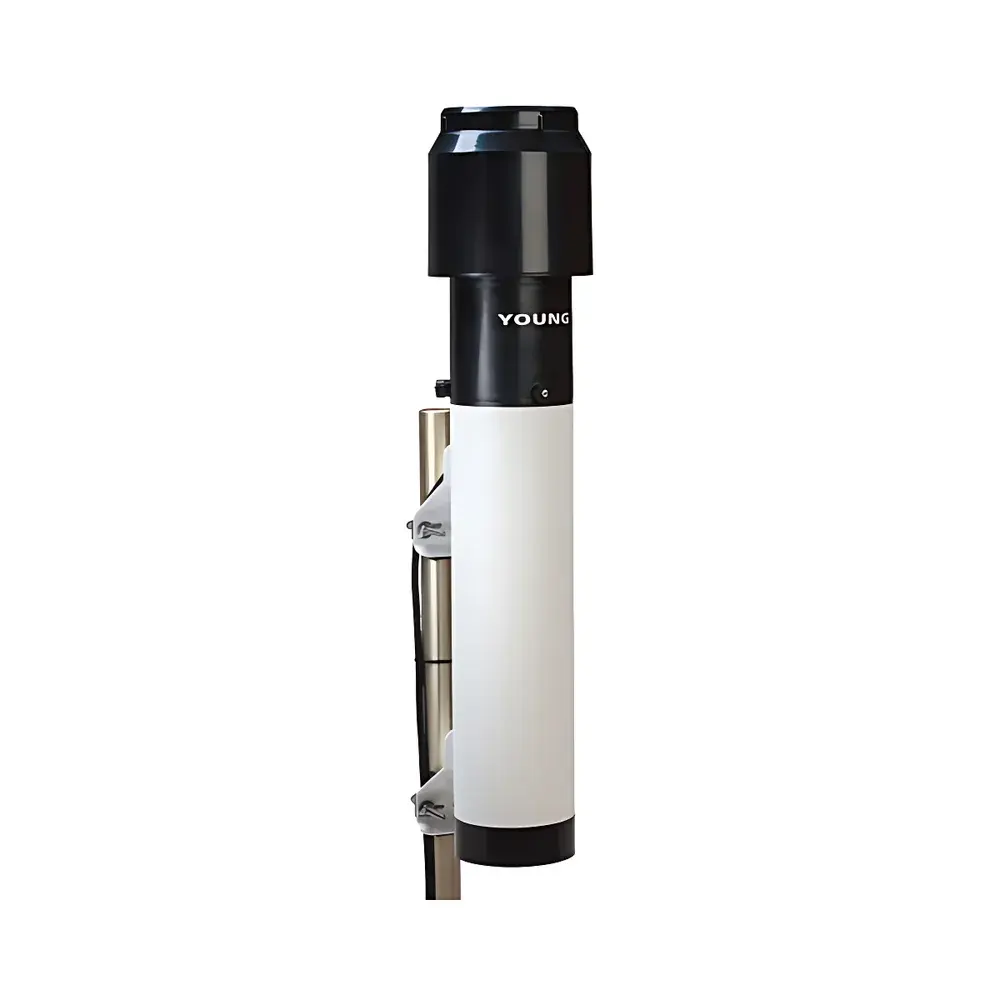
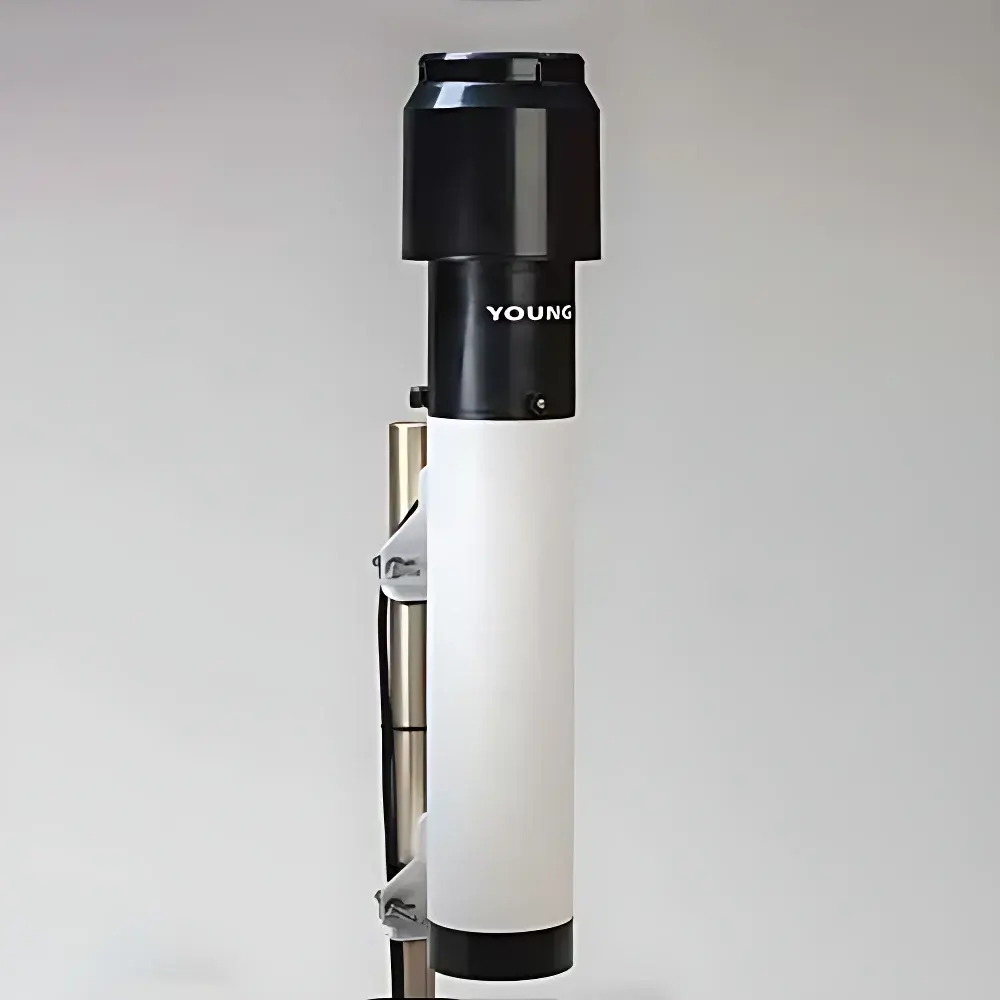
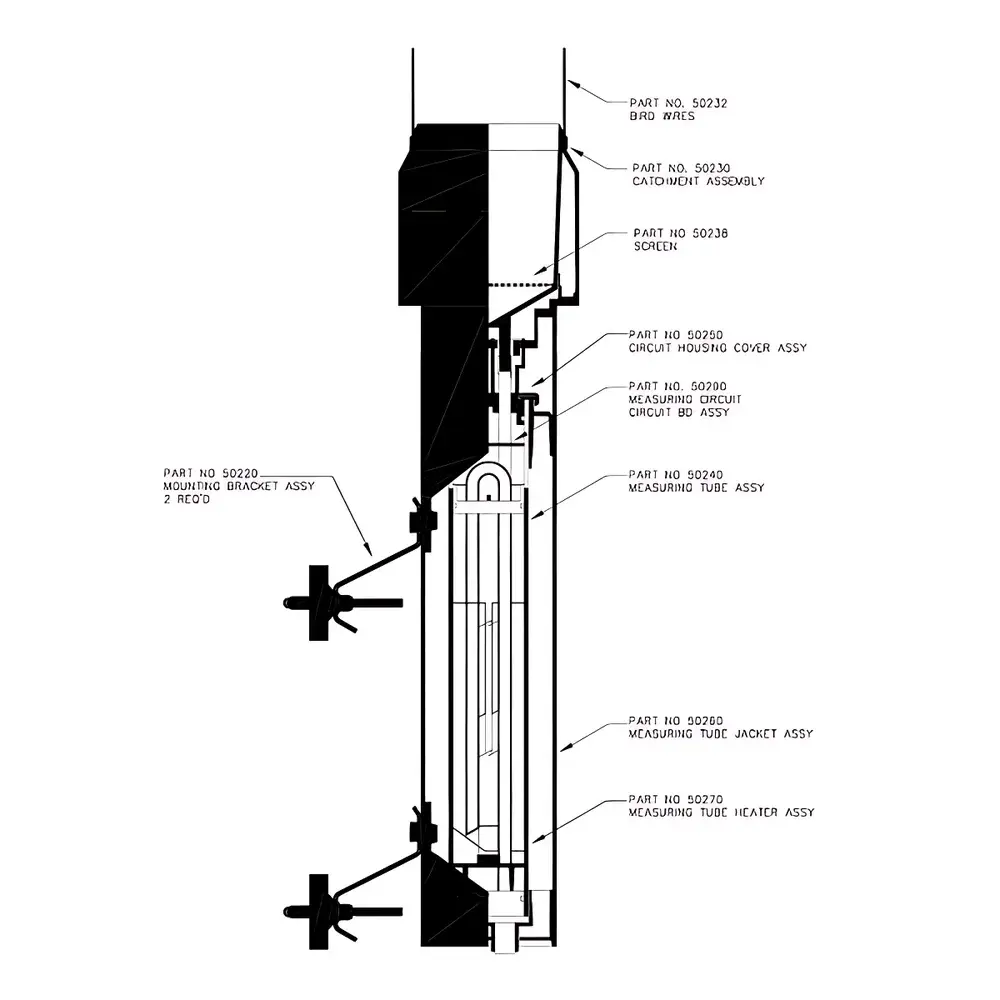
R.M. Young 50203 Siphon Rain Gauge
| Brand | R.M. Young |
|---|---|
| Origin | USA |
| Model | 50203 |
| Threshold | 1 mm |
| Accuracy | ±1 mm |
| Output Signal | 0–5.00 VDC (linear, 0–50 mm rainfall) |
| Siphon Cycle Time | ~30 s |
| Power Supply (gauge only) | 8–30 VDC |
| Operating Temperature Range | –20 to +50 °C (unheated operation) |
| Dimensions (body) | 14 cm diameter × 65 cm height |
| with mounting housing | 39 cm height |
| Collection Orifice Diameter | 113 mm |
| Effective Collection Area | 100 cm² |
| Mounting | U-bracket for vertical mast (25–50 mm diameter) |
| Weight (instrument) | 2.5 kg |
| Shipping Weight | 4.0 kg |
Overview
The R.M. Young 50203 Siphon Rain Gauge is a precision meteorological instrument engineered for long-term, maintenance-free measurement of liquid and solid precipitation—including rain, snowmelt, and mixed-phase events—under unattended field conditions. Unlike tipping-bucket or weighing gauges, the 50203 employs a siphon-based hydrostatic displacement principle: accumulated precipitation flows from the collector into a calibrated vertical column, where each 1 mm of equivalent rainfall produces a precisely defined 5 mm rise in fluid level. This geometric amplification enhances resolution and minimizes parallax and meniscus-related reading errors. A center-mounted capacitive level sensor detects column height continuously and outputs a linear 0–5.00 VDC analog signal proportional to accumulated depth (0–50 mm per siphon cycle). The absence of mechanical actuators, gears, or pivoting components ensures high reproducibility and eliminates wear-induced drift—critical for climate monitoring networks, hydrological observatories, and regulatory compliance reporting.
Key Features
- True siphon mechanism with automatic self-emptying at 250 mm column height (equivalent to 50 mm rainfall), requiring no external actuation or timing logic.
- Capacitive liquid-level sensing technology—immune to vibration, tilt, and platform motion—validated for deployment on buoys, offshore platforms, and mobile research vessels.
- Robust thermoplastic housing with UV-stabilized polymer construction, delivering exceptional corrosion resistance in coastal, industrial, and acidic deposition environments.
- No moving parts in the measurement path: eliminates mechanical hysteresis, friction errors, and calibration drift associated with mechanical linkages or switches.
- Integrated thermal management design (structural insulation + optional heater variants) supports reliable operation across the full industrial temperature range (–20 to +50 °C).
- Standard 100 cm² collection area conforming to WMO Guide to Meteorological Instruments and Methods of Observation (CIMO Guide, Chapter 6) for comparability with reference networks.
Sample Compatibility & Compliance
The 50203 is designed to measure natural precipitation without phase discrimination—snow accumulates in the collector and melts passively under ambient conditions, contributing to total water-equivalent depth. Its siphon architecture inherently accommodates slush, graupel, and rime when meltwater enters the column. The instrument complies with key international standards for precipitation measurement accuracy and siting, including ISO 9060:2018 (spectral responsivity classification for solar radiation instruments, referenced for environmental exposure testing), ASTM D7273-18 (standard practice for installation and maintenance of precipitation gauges), and WMO No. 8 (CIMO Guide) recommendations for gauge exposure, wind shielding, and siting elevation. While the 50203 itself does not include active heating, its structural design allows integration with third-party wind shields and heated enclosures meeting WMO Class A siting criteria.
Software & Data Management
The 0–5.00 VDC analog output is compatible with industry-standard data loggers (e.g., Campbell Scientific CR series, Onset HOBO, Delta-T DL2e) supporting 12- to 16-bit voltage input resolution. When paired with a compliant logger, the system supports timestamped, traceable precipitation records suitable for GLP/GMP-aligned environmental monitoring programs. Raw voltage values are converted to millimeters using factory-determined linear calibration coefficients (supplied with unit). Optional firmware extensions enable real-time siphon event detection via voltage slope analysis, facilitating event-based triggering of auxiliary sensors (e.g., visibility meters, particle counters). All collected data may be exported in CSV or NetCDF format for ingestion into hydrological modeling platforms (HEC-HMS, SWAT) or regulatory submission systems aligned with EPA 40 CFR Part 136 or EU INSPIRE metadata requirements.
Applications
- Long-term climate station networks requiring NIST-traceable, low-drift precipitation records over multi-decade intervals.
- Hydrological basins and watershed management authorities performing runoff coefficient validation and flood frequency analysis.
- Environmental impact assessments (EIA) for infrastructure projects where precipitation depth and intensity duration-frequency (IDF) curves inform drainage design.
- Oceanographic buoys and autonomous surface vehicles (ASVs) operating in high-humidity, salt-laden, and dynamically tilted conditions.
- Calibration reference sites supporting intercomparison studies between optical disdrometers, radar QPE algorithms, and satellite precipitation products (e.g., GPM IMERG).
- Academic atmospheric science field campaigns requiring ruggedized, low-power, analog-output instrumentation deployable in remote or off-grid locations.
FAQ
Does the 50203 require external power to operate the siphon mechanism?
No—the siphon action is purely gravitational and hydrostatic; only the capacitive sensor and signal conditioning circuitry require DC power (8–30 VDC).
Can the 50203 measure snowfall directly?
It measures snowmelt-derived water depth; for solid-phase accumulation, it must be used with passive melting or in conjunction with heated variants (e.g., model 50202) for real-time snow water equivalent (SWE) estimation.
What is the maximum measurable rainfall intensity before overflow occurs?
At 50 mm per siphon cycle and ~30 s drain time, the theoretical upper limit is approximately 6 mm/min—sufficient for most convective and orographic rainfall events observed globally.
Is the 100 cm² collection area adjustable or certified?
Yes—the orifice is fixed and manufactured to ISO/IEC 17025-accredited dimensional tolerances; the effective area is validated during factory calibration and documented in the certificate of conformance.
How is zero-point drift mitigated over extended deployments?
Capacitive sensing eliminates mechanical zero-shift; periodic verification against a calibrated volumetric standard (e.g., 10 mL syringe delivery) is recommended annually per WMO maintenance guidelines.