
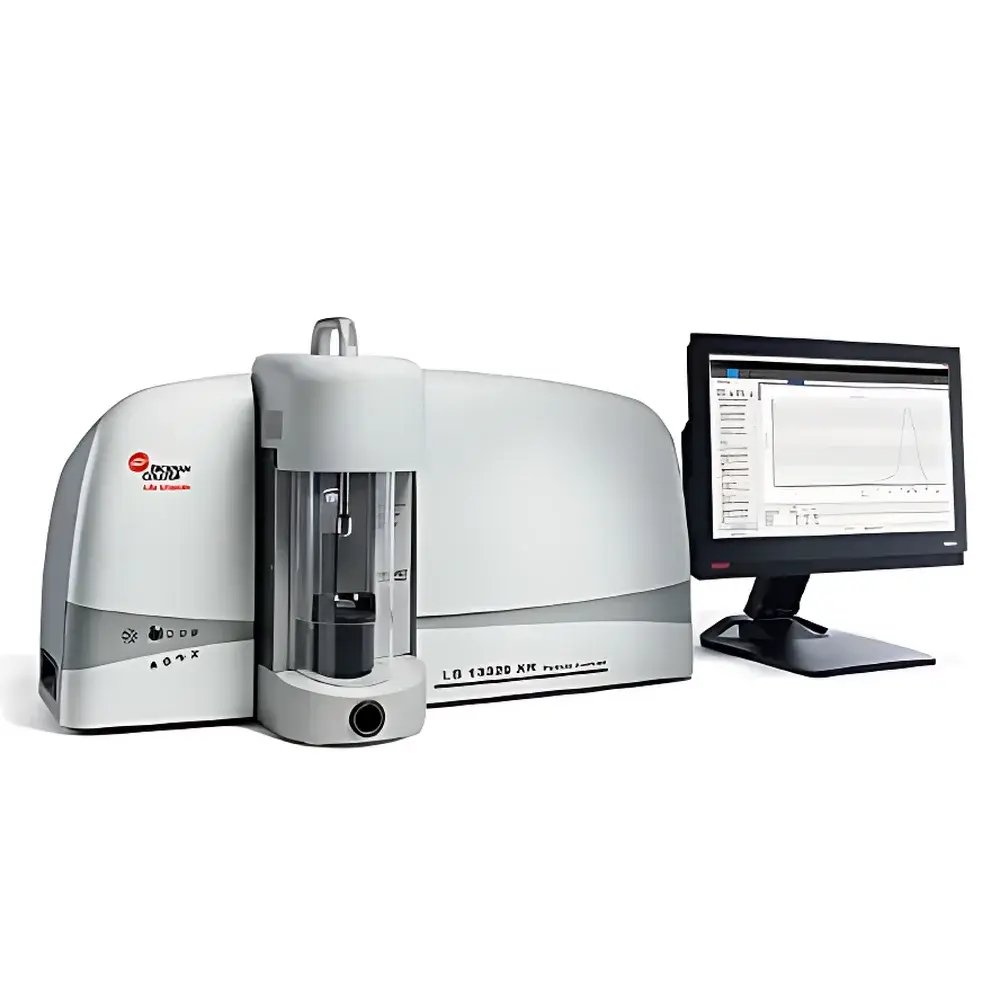
Beckman Coulter LS 13 320 XR Laser Diffraction Particle Size Analyzer
| Brand | Beckman Coulter |
|---|---|
| Origin | USA |
| Manufacturer Type | Original Equipment Manufacturer (OEM) |
| Product Category | Imported Instrument |
| Model | LS 13 320 XR |
| Dispersion Method | Dry & Wet Dispersion |
| Instrument Type | Laboratory Laser Diffraction Analyzer |
| Measurement Range | 10 nm – 3500 µm |
| Repeatability | < ±0.5% |
| Measurement Time | 10 seconds |
Overview
The Beckman Coulter LS 13 320 XR Laser Diffraction Particle Size Analyzer is an advanced, ISO 13320-compliant laboratory instrument engineered for high-fidelity particle size distribution (PSD) analysis across an exceptionally broad dynamic range—from 10 nanometers to 3500 micrometers. It operates on the fundamental principle of laser diffraction, where particles in suspension or aerosol scatter incident light at angles inversely proportional to their size. The system employs multi-wavelength illumination (475 nm, 613 nm, 785 nm, and 900 nm) combined with polarized light detection to resolve complex scattering patterns with enhanced angular discrimination. Its core innovation lies in the proprietary Polarization Intensity Differential Scattering (PIDS™) technology—patented under US Nos. 4,953,978 and 5,104,221—which enables unambiguous detection and quantification of sub-100 nm particles without reliance on extrapolation or empirical calibration. Unlike conventional single-wavelength diffraction systems, PIDS leverages polarization-dependent scattering signatures to distinguish nanoscale populations even within polydisperse, multimodal samples—making the LS 13 320 XR uniquely capable of delivering traceable, model-independent nanoscale resolution while maintaining microscale accuracy.
Key Features
- 132 physically discrete angular detectors arranged in a logarithmic X-array configuration, yielding 136 independent data channels for high-resolution scattering intensity mapping.
- Integrated solid-state laser source with fiber-coupled delivery; zero warm-up time and >70,000 hours operational lifetime.
- Parallel signal acquisition architecture ensuring synchronized, low-latency, high signal-to-noise ratio (SNR) data capture across all wavelengths and detectors.
- Automated peak detection and multimodal distribution deconvolution—no pre-assumption of number of modes or selection of optical models required.
- Zero-Time Optical Modeling System: generates application-specific Mie or Fraunhofer optical models in under one second using an embedded database of >1,200 refractive index/extinction coefficient pairs.
- Real-time instrument self-diagnostic feedback during measurement, including laser power stability, flow cell cleanliness, and detector saturation status.
- Touchscreen-enabled ADAPT™ software with intuitive three-step workflow: load → measure → report—with visual pass/fail flagging based on user-defined specification limits.
Sample Compatibility & Compliance
The LS 13 320 XR supports both wet dispersion (via integrated liquid module with ultrasonic probe and peristaltic pump) and dry dispersion (using pressurized air-assisted venturi nozzle), enabling analysis of cohesive powders, fragile agglomerates, emulsions, colloids, and nanoparticle suspensions. All dispersion modules follow “plug-and-play” mechanical and electrical interfacing standards, permitting rapid reconfiguration without recalibration. The system complies with ISO 13320:2020 for laser diffraction methodology, meets FDA 21 CFR Part 11 requirements for electronic records and signatures—including full audit trail, user access control, and electronic signature validation—and supports GLP/GMP-aligned workflows through configurable report templates, metadata stamping, and version-controlled method storage.
Software & Data Management
ADAPT™ software provides a secure, role-based interface compliant with analytical data integrity principles (ALCOA+). It includes automated data archiving, export to ASTM E29, ISO/IEC 17025–compatible formats (CSV, PDF/A-2, XML), and direct integration with LIMS via ODBC and RESTful API. Each measurement record embeds full provenance: instrument ID, operator credentials, environmental conditions (temperature, humidity), dispersion parameters, optical model selection, and raw scattering matrix. The software enforces change control for critical parameters and logs all modifications with timestamped user attribution—ensuring full traceability for regulatory submissions and internal quality audits.
Applications
This analyzer serves critical quality control and R&D functions across pharmaceuticals (e.g., inhalable APIs, injectable nanosuspensions, tablet excipient grading), advanced materials (battery cathode/anode powders, catalysts, quantum dots), paints & coatings (pigment dispersion stability), food & beverage (emulsion droplet sizing, starch granule distribution), and environmental science (aerosol PM characterization, sediment grain analysis). Its dual-range capability eliminates the need for separate nano- and micro-analyzers, reducing capital cost, lab footprint, and inter-instrument variability.
FAQ
Does the LS 13 320 XR require routine optical alignment?
No—its monolithic optical bench and fiber-coupled laser design eliminate manual alignment; factory calibration is retained over instrument lifetime.
Can the system analyze opaque or highly absorbing particles?
Yes—multi-wavelength PIDS compensates for absorption effects by comparing polarization-resolved scattering cross-sections across spectral bands.
Is method transfer possible between legacy LS instruments and the LS 13 320 XR?
Yes—backward-compatible ADAPT method files retain historical SOPs; optional migration support ensures seamless transition of validated protocols.
What sample volume is required for wet analysis?
Typical minimum is 20 mL for standard cuvette mode; low-volume adapter option reduces requirement to 3 mL.
How is compliance with 21 CFR Part 11 enforced in daily operation?
Through mandatory electronic signatures for method execution, automatic generation of immutable audit trails, and configurable password policies aligned with NIST SP 800-63B.



