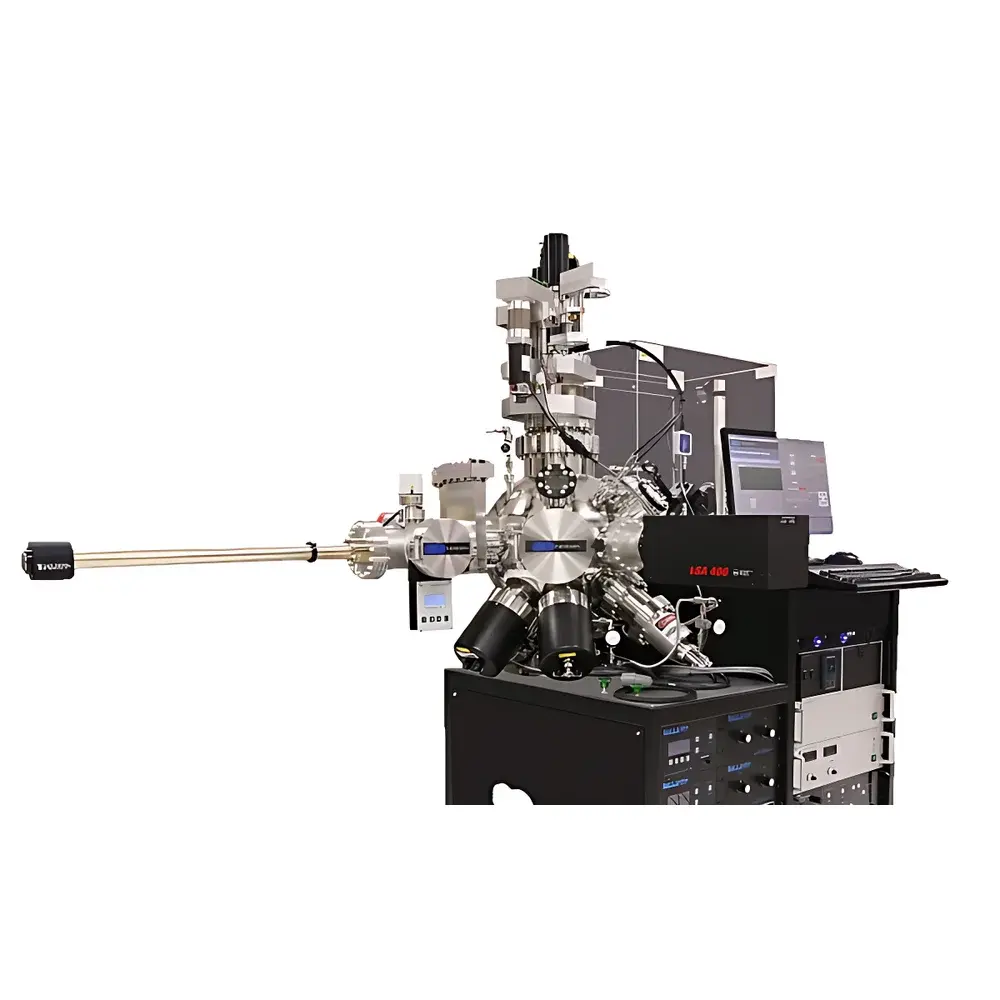
Neocera Pioneer 180 Laser MBE/PLD System
| Brand | Neocera |
|---|---|
| Origin | USA |
| Model | Pioneer 180 Laser MBE/PLD System |
| Substrate Heating | 1000 °C (laser heater), 850 °C (radiant heater) |
| Substrate Size | 1 cm × 1 cm (laser-heated stage), 2″ diameter (radiant-heated stage) |
| Vacuum Chamber Diameter | 18″ |
| RHEED Gun Voltage | 30 keV |
| RHEED Operating Pressure | ≤500 mTorr (O₂) |
| Gas Flow Control | O₂/N₂ up to 100 SCCM |
| Software Platform | Windows 7 + LabVIEW 2013 |
| Target Mounting Options | 6 × 1″ or 3 × 2″ rotating target holder |
Overview
The Neocera Pioneer 180 Laser MBE/PLD System is a high-precision, ultra-high-vacuum (UHV)-compatible thin-film growth platform engineered for atomic-layer-resolved pulsed laser deposition (PLD) and hybrid molecular beam epitaxy (MBE)-style synthesis. Unlike conventional PLD systems operating at moderate vacuum levels, the Pioneer 180 integrates differential pumping architecture to simultaneously sustain two distinct pressure regimes: a controlled PLD process environment (up to 500 mTorr in reactive oxygen or nitrogen atmospheres) and a stable RHEED observation zone (<10⁻⁶ Torr). This dual-pressure capability enables real-time, in situ monitoring of surface reconstruction, layer-by-layer growth kinetics, and stoichiometric evolution during oxide, nitride, chalcogenide, or complex perovskite film formation. The system employs a 30 keV reflection high-energy electron diffraction (RHEED) gun with integrated CCD imaging and shutter control—providing quantitative intensity oscillation data essential for kinetic studies and epitaxial quality assessment. Its modular UHV-compatible design supports seamless integration with complementary surface science tools, including XPS and ARPES, via load-lock transfer without air exposure.
Key Features
- Hybrid PLD/MBE architecture with differential pumping for concurrent high-pressure deposition and low-pressure RHEED monitoring
- Dual-mode substrate heating: high-precision laser heating (up to 1000 °C) for localized thermal control and radiant heating (up to 850 °C) for uniform large-area substrates
- Configurable target carousel supporting up to six 1″ targets or three 2″ targets with programmable rotation and indexing
- Integrated gas delivery system with mass flow controllers (MFCs) for O₂ and N₂ (0–100 SCCM), enabling precise reactive atmosphere tuning for metal oxide and nitride synthesis
- Load-lock compatible substrate stage facilitating air-free transfer to external UHV analytical systems (e.g., XPS, ARPES, LEED)
- Optional MAPLE (Matrix-Assisted Pulsed Laser Evaporation) configuration for thermally sensitive organic and polymeric thin films
- Expandable deposition source options: pulsed electron deposition (PED), RF/DC sputtering, and DC ion sources for multi-technique co-deposition
Sample Compatibility & Compliance
The Pioneer 180 accommodates a range of substrate geometries and materials relevant to semiconductor, quantum materials, and oxide electronics research. Standard configurations support 1 cm × 1 cm samples on the laser-heated stage—ideal for small single crystals or patterned templates—and 2″ wafers on the radiant-heated stage for scalable prototyping. All internal components are constructed from low-outgassing, UHV-grade stainless steel (304L/316L), and vacuum seals utilize metal (Cu or Ni) gaskets compliant with ASTM F2789 and ISO 14001 cleanroom fabrication standards. The system meets UHV compatibility requirements per ISO 27893 for base pressures ≤5×10⁻⁹ Torr after bakeout. Differential pumping stages are certified for continuous operation under mixed-gas conditions (O₂, N₂, Ar) per SEMI S2-0215 safety guidelines. RHEED data acquisition and instrument control logs are timestamped and exportable in ASCII/CSV formats to support GLP-compliant documentation workflows.
Software & Data Management
System operation is managed through a LabVIEW 2013-based control suite running on Windows 7 Embedded, providing deterministic real-time sequencing for laser firing, shutter actuation, substrate rotation, temperature ramping, and gas flow modulation. The RHEED software module includes live CCD image capture, intensity profile extraction along the specular rod, oscillation period tracking, and automated background subtraction. All operational parameters—including laser fluence, pulse repetition rate, chamber pressure, substrate temperature, and RHEED intensity—are logged with millisecond resolution and synchronized timestamps. Raw data files are stored in hierarchical directory structures compliant with FAIR (Findable, Accessible, Interoperable, Reusable) principles. While native 21 CFR Part 11 compliance is not embedded, audit trail functionality can be implemented via third-party electronic lab notebook (ELN) integration for regulated R&D environments requiring traceability and user access control.
Applications
- Growth and characterization of complex oxide heterostructures (e.g., LaAlO₃/SrTiO₃, BiFeO₃/La₀.₇Sr₀.₃MnO₃) for emergent interfacial phenomena
- Epitaxial synthesis of high-Tc superconductors (YBCO, LSCO) with in situ stoichiometry optimization
- Development of ferroelectric, multiferroic, and topological insulator thin films requiring atomic-scale interface control
- Deposition of transparent conducting oxides (ITO, AZO) and wide-bandgap semiconductors (ZnO, Ga₂O₃) for optoelectronic devices
- MAPLE-enabled fabrication of bioactive polymer coatings, conjugated polymers, and organic-inorganic hybrid perovskites
- In situ cross-platform studies coupling PLD growth with angle-resolved photoemission spectroscopy (ARPES) or X-ray photoelectron spectroscopy (XPS)
FAQ
What vacuum level is required for stable RHEED operation during PLD?
RHEED requires a base pressure ≤10⁻⁶ Torr at the electron gun aperture; the Pioneer 180 achieves this via differential pumping even when the main chamber operates at up to 500 mTorr.
Can the system accommodate custom target materials such as ceramic oxides or metallic alloys?
Yes—the target holders accept standard 1″ or 2″ pellets fabricated by conventional sintering or cold-pressing, with optional water-cooled mounting for high-power ablation stability.
Is remote operation supported for unattended growth runs?
The LabVIEW interface supports TCP/IP-based remote monitoring and script-triggered sequence execution, though physical safety interlocks require local presence for initial chamber venting and sample loading.
How is magnetic shielding implemented for RHEED beam integrity?
The system incorporates mu-metal shielding around the RHEED column and active degaussing coils to suppress ambient and eddy-current-induced fields below 0.1 mG, ensuring electron beam collimation and diffraction pattern fidelity.
What maintenance intervals are recommended for the laser heater and RHEED gun?
Laser heater optics require quarterly inspection and cleaning; RHEED filament replacement is typically scheduled every 6–12 months depending on cumulative beam-on time and oxygen exposure history.