
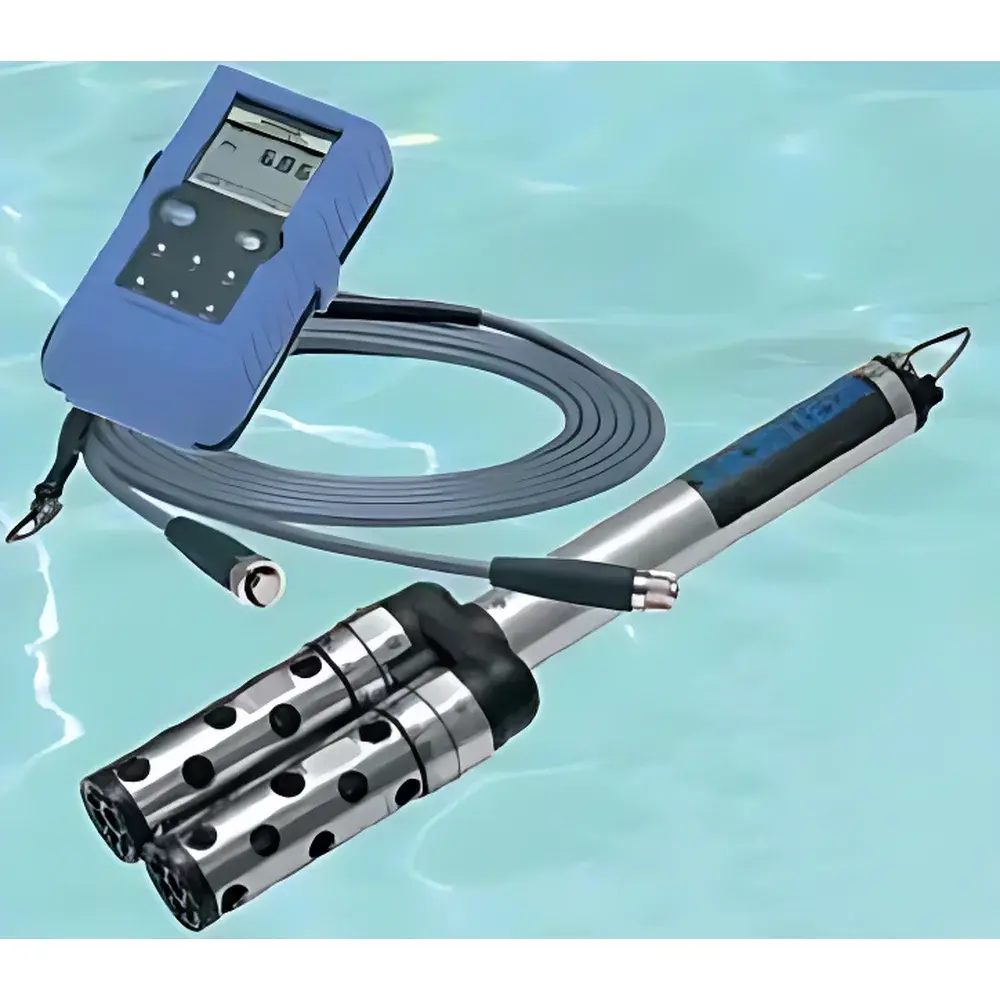
HORIBA W-20XD Series Multi-Parameter In-Situ Water Quality Monitoring System
| Brand | HORIBA |
|---|---|
| Origin | Japan |
| Model | W-20XD Series |
| Instrument Type | In-Line / Submersible Water Quality Analyzer |
| Operating Depth | Up to 100 m |
| Data Logging Duration | 30 days (2880 records, 15-min interval) |
| IP Rating | IP67 (Control Unit) |
| Measurement Parameters | Up to 13 simultaneous parameters including pH, DO, EC, Salinity, TDS, Seawater Specific Gravity (δt), Turbidity, Depth, Temperature, ORP, and optional ion-selective electrodes (NO₃⁻, Cl⁻, Ca²⁺, F⁻, K⁺, NH₃) |
Overview
The HORIBA W-20XD Series is a rugged, submersible multi-parameter water quality monitoring system engineered for long-term, unattended in-situ deployment in challenging aquatic environments. Designed around a modular architecture with a waterproof control unit (IP67) and pressure-rated sensor probes, the system operates on the principle of electrochemical, optical, and physical transduction—employing glass electrode potentiometry for pH, membrane-covered galvanic cell detection for dissolved oxygen, AC four-electrode conductivity measurement for electrical conductivity and derived parameters (salinity, TDS, seawater specific gravity), nephelometric turbidity detection via transmitted light scattering, platinum redox electrode for ORP, thermistor-based temperature sensing, piezoresistive pressure transduction for depth, and solid-state ion-selective electrodes for targeted anion/cation quantification. Its core application domain spans regulatory environmental monitoring, hydrological research, aquaculture management, industrial effluent compliance tracking, and watershed assessment—particularly where extended autonomous operation, high-pressure tolerance (up to 100 m H₂O), and metrological traceability are required.
Key Features
- Autonomous 30-day data logging at user-configurable intervals (minimum 15 minutes), storing up to 2880 complete parameter sets internally without external power or communication infrastructure.
- Submersible probe rated for continuous operation at depths up to 100 meters, featuring reinforced housing and newly developed pressure-compensated electrodes with stable calibration retention under hydrostatic load.
- Integrated automatic temperature compensation across all applicable parameters (pH, DO, EC, salinity, TDS, δt, ORP), eliminating manual correction during post-processing.
- Modular probe configuration: base W-22XD supports 10 parameters; upgraded W-23XD expands capability to 13 parameters—including optional ion-selective electrodes for NO₃⁻, Cl⁻, Ca²⁺, F⁻, K⁺, and NH₃—each with configurable measurement ranges and pH-dependent operational windows.
- Field-deployable design: probe can be submerged independently (no tethered cable required during measurement phase); data retrieval and configuration performed via secure wired interface or optional wireless telemetry module.
- Onboard auto-calibration routines for pH (two-point) and conductivity (automatic range switching), reducing field maintenance frequency and operator dependency.
Sample Compatibility & Compliance
The W-20XD Series is validated for use in freshwater, brackish water, seawater, groundwater, wastewater, and agricultural runoff. Its sensor materials—including chemically resistant PEEK housings, platinum and glass electrodes, and silicone membranes—are selected to minimize biofouling and chemical interference. The system adheres to fundamental measurement principles referenced in ISO 7888 (conductivity), ISO 5814 (dissolved oxygen), ASTM D1293 (pH), ASTM D3370 (turbidity), and USP (particulate matter in water for pharmaceutical use). While not pre-certified for EPA Method compliance out-of-box, its measurement methodologies align with EPA-approved techniques for ambient water monitoring (e.g., EPA 150.1 for conductivity, EPA 360.1 for DO). Data integrity supports GLP/GMP-aligned workflows through timestamped, non-erasable internal storage and optional audit-trail-enabled software export.
Software & Data Management
Data retrieval is performed via HORIBA’s proprietary PC-based configuration and analysis software, supporting CSV, Excel, and XML export formats compatible with LIMS integration. The software enables spectral visualization of time-series trends, statistical summaries (min/max/mean/std dev), alarm threshold setting per parameter, and calibration history logging. All stored records include UTC timestamps, probe ID, and sensor status flags (e.g., membrane saturation, electrode drift warning). For remote applications, optional GSM or LoRaWAN telemetry modules enable encrypted periodic data push to cloud-hosted dashboards—fully compliant with IEC 62443-3-3 for industrial cybersecurity. Raw sensor outputs (mV, Ω, mA) are accessible for third-party algorithm development, satisfying requirements for method validation under ISO/IEC 17025.
Applications
- Long-term limnological studies in lakes, reservoirs, and rivers—tracking diel and seasonal variations in eutrophication indicators (DO, pH, turbidity, nutrients).
- Oceanographic profiling and coastal zone monitoring, especially for salinity intrusion mapping and δt-based density stratification analysis.
- Regulatory compliance monitoring at wastewater discharge points, requiring concurrent measurement of pH, ORP, EC, and targeted ions (e.g., NO₃⁻ in agricultural runoff).
- Aquaculture site management—real-time feedback on dissolved oxygen saturation, temperature stress, and ammonia toxicity thresholds (NH₃, not NH₄⁺).
- Groundwater quality assessment in contaminated sites, leveraging redox potential (ORP) as a proxy for biogeochemical activity and electron acceptor availability.
- Calibration reference deployments for satellite-derived water quality products (e.g., turbidity, chlorophyll-a proxies) via co-located in-situ ground truthing.
FAQ
What is the maximum operating depth for the W-20XD probe?
The probe is rated for continuous submersion up to 100 meters water column (1 MPa hydrostatic pressure), with pressure-compensated sensor elements ensuring measurement stability across the full depth range.
Does the system support remote data transmission?
Yes—while standard operation uses local USB or RS-232 retrieval, optional GSM, LTE-M, or LoRaWAN telemetry modules enable encrypted over-the-air data transfer to secure cloud platforms.
Can ion measurements be performed simultaneously with core parameters?
Yes—the W-23XD configuration supports concurrent acquisition of up to 13 parameters, including up to six ion-selective measurements alongside pH, DO, EC, temperature, turbidity, depth, ORP, salinity, TDS, and seawater specific gravity.
Is the system suitable for drinking water compliance reporting?
It meets technical requirements for many parameters cited in WHO Guidelines for Drinking-water Quality and EU Directive 98/83/EC (e.g., pH, turbidity, conductivity, temperature), though formal accreditation requires site-specific validation per ISO/IEC 17025.
How often does the system require recalibration in field use?
Under stable conditions, pH and conductivity calibrations are recommended every 30 days; DO membrane replacement every 6–12 months depending on fouling exposure; ion electrodes typically retain accuracy for 3–6 months before reconditioning or recalibration.







