
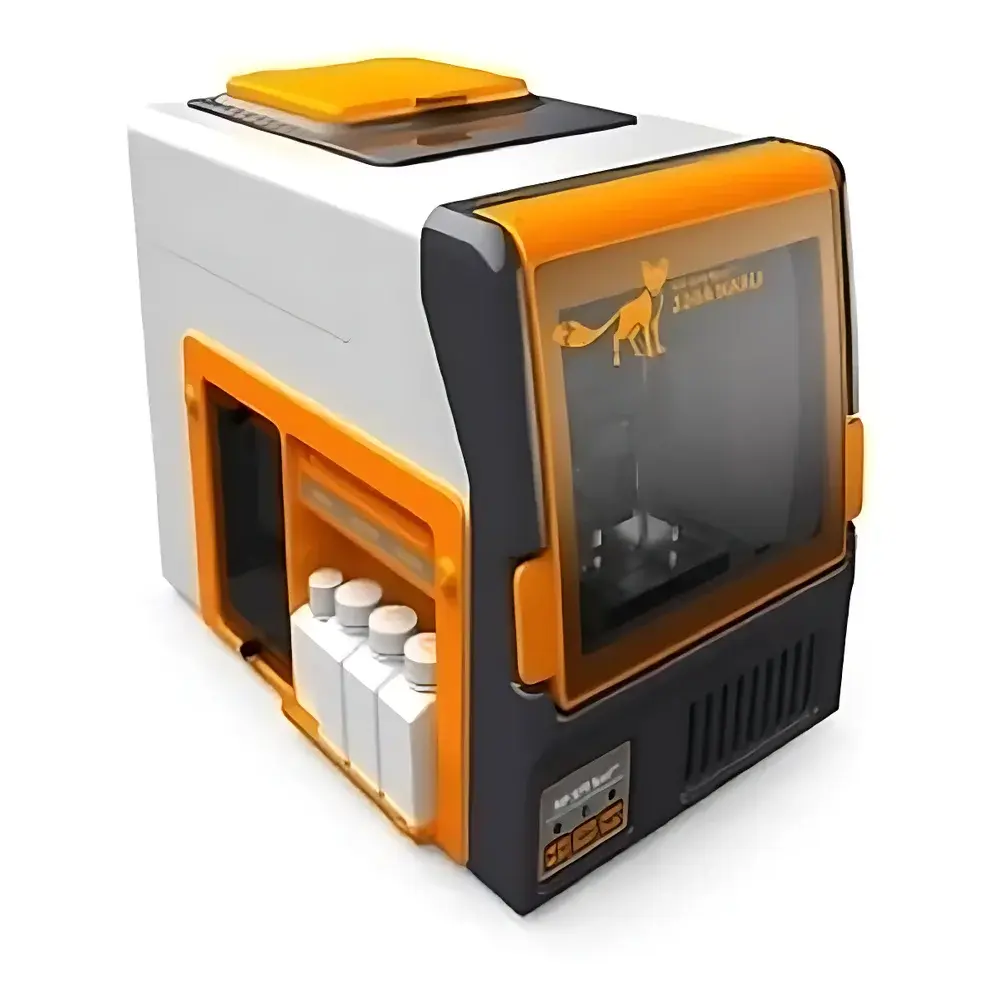
Bionavis MP-SPR Navi 220A NAALI Multi-Parameter Surface Plasmon Resonance Analyzer
| Brand | Bionavis |
|---|---|
| Origin | Finland |
| Model | MP-SPR Navi 220A NAALI |
| Sample Volume | 250 µL |
| Injection Volume | 50 µL |
| Analysis Time | 5–10 min |
| Temperature Control Range | 15 °C–45 °C (ambient ±7 °C / +20 °C) |
| Angular Scan Range | 40°–78° |
| Angular Resolution | 0.001° |
| Laser Wavelengths | 670 nm (standard), optional dual-wavelength (670 nm + 785 nm) |
| Refractive Index Range | 1.00–1.40 (bulk), extendable for high-RI materials (e.g., diamond-like carbon, n ≈ 2.7) |
| Flow Rate | 1–1000 µL/min |
| Sensitivity | 1 µRIU (refractive index unit), 1 pg/mm² (protein surface coverage) |
| Kinetic Range | kₐ = 10³–10⁸ M⁻¹s⁻¹, k = 10⁻⁷–0.1 s⁻¹, K_D = 10⁻¹²–10⁻³ M |
| Detection Limit | <100 Da (liquid phase), H₂ (2 Da, gas phase) |
| Noise | Short-term ≤0.3 µRIU, Drift <1 µRIU/min |
| Flow Channels | 2 independent, switchable in series or parallel |
| Sensor Chip Compatibility | Au, Ag, Cu, Pt, SiO₂, Al₂O₃, TiO₂, CMD, Ni²⁺, custom functionalized surfaces |
| Flow Cell Options | PDMS (1 µL/channel), PEEK (SPR305-MS), electrochemical (SPR321-EC), gas-phase (SPR310-GS), fast-kinetics (SPR302-LS), or custom |
Overview
The Bionavis MP-SPR Navi 220A NAALI is a multi-parameter surface plasmon resonance (MP-SPR) analyzer engineered for label-free, real-time molecular interaction analysis across complex biological and material interfaces. Unlike conventional angular-interrogation SPR systems—limited to narrow angular windows near the resonance dip—the MP-SPR Navi 220A employs true angular scanning over a broad range (40°–78°) with sub-millidegree resolution (0.001°), enabling acquisition of full SPR reflectance curves. This capability permits simultaneous quantification of multiple interfacial parameters—including thickness, refractive index, and dielectric constant—without assumptions about layer homogeneity or optical model constraints. The instrument operates on a rotating laser and detector architecture, eliminating the need for prism coupling oils and enabling rapid sensor chip exchange via integrated prism modules with index-matching gel. Its dual-wavelength option (670 nm + 785 nm) further extends analytical utility by decoupling thickness and refractive index contributions in multilayer systems, supporting characterization of high-refractive-index films such as diamond-like carbon (n ≈ 2.7) or inorganic crystals.
Key Features
- True angular scanning SPR with 40°–78° range and 0.001° resolution—enabling full curve acquisition and model-free parameter extraction
- Dual-laser configuration (670 nm standard; optional 785 nm) for simultaneous thickness and refractive index determination
- Two independently controlled microfluidic channels with programmable serial/parallel injection modes and flow rates from 1 to 1000 µL/min
- Integrated degassing unit and precision syringe pumps ensure stable baseline and reproducible mass transport conditions
- Low sample consumption: minimum injection volume 50 µL; partial-loop injection reduces total sample requirement to ≤100 µL per assay
- Temperature-controlled measurement chamber (15 °C–45 °C) with ±0.1 °C stability for thermodynamic and kinetic profiling
- Modular flow cell design: interchangeable PDMS (1 µL/channel), chemically resistant PEEK, electrochemical, gas-phase, or fast-kinetics configurations
- Universal sensor compatibility: supports bare and functionalized metal (Au, Ag, Pt), oxide (SiO₂, TiO₂, Al₂O₃), and polymer surfaces; no gold-coated prisms required
Sample Compatibility & Compliance
The MP-SPR Navi 220A accommodates diverse sample matrices without signal interference or matrix-induced artifacts. It enables direct kinetic measurements in undiluted biological fluids—including 100% human serum, urine, and saliva—thanks to PureKinetics™ algorithmic correction for bulk refractive index shifts arising from buffer composition, DMSO content (up to 5%), or viscosity gradients. Measurements are validated under physiologically relevant conditions and comply with GLP/GMP-aligned data integrity standards: all raw angular scans, time-stamped metadata, and instrument logs are stored with audit-trail functionality compatible with FDA 21 CFR Part 11 requirements. The system supports ISO 9001-certified manufacturing workflows and meets ASTM E2554 guidelines for quantitative surface binding analysis. Sensor chips are disposable and sterilizable, ensuring cross-contamination avoidance during high-throughput screening.
Software & Data Management
The MP-SPR Navi™ Control software provides full instrument orchestration—including automated 96-well plate handling, gradient elution programming, and temperature ramping—with intuitive graphical workflow design. Raw angular scan data are processed in real time using TraceDrawer™ for robust global fitting of association/dissociation kinetics (kₐ, k , KD) and heterogeneity modeling. LayerSolver™ (optional add-on) enables rigorous optical modeling of multilayer architectures using Fresnel formalism, supporting quantitative film thickness and density estimation for polymeric, lipid, or protein-based coatings. All software modules generate PDF reports compliant with ALPAC and ICH M10 standards, including uncertainty propagation and residual analysis. Data files adhere to HDF5 format for long-term archival and third-party interoperability (e.g., Python-based analysis pipelines, MATLAB integration).
Applications
- Therapeutic Antibody Characterization: Quantification of affinity and on/off rates for IgG, bispecifics, and antibody-drug conjugates directly in serum-containing media, bypassing purification artifacts
- Nanoparticle–Biomolecule Interactions: Real-time monitoring of protein corona formation on liposomes, polymeric NPs, and metallic colloids in physiological buffers
- Biosensor Development: Optimization of recognition layer density, orientation, and stability on glass, silicon, or flexible polymer substrates for point-of-care diagnostics
- Biomaterial–Cell Interface Studies: Label-free tracking of extracellular matrix protein adsorption, conformational changes, and integrin-mediated adhesion on hydrogels and biodegradable scaffolds
- Small-Molecule Drug Screening: Detection of low-MW binders (<100 Da) to membrane proteins reconstituted in supported lipid bilayers or nanodiscs
- Gas-Phase & Electrochemical SPR: Coupled operation with SPR310-GS or SPR321-EC flow cells for catalytic surface reaction monitoring and redox-dependent binding studies
FAQ
Does the MP-SPR Navi 220A require gold-coated prisms or index-matching oil?
No. It uses a gel-coupled prism module enabling rapid, contamination-free sensor exchange without optical oils or costly consumables.
Can it measure interactions in organic solvents like acetonitrile or ethanol?
Yes. The system is validated for aqueous, polar organic, and mixed solvent environments—including full angular scans across gas–liquid transitions.
How does PureKinetics™ improve data accuracy in complex matrices?
It dynamically corrects for bulk RI drift caused by DMSO, glycerol, or serum components—enabling reliable kinetics even at 5% DMSO or 100% serum.
Is the instrument compatible with regulatory submissions (e.g., FDA, EMA)?
Yes. Software includes electronic signatures, audit trails, and raw-data export in HDF5 format—fully aligned with 21 CFR Part 11 and Annex 11 requirements.
What is the minimum detectable molecular weight in liquid phase?
The system resolves binding events for analytes down to <100 Da, with demonstrated sensitivity for small-molecule inhibitors and metabolites.




