
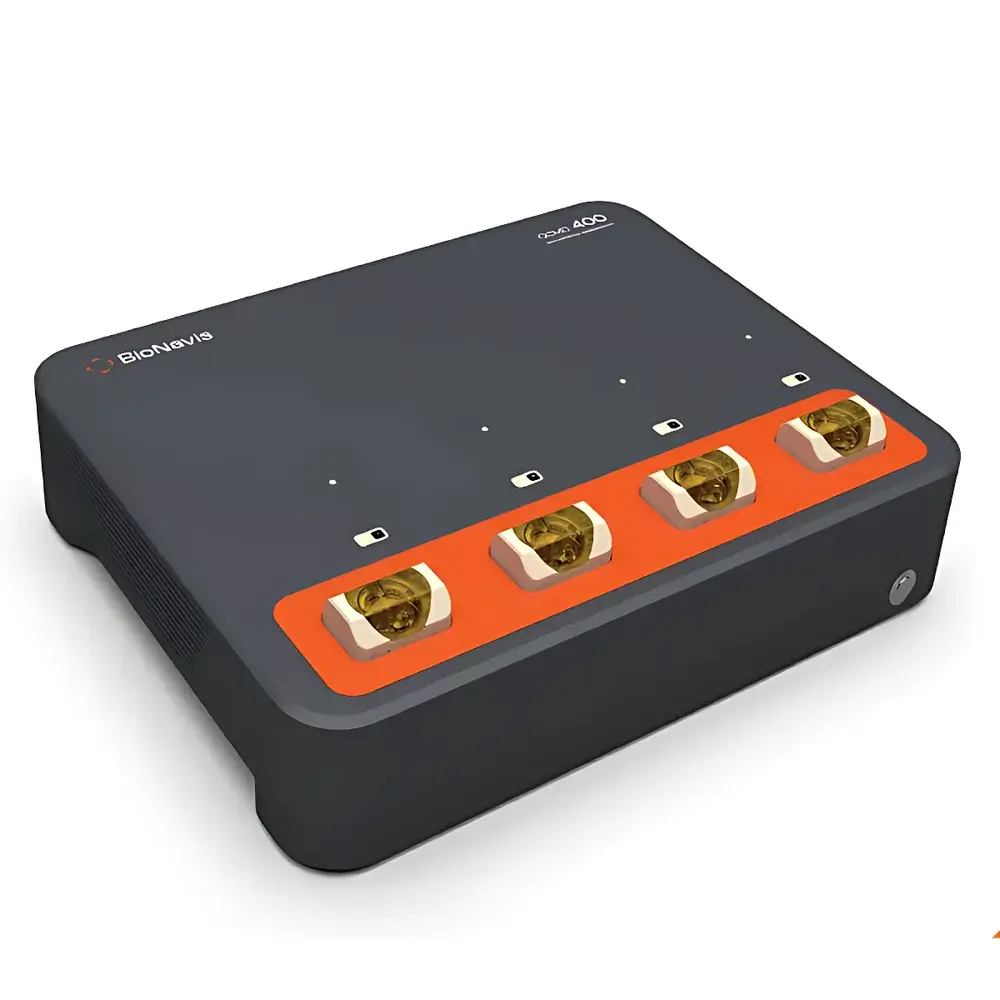
BioNavis QCMD 400 Quartz Crystal Microbalance with Dissipation Monitoring
| Brand | BioNavis |
|---|---|
| Origin | Finland |
| Model | QCMD 400 |
| Temperature Range | 15–45 °C |
| Frequency Range | 4–160 MHz |
Overview
The BioNavis QCMD 400 is a high-performance, four-channel Quartz Crystal Microbalance with Dissipation monitoring (QCM-D) system engineered for real-time, label-free analysis of interfacial mass changes and viscoelastic properties at solid–liquid, solid–gas, or solid–air interfaces. Based on the piezoelectric resonance principle, the instrument measures shifts in the fundamental and higher-order harmonic frequencies (Δfn) and corresponding energy dissipation (ΔDn) of AT-cut quartz sensors upon mass adsorption, film formation, or structural rearrangement. Unlike conventional single-frequency QCM, the QCMD 400 operates across a broad frequency spectrum (4–160 MHz), enabling multi-harmonic analysis that significantly enhances sensitivity, depth resolution, and quantitative modeling of soft, hydrated layers—particularly critical in biological, polymeric, and electrochemical systems. Its robust thermal control (15–45 °C) ensures stable operation under physiologically relevant or industrially variable conditions, supporting reproducible measurements compliant with GLP-aligned laboratory practices.
Key Features
- Four independent measurement channels for parallel, time-synchronized experiments—ideal for comparative studies across surface chemistries, buffer conditions, temperature gradients, or pH regimes.
- Multi-harmonic QCM-D capability up to the 13th overtone (at 160 MHz), delivering simultaneous Δf and ΔD data for rigorous viscoelastic modeling using established formalisms (e.g., Voigt-based fitting, Sauerbrey approximation, and coupled acoustic-electrical models).
- Integrated precision syringe pump with programmable flow rates (0.01–1000 µL/min) and low-dead-volume fluidic paths compatible with aqueous, organic, and corrosive electrolytes.
- QuickLock flow cell design enables rapid sensor exchange (<30 s) without disassembly—minimizing downtime and contamination risk during high-throughput screening.
- Thermally stabilized sensor stage with ±0.1 °C accuracy over the full 15–45 °C operating range, supporting kinetic studies under controlled physiological or process-relevant temperatures.
- Modular architecture allowing seamless integration with external instrumentation (e.g., potentiostats, UV-Vis spectrophotometers, or AFM stages) for correlative electrochemical, optical, or nanomechanical characterization.
Sample Compatibility & Compliance
The QCMD 400 accommodates standard 5 MHz and high-frequency quartz sensors (e.g., 10, 25, and 50 MHz), including gold-coated, silicon oxide, aluminum oxide, and custom functionalized variants (e.g., COOH-, NH2-, or biotin-terminated surfaces). It supports liquid-phase measurements in buffered saline, organic solvents, ionic liquids, and aggressive electrolytes (e.g., H2SO4, NaOH), as well as gas- and air-phase analyses for thin-film deposition or environmental sensing. All hardware and firmware comply with CE marking requirements. Data acquisition and storage meet audit-trail readiness standards aligned with FDA 21 CFR Part 11 for electronic records and signatures—enabling traceability, user access control, and immutable event logging essential for regulated environments (e.g., pharmaceutical development, medical device coating validation, or battery material qualification per ISO 17025).
Software & Data Management
The QCMD Control Suite provides intuitive experiment setup, real-time visualization of f/D trends, and automated baseline correction. Raw harmonic data are exported in ASCII or HDF5 format for third-party analysis (MATLAB, Python, Origin). Built-in modeling tools support Sauerbrey mass calculation, Voigt-layer fitting, and multi-parameter optimization of thickness, shear modulus, and viscosity. Audit logs record operator ID, timestamp, parameter settings, and calibration events—fully exportable for internal QA review or regulatory submission. Software updates follow a documented change-control process, and version history is retained per ISO/IEC 17025 clause 7.7.
Applications
- Biomedical Materials: Quantification of protein adsorption kinetics, cell adhesion dynamics, hydrogel swelling behavior, and antimicrobial coating efficacy—supporting ISO 10993-compliant biocompatibility assessment.
- Electrode–Electrolyte Interfaces: In situ monitoring of SEI layer growth, lithium-ion intercalation, polymer electrode degradation, and corrosion inhibition in fuel cells and solid-state batteries.
- Surface Science & Coatings: Real-time evaluation of ALD/MLD film growth, anti-fouling polymer grafting, corrosion inhibitor adsorption on carbon steel or stainless steel, and solvent-induced swelling in protective coatings.
- Petroleum & Reservoir Engineering: Wettability assessment of rock analogs, surfactant adsorption isotherms on mineral surfaces, and asphaltene deposition kinetics under reservoir-relevant T/P conditions.
- Biosensor Development: Label-free affinity ranking of antibody–antigen pairs, DNA hybridization efficiency, aptamer–target binding, and competitive inhibition assays—compatible with microfluidic integration per ISO 22196.
- Cleaning & Formulation Science: Mechanistic evaluation of detergent–soil interaction, enzyme-mediated biofilm removal, and anti-redeposition polymer performance on stainless steel or polymer substrates.
FAQ
What sensor frequencies are supported by the QCMD 400?
The system supports fundamental frequencies from 4 MHz to 160 MHz, covering standard 5 MHz crystals through high-overtone configurations (e.g., 10, 25, 50, and 100 MHz sensors) with full harmonic tracking up to n = 13.
Can the QCMD 400 operate in non-aqueous environments?
Yes—it is fully compatible with organic solvents (e.g., ethanol, DMF, THF), ionic liquids, and acidic/basic electrolytes, provided appropriate sensor coatings and wetted materials (e.g., PTFE, Kalrez, and Hastelloy) are selected.
Is the software compliant with 21 CFR Part 11 requirements?
The QCMD Control Suite includes electronic signature capability, role-based access control, and tamper-evident audit trails—designed to support compliance in regulated laboratories conducting GxP work.
How does temperature control impact measurement reproducibility?
Precise thermal stabilization (±0.1 °C) minimizes drift in resonant frequency and dissipation baselines, ensuring high inter-run reproducibility—critical for long-duration kinetic studies or comparative screening across multiple days.
Can I integrate the QCMD 400 with an electrochemical workstation?
Yes—the system provides TTL synchronization signals and analog voltage outputs for external triggering, enabling synchronized QCM-D and voltammetric measurements (e.g., cyclic voltammetry, EIS) on the same electrode surface.




