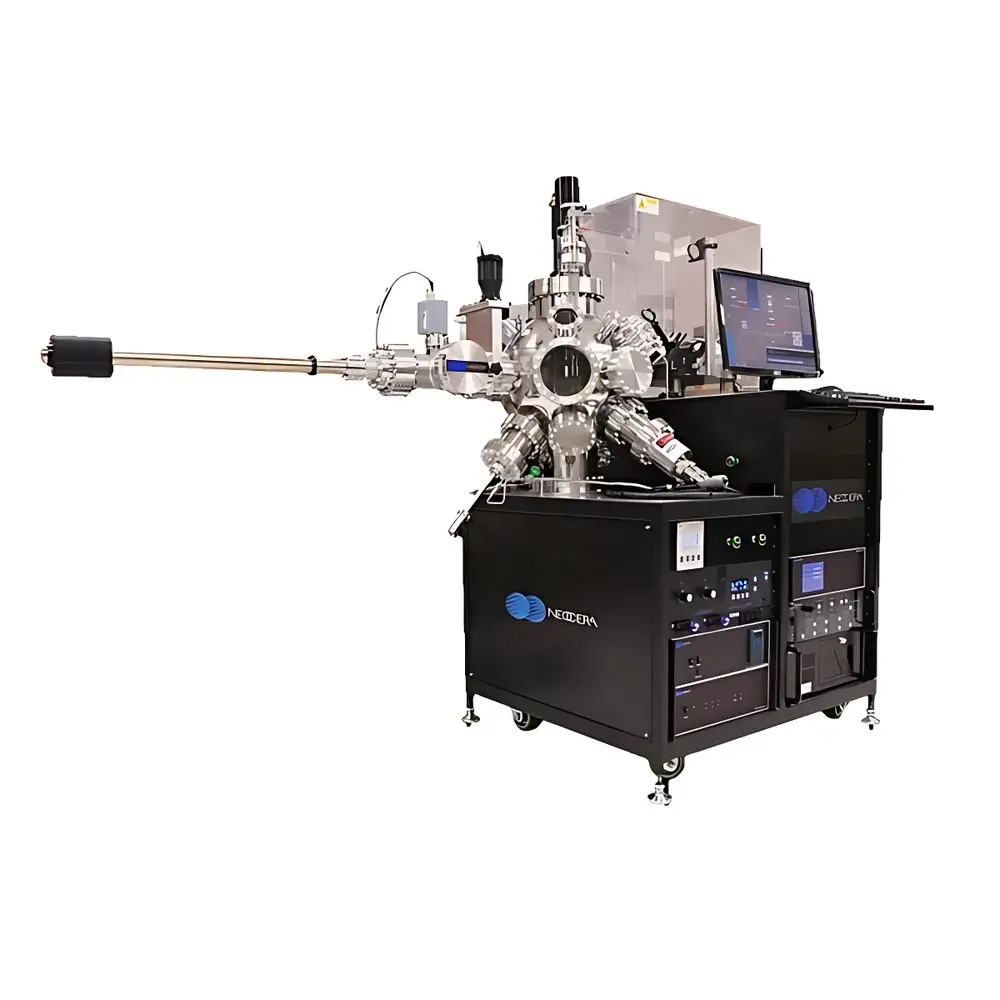
Combinatorial PLD System by Neocera
| Brand | Neocera |
|---|---|
| Origin | USA |
| Model | Combinatorial PLD System |
| System Type | Turnkey Pulsed Laser Deposition Platform with Continuous Composition Spread (CCS-PLD) Capability |
| Substrate Compatibility | 2-inch wafers (4-inch and 6-inch available on request) |
| Operating Environment | Up to 800 °C, up to 500 mTorr O₂ partial pressure |
| Deposition Mode | Standard PLD + CCS-PLD (Continuous Composition Spread) |
| Target Configuration | Multi-target carousel for binary/ternary/quaternary combinatorial synthesis |
| Film Architecture Support | Epitaxial thin films, multilayer heterostructures, superlattices |
| Oxygen Compatibility | Fully compatible with reactive oxygen ambient for metal oxide epitaxy |
| Post-deposition Annealing | Not required due to in-situ compositional grading and kinetic control |
| Maskless Operation | Enabled by angular deposition gradient and laser fluence modulation |
| Layer Resolution | Sub-monolayer precision per pulse cycle |
| Compliance | Designed for GLP-compliant thin-film R&D environments |
Overview
The Combinatorial PLD System by Neocera is a fully integrated, turnkey pulsed laser deposition platform engineered for high-throughput materials discovery and optimization of functional thin-film systems. It implements Continuous Composition Spread (CCS-PLD), a physically grounded combinatorial synthesis technique that exploits the natural cosn(θ) angular dependence of ablation plume flux (where n = 5–11) to generate smooth, monotonic composition gradients across a single substrate during one uninterrupted deposition run. Unlike discrete library approaches requiring multiple masks or sequential depositions, CCS-PLD achieves continuous variation in stoichiometry—across binary, ternary, or quaternary systems—without mechanical shadowing or post-deposition thermal diffusion. This enables direct correlation between local composition and functional properties (e.g., Tc, dielectric constant, bandgap, catalytic activity) under identical growth conditions—temperature, oxygen partial pressure, laser fluence, and background gas—thereby eliminating batch-to-batch variability and accelerating phase diagram mapping.
Key Features
- Integrated dual-mode operation: seamless switching between conventional single-target PLD and CCS-PLD modes via software-controlled target positioning and laser scanning logic
- Multi-target carousel supporting ≥4 independently cooled and electrically isolated targets, enabling precise stoichiometric tuning through synchronized ablation timing and angular offset calibration
- In-situ temperature control up to 800 °C with radiative heating and thermocouple feedback, certified for sustained operation under 500 mTorr O₂—critical for epitaxial growth of complex oxides (e.g., cuprates, manganites, perovskites)
- Sub-monolayer deposition resolution achieved via pulse-by-pulse fluence modulation and real-time plume monitoring (optional ICCD-integrated diagnostics)
- Maskless composition engineering: eliminates alignment errors, shadowing artifacts, and interfacial contamination associated with physical masks or shadow masks
- Robust vacuum architecture: all-metal UHV-compatible chamber (base pressure <5×10⁻⁹ Torr), ISO-K flanged ports, bake-out capability, and differential pumping for oxygen-rich processes
Sample Compatibility & Compliance
The system accommodates standard 2-inch substrates (Si, SrTiO₃, LaAlO₃, MgO, sapphire, SiC); 4-inch and 6-inch configurations are available with custom substrate heater and manipulator design. Substrate rotation and tilting are programmable to enhance compositional uniformity and mitigate plume shadowing effects. All wetted components—including target holders, shield plates, and sample stage—are fabricated from oxygen-compatible alloys (e.g., Inconel 718, TZM molybdenum) and passivated to prevent cross-contamination during multi-target runs. The platform meets ASTM F1529-22 requirements for thin-film deposition reproducibility and is routinely deployed in laboratories adhering to ISO/IEC 17025 and GLP frameworks. Optional 21 CFR Part 11–compliant software provides electronic signatures, audit trails, and role-based access control for regulated oxide electronics development.
Software & Data Management
Neocera’s proprietary PLD Control Suite v4.x provides deterministic, script-driven automation of deposition sequences—including multi-step CCS ramps, layer-stacked heterostructures, and periodic superlattice construction. Real-time parameter logging (laser energy, chamber pressure, substrate temperature, target position, pulse count) is stored in HDF5 format with metadata-enriched headers compliant with FAIR data principles. Integrated Python API enables coupling with machine learning pipelines for autonomous composition–property inference. Process recipes are version-controlled and exportable for inter-laboratory protocol transfer. Optional add-ons include in-situ RHEED interface integration and time-resolved plume imaging synchronization.
Applications
- Rapid phase diagram exploration of transition-metal oxides, chalcogenides, and nitrides
- Optimization of critical parameters in high-Tc superconductors, ferroelectric tunnel junctions, and memristive oxides
- Growth of lattice-matched heterostructures for 2D quantum materials (e.g., LaAlO₃/SrTiO₃ interfaces)
- Development of compositionally graded buffer layers for III–V/Si integration
- Screening of dopant solubility limits and defect chemistry under controlled oxygen activity
- Fabrication of catalyst libraries for electrochemical CO₂ reduction or water splitting
FAQ
What distinguishes CCS-PLD from conventional combinatorial PLD approaches?
CCS-PLD leverages intrinsic plume angular distribution rather than mechanical masking or sequential deposition, enabling true continuous gradients without interfacial discontinuities or thermal history differences.
Can the system deposit insulating or highly resistive targets reliably?
Yes—the system includes RF-compensated target biasing and plasma-assisted ignition protocols optimized for dielectric and wide-bandgap targets (e.g., Al₂O₃, HfO₂, LiNbO₃).
Is in-situ surface analysis (e.g., XPS, AES) supported?
The chamber features six CF-63 viewports and two load-lock–compatible transfer ports, enabling integration with UHV surface science tools without breaking base vacuum.
How is composition calibration validated?
Neocera provides traceable reference standards and supports quantitative EDX/TEM-EELS cross-section analysis; users may employ in-house XRD rocking curve asymmetry or RBS channeling for absolute stoichiometry verification.
What maintenance intervals are recommended for high-oxygen operation?
Target shields and chamber liners require inspection every 200 hours of O₂-rich operation; full gasket replacement and vacuum bake-out are scheduled at 1,000-hour intervals per ISO 27001-aligned lab SOPs.