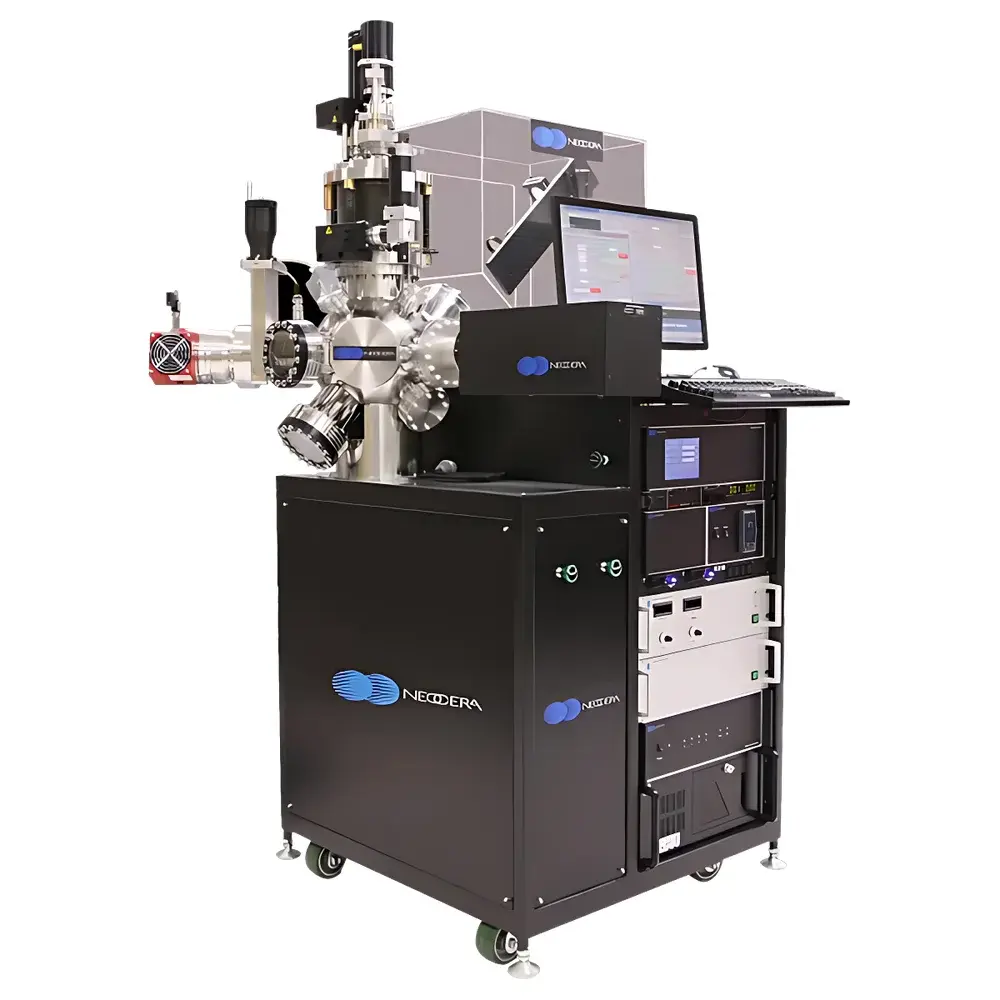
Neocera Pioneer 120 Advanced PLD System
| Brand | Neocera |
|---|---|
| Origin | USA |
| Manufacturer Type | Authorized Distributor |
| Origin Category | Imported |
| Model | Pioneer 120 Advanced PLD System |
| Substrate Heating | Up to 850°C, Radiant Heater, O₂-Compatible |
| Substrate Size | 10 mm × 10 mm to 2-inch diameter |
| Vacuum Base Pressure | ≤5×10⁻⁹ Torr |
| Chamber Diameter | 12 inches |
| Target Capacity | 6×1″ or 3×2″ targets |
| Turbo Pump Speed | 260 L/s (software-controlled) |
| In-situ Diagnostics | RHEED-compatible |
| Load Lock | Optional |
| Software Platform | Windows 7 + LabVIEW 2013 |
Overview
The Neocera Pioneer 120 Advanced PLD System is a high-vacuum, turnkey pulsed laser deposition platform engineered for the reproducible growth of epitaxial thin films, complex multilayer heterostructures, and artificial superlattices—particularly in oxide, nitride, and chalcogenide material systems. Unlike conventional conductive-heated PLD configurations, this system employs a fully isolated radiant heating stage, enabling true oxygen compatibility up to 1 atm (760 Torr) during both deposition and post-deposition annealing. This capability is critical for stoichiometric oxide epitaxy—where precise oxygen partial pressure control, thermal stability under oxidizing conditions, and controlled cooldown in ambient oxygen are essential to suppress cation volatility and maintain lattice integrity. The substrate stage rotates continuously through 360° without mechanical coupling to the heater, eliminating torque-induced misalignment and ensuring uniform film thickness and crystallinity across the entire wafer area. Integrated with ultra-high vacuum (UHV) architecture (base pressure ≤5×10⁻⁹ Torr), the system supports seamless integration with complementary UHV tools—including sputtering modules, molecular beam epitaxy (MBE) sources, and surface science analytical chambers (e.g., XPS, ARPES, LEED)—via standardized CF-63 or CF-100 transfer interfaces.
Key Features
- Radiant substrate heater operating up to 850°C, fully decoupled from rotation mechanism and compatible with O₂ partial pressures up to 760 Torr
- Motorized 6-position target carousel with individual target rotation, rastering, and software-selectable positioning for multilayer and superlattice synthesis
- Closed-loop process pressure control using mass flow controllers (MFCs) and capacitance manometers, supporting dynamic gas switching between inert and reactive environments
- UHV-compatible chamber (12″ diameter) constructed from 304 stainless steel with all-metal seals and bake-out capability to 150°C
- Integrated turbo-molecular pump (260 L/s) backed by a dry scroll pump, achieving base pressure ≤5×10⁻⁹ Torr without oil contamination
- Full LabVIEW 2013-based automation: synchronized control of laser trigger timing, shutter actuation, heater ramp/soak profiles, target selection, and pressure regulation
- Modular design supporting optional load-lock integration, RF/DC sputter sources, ion-beam assisted deposition (IBAD), and high-pressure RHEED configuration
Sample Compatibility & Compliance
The Pioneer 120 Advanced PLD accommodates substrates ranging from small single-crystal chips (10 mm × 10 mm) to full 2-inch wafers, including insulating (e.g., SrTiO₃, LaAlO₃), semiconducting (Si, GaAs), and metallic (Nb, YBCO) platforms. All wetted materials—including heater elements, thermocouple sheaths, and gas lines—are selected for oxygen stability and low outgassing (per ASTM E1557–21). The system complies with ISO 27401:2021 for UHV cleanliness and meets GLP/GMP documentation requirements when configured with audit-trail-enabled LabVIEW logging (21 CFR Part 11 compliant add-on available). Vacuum interlocks, overtemperature cutoffs, and laser safety interlocks conform to IEC 60825-1:2014 Class 4 laser enclosure standards.
Software & Data Management
Control is executed via a dedicated Windows 7 host PC running custom LabVIEW 2013 applications. The software provides hierarchical access levels (operator, engineer, administrator), timestamped parameter logging at 100 Hz resolution, and export to CSV or HDF5 formats. Process recipes—including laser fluence, repetition rate, substrate temperature ramp rates, MFC setpoints, and shutter sequences—are stored with version control and checksum validation. Optional data acquisition modules support real-time RHEED intensity monitoring with FFT-based oscillation analysis for layer-by-layer growth tracking. All system states (pump status, valve positions, heater voltage/current, pressure transients) are archived with SHA-256 hash integrity verification for regulatory traceability.
Applications
- Growth of high-Tc cuprate superconductors (e.g., YBa₂Cu₃O₇₋δ) requiring precise oxygen stoichiometry control during deposition and cooling
- Epitaxial ferroelectric oxides (Pb(Zr,Ti)O₃, BiFeO₃) where volatile Pb and Bi loss must be minimized under elevated pO₂
- Complex perovskite heterostructures (e.g., La₀.₇Sr₀.₃MnO₃/SrTiO₃) for interface-driven emergent phenomena
- Nitride-based quantum wells (AlN/GaN) leveraging in-situ RHEED for surface reconstruction monitoring
- Integration into UHV cluster tools for combinatorial synthesis followed by immediate surface-sensitive characterization (XPS, ARPES, STM)
FAQ
Is the radiant heater compatible with ozone or NO₂ atmospheres?
Yes—the heater assembly and thermocouple feedthroughs are rated for continuous operation in O₂, O₃, and NO₂ up to 1 atm, provided gas purity meets ASTM D6167 specifications.
Can the system be upgraded to include a load-lock chamber?
Yes—Neocera offers factory-installed CF-63 load-lock modules with integrated cryo-shielding and independent pumping, enabling batch processing without breaking main chamber vacuum.
What laser specifications are required for optimal performance?
The system is optimized for excimer (KrF, 248 nm) or solid-state (Nd:YAG, 266/355 nm) lasers delivering 1–10 J/cm² fluence at 1–10 Hz; laser alignment ports and beam path shielding are pre-configured.
Does the software support remote monitoring via Ethernet?
Yes—LabVIEW Real-Time modules enable secure web-based status viewing and limited parameter adjustment via HTTPS, compliant with IEEE 802.1X network authentication.
Are calibration certificates provided for pressure and temperature sensors?
All capacitance manometers and calibrated Type-S thermocouples ship with NIST-traceable calibration reports valid for 12 months.