
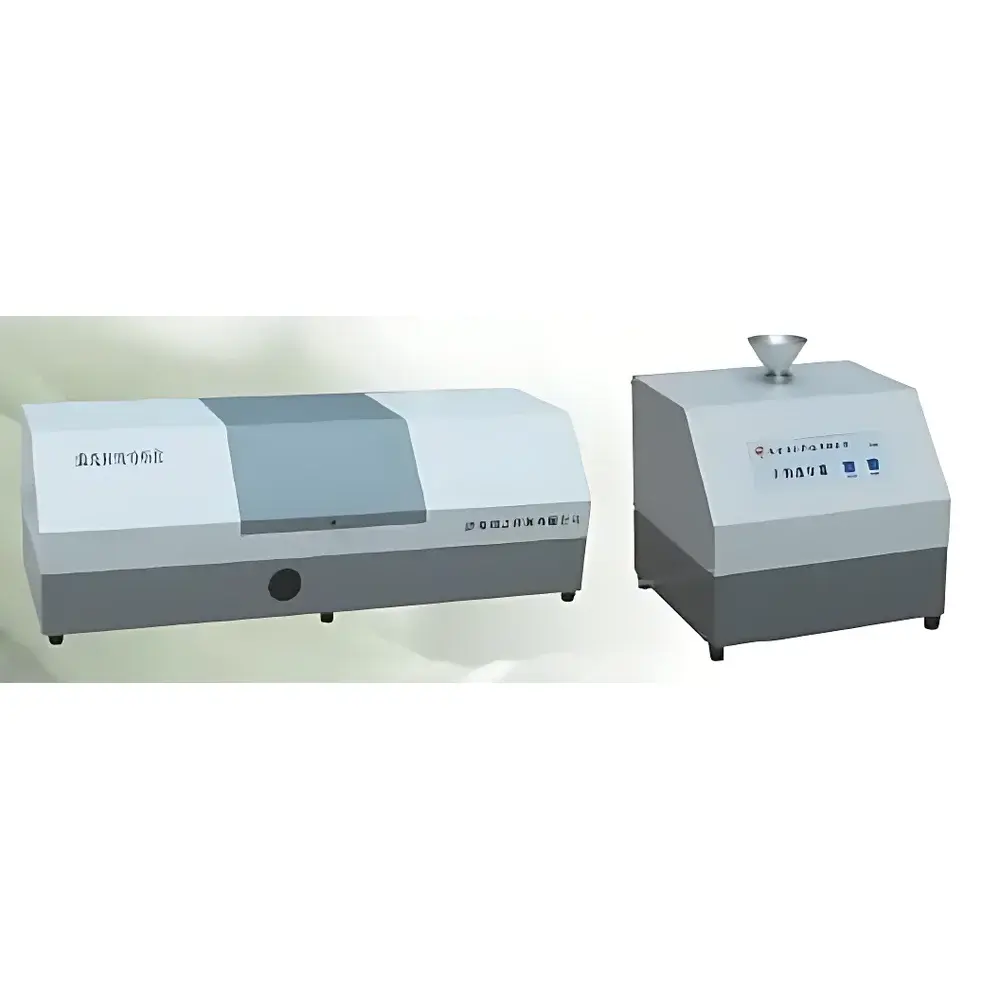
Rise-2012 Dry-Dispersion Laser Diffraction Particle Size Analyzer
| Origin | Beijing, China |
|---|---|
| Manufacturer Type | Authorized Distributor |
| Origin Category | Domestic (PRC) |
| Model | Rise-2012 |
| Price Range | USD 0–14,500 |
| Dispersion Method | Dry dispersion only |
| Measurement Range | 0.1–600 µm |
| Repeatability | < ±1% (D50 of NIST-traceable standard reference material) |
| Measurement Time | ≤10 seconds per run |
Overview
The Rise-2012 Dry-Dispersion Laser Diffraction Particle Size Analyzer is an industrial-grade instrument engineered for rapid, high-fidelity particle size distribution (PSD) characterization of free-flowing dry powders. It operates on first-principles Mie scattering theory—fully accounting for particle refractive index, absorption coefficient, and dispersant optical properties—to deliver mathematically rigorous inversion of angular light intensity data into volumetric PSD. Unlike simplified Fraunhofer approximations, Mie-based analysis ensures metrological validity across the full 0.1–600 µm range, particularly critical for sub-10 µm particles and polydisperse systems where optical diffraction assumptions break down. The system employs a single, fixed-focus Fourier optical configuration with no moving parts or manual alignment—eliminating drift-related calibration loss and enabling long-term measurement stability. Its He–Ne laser source (λ = 632.8 nm) provides exceptional temporal coherence and power stability (>25,000 h rated lifetime), forming the foundation for reproducible signal acquisition under ISO 13320-compliant measurement conditions.
Key Features
- Non-uniform, cross-dimensional 3D扇-shaped (fan-shaped) photodetector array with up to 90° maximum detection angle—optimized for high-resolution backscatter capture and robust small-particle sensitivity
- Integrated dry dispersion module featuring automated powder feeder, oil-free silent air compressor (≤45 dB(A)), and high-efficiency refrigerated air dryer—ensuring contaminant-free, consistent aerosol generation without solvents or surfactants
- Real-time dispersion validation: instantaneous jet velocity profiling and pressure monitoring confirm turbulent flow regime prior to laser interrogation zone
- Single-optic-path, fixed-focus Fourier design—no lens swapping or alignment required; eliminates inter-run variability from mechanical recalibration
- Robust mechanical architecture compliant with Q/01RZ01–2004 manufacturing standards; no consumable optics or fragile alignment mechanisms
- Compact footprint (950 × 330 × 300 mm) and low power draw (200 W @ 220 VAC, 50 Hz) suitable for QC labs and production environments
Sample Compatibility & Compliance
The Rise-2012 is validated for use with non-cohesive, thermally stable, non-volatile dry powders—including metal oxides, pharmaceutical actives, catalysts, ceramics, toners, and mineral fillers. It excludes samples prone to electrostatic agglomeration, hygroscopicity, or mechanical degradation under pneumatic shear. For regulatory compliance, the system supports audit-ready operation under GLP and GMP frameworks: raw intensity data, detector voltage logs, and environmental metadata (temperature, pressure, flow rate) are timestamped and stored with each measurement. While not FDA 21 CFR Part 11–certified out-of-the-box, its PADMAS software architecture permits integration with validated electronic lab notebook (ELN) platforms via CSV/Excel export and configurable metadata tagging. All measurements adhere to ISO 13320:2020 (Particle size analysis — Laser diffraction methods) and ASTM E2979–21 (Standard Guide for Laser Diffraction Particle Size Analysis of Powders).
Software & Data Management
PADMAS (Particle Diameter Measurement & Analysis System) is a Windows-based analytical suite offering full traceability and post-processing flexibility. It performs unconstrained inverse Mie fitting—requiring no a priori distribution assumptions—thereby preserving true multimodal structure in complex samples. Default classification comprises 130 size channels from 0.02–2000 µm; users may define custom binning (1–130 channels) aligned with process specifications or industry standards (e.g., ASTM C136 sieve equivalents). Output includes D10, D50, D90, span, specific surface area (volume- and mass-based), Rosin–Rammler parameters, and differential/cumulative distributions. Reports export natively to Excel (.xlsx), PDF, PNG, and EMF formats; header/footer fields are editable, and preview mode enables real-time layout verification. Batch processing, statistical comparison across runs, and trend charting support routine quality control and SPC implementation.
Applications
- Pharmaceutical solid dosage development: excipient grading, API crystallization monitoring, blend uniformity assessment
- Advanced materials R&D: nanoparticle aggregation state analysis, sintering feedstock qualification, battery cathode/anode powder specification
- Quality assurance in ceramics & abrasives: raw material acceptance testing, kiln feed consistency control, final product release criteria
- Environmental particulate studies: airborne dust characterization, soil texture analysis (sand/silt/clay fractions)
- Industrial catalyst manufacturing: pore structure inference via PSD-derived surface area, attrition resistance correlation
FAQ
Does the Rise-2012 support wet dispersion?
No—this model is exclusively configured for dry dispersion. A separate wet-module variant (Rise-2012W) is available for liquid-suspended samples.
What reference materials are recommended for daily verification?
NIST SRM 1963 (silica, ~100 µm), SRM 1979 (alumina, ~10 µm), and GBW(E)130109 (Chinese national standard, D50 ≈ 45 µm) are routinely used for repeatability and accuracy checks.
Is the detector array user-serviceable?
The photodetector module is factory-calibrated and sealed; field replacement requires return-to-factory service to maintain optical alignment integrity and Mie inversion fidelity.
Can PADMAS generate 21 CFR Part 11–compliant audit trails?
Out-of-the-box functionality includes full operator log, timestamped raw data, and version-stamped reports—but formal Part 11 validation requires site-specific IQ/OQ documentation and integration with a qualified ELN or LIMS.
What maintenance intervals are specified?
Compressor air filter replacement every 500 operating hours; annual verification of laser power output and detector dark-current baseline; no optical cleaning required under normal ambient lab conditions.
Related Products



