
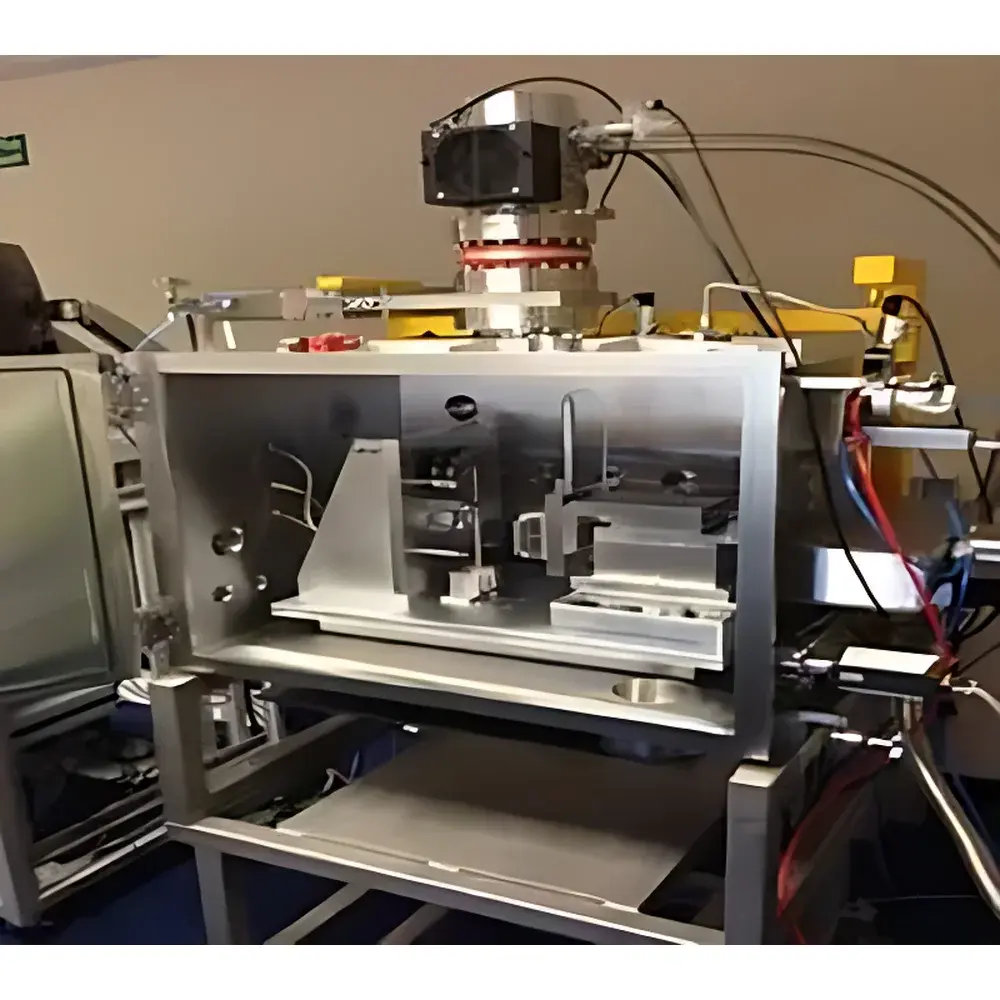
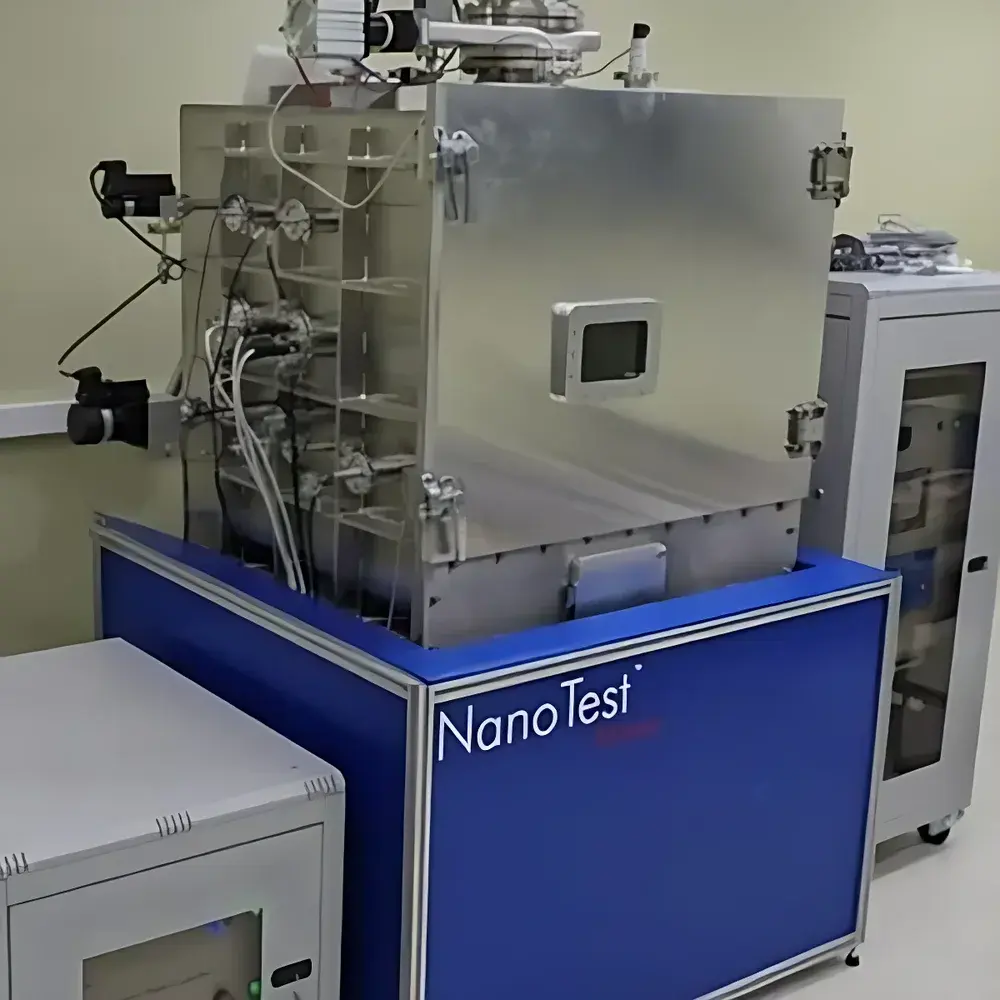
Micro Materials NanoTest Xtreme Nanoindentation and Scratch Testing System
| Brand | Micro Materials |
|---|---|
| Origin | United Kingdom |
| Model | Xtreme |
| Instrument Type | Nanoindentation and Scratch Tester |
| Displacement Resolution | 0.002 nm |
| Indenter Types | Diamond, Boron Nitride, Sapphire |
| Thermal Drift | < 0.005 nm/s |
| Vacuum Level | 10⁻⁷ mbar |
| Temperature Range (Vacuum) | −40 °C to 1000 °C |
| Load Frame | Electromagnetic Actuation |
| Load Resolution | 3 nN |
| Repeatability Accuracy | < 0.4 µm |
| Compliance | ISO 14577, ASTM E2546 |
Overview
The Micro Materials NanoTest Xtreme is a high-precision, ultra-stable nano-mechanical testing platform engineered for quantitative mechanical characterization under extreme environmental conditions—including high vacuum, cryogenic temperatures down to −40 °C, and elevated temperatures up to 1000 °C. Built upon over three decades of innovation in nanomechanics since the company’s founding in 1988, the Xtreme system implements a rigorously validated electromagnetic loading architecture coupled with capacitive displacement sensing to deliver sub-picometer resolution and exceptional thermal stability. Its core measurement principle relies on controlled quasi-static and dynamic force–displacement response acquisition during nanoindentation, nanoscratch, nano-wear, nano-impact, and fretting tests—enabling extraction of hardness, elastic modulus, fracture toughness, adhesion energy, coefficient of friction, and time-dependent viscoelastic parameters. Unlike conventional ambient or inert-gas systems, the Xtreme integrates a fully bakeable, high-vacuum chamber (base pressure ≤10⁻⁷ mbar) that eliminates surface oxidation, moisture condensation, and hydrocarbon contamination—critical for studying thermally activated deformation mechanisms, radiation-damaged interfaces, or low-temperature embrittlement phenomena.
Key Features
- Electromagnetic actuation with dual-load capability: standard 500 mN head (rated to 1000 °C in vacuum) and optional 30 N high-force head (rated to 800 °C in vacuum)
- Capacitive displacement sensor delivering 0.002 nm resolution and < 0.005 nm/s thermal drift—achieved through symmetric thermal design and active stabilization of the load frame
- Integrated high-vacuum-compatible heating/cooling stage with ±0.1 °C temperature uniformity across a 16 mm × 16 mm sample area
- Full compatibility with all standard nanomechanical test modes under vacuum: nanoindentation, nanoscratch, nano-wear, nano-impact, and nanofretting
- Optional SPM-grade XYZ nanopositioning stage (100 µm × 100 µm scan range, 2 nm positioning accuracy) for correlative topographic imaging and site-specific testing
- High-magnification optical microscope with motorized focus and digital image capture for real-time indenter alignment and post-test defect analysis
- Gas-fill option enabling controlled partial-pressure environments (e.g., H₂, He, Ar) to replicate operational service conditions
Sample Compatibility & Compliance
The NanoTest Xtreme accommodates a broad spectrum of solid materials—including metallic alloys, ceramic coatings, semiconductor thin films, polymer composites, biomaterials, and nuclear-grade cladding layers—without requiring conductive coating or vacuum-specific sample preparation. Sample handling supports manual positioning, grid-based automated indentation arrays, and multi-sample holders for high-throughput screening. All mechanical data acquisition and reporting conform to international metrological standards: ISO 14577 (Metallic materials — Instrumented indentation test for hardness and materials parameters) and ASTM E2546 (Standard Test Method for Instrumented Indentation Testing). The system architecture supports GLP/GMP-compliant operation via audit-trail-enabled software logging, electronic signatures, and full traceability of calibration records—aligning with FDA 21 CFR Part 11 requirements for regulated laboratories.
Software & Data Management
Control and analysis are performed using the proprietary NanoTest Analysis Suite—a modular, Windows-based application built for scientific reproducibility and regulatory readiness. The software provides real-time visualization of load–displacement curves, automatic tip-area function calibration (Oliver–Pharr, Doerner–Nix), depth-sensing correction algorithms, and statistical post-processing for modulus/hardness mapping. All raw data files are stored in open-format HDF5 containers with embedded metadata (test parameters, environmental conditions, calibration history), ensuring long-term archival integrity and third-party interoperability. Export options include CSV, MATLAB (.mat), and standardized XML schemas compliant with MIAME/MINSEQ guidelines for materials informatics integration.
Applications
The NanoTest Xtreme addresses mission-critical challenges in advanced materials R&D and quality assurance across multiple high-tech sectors. In aerospace engineering, it quantifies creep resistance and interfacial delamination in thermal barrier coatings subjected to turbine-relevant thermal cycling. In nuclear materials science, it evaluates irradiation-induced hardening gradients in oxide-dispersion-strengthened steels under simulated reactor coolant atmospheres. For semiconductor manufacturing, it measures residual stress and adhesion strength of low-k dielectrics and Cu interconnects at process-relevant temperatures. In biomedical device development, it characterizes fatigue-driven wear evolution in orthopedic implant coatings under physiological humidity and load profiles. Additional application domains include MEMS reliability assessment, photovoltaic absorber layer mechanical robustness, and hydrogen embrittlement susceptibility mapping in pipeline steels.
FAQ
What vacuum level is required to achieve stable −40 °C testing without frost formation?
A base pressure of ≤10⁻⁶ mbar is sufficient; the system’s integrated cryo-shielding and cold trap prevent water vapor condensation on the indenter and sample surface.
Can the same indenter be used across the full −40 °C to 1000 °C range?
Yes—diamond, boron nitride, and sapphire indenters are qualified for use throughout the entire temperature range under vacuum, with certified thermal expansion compensation applied in software.
Is the system compatible with in situ SEM or synchrotron X-ray diffraction?
The compact, non-magnetic aluminum frame and modular vacuum flange design support integration into custom in situ chambers; external synchronization signals (TTL triggers, analog voltage outputs) enable precise temporal alignment with external detectors.
How is thermal drift corrected during long-duration creep or relaxation tests?
Drift correction uses a dual-sensor methodology: real-time monitoring of frame temperature gradients combined with iterative baseline subtraction from displacement data, validated per ISO 14577 Annex D.
Does the system support automated calibration routines per ISO 14577?
Yes—the software includes guided workflows for tip geometry verification, load-frame compliance determination, and displacement sensor linearity validation using NIST-traceable reference standards.



