
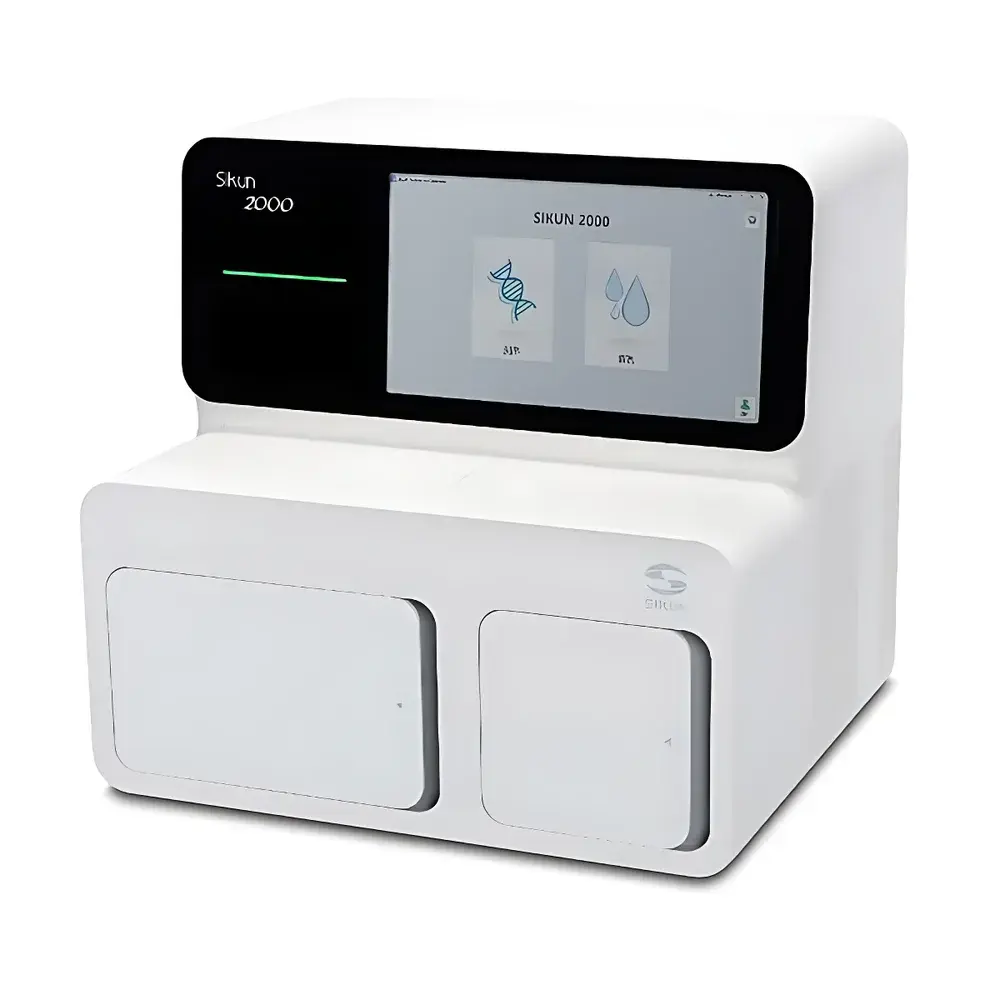
Autobio Sikun2000 Next-Generation Gene Sequencer
| Brand | Autobio |
|---|---|
| Model | Sikun2000 |
| Instrument Type | Second-Generation Sequencing Platform |
| Regulatory Status | CE-IVDR and NMPA-Certified In Vitro Diagnostic Device |
| Form Factor | Benchtop Sequencer |
| Read Length Range | 50–300 bp |
| Data Quality | Q30 ≥ 85%–90% |
| Accuracy | >99.9% Base Call Accuracy (per-cycle consensus) |
| Run Time | As fast as 3.2 hours (dependent on read length and chip configuration) |
| Throughput | Mid-Throughput Chip: 220 million reads (11–66 Gb) |
| High-Throughput Chip | 660 million reads (33–200 Gb) |
| Chemistry | Surface-Based Bridge Amplification with Reversible Dye-Terminator Fluorescence Detection |
| Compliance | Designed and validated per ISO 13485, IEC 62304, and aligned with FDA 21 CFR Part 820 and EU IVDR Annex I essential requirements |
Overview
The Autobio Sikun2000 is a CE-IVDR and NMPA-certified benchtop next-generation sequencing (NGS) platform engineered for clinical diagnostics and translational research laboratories requiring high-fidelity, rapid-turnaround nucleic acid analysis. It employs a surface-based bridge amplification chemistry coupled with reversible dye-terminator fluorescence detection — a proven second-generation sequencing paradigm that enables highly parallel, clonal cluster generation directly on proprietary flow cell substrates. Each sequencing cycle captures optical signals from incorporated nucleotides via high-sensitivity sCMOS imaging, followed by real-time base calling using optimized probabilistic algorithms trained on extensive empirical calibration datasets. This architecture delivers robust reproducibility across runs, low inter-run coefficient of variation (<3.5% for Q30 yield), and stringent control over phasing/pre-phasing errors — critical for diagnostic-grade variant detection in heterogeneous clinical samples.
Key Features
- Rapid Turnaround Time: Achieves full sequencing runs in as little as 3.2 hours for targeted panels (e.g., 50 bp single-read), enabling same-day reporting in time-sensitive clinical workflows such as prenatal screening or oncology triage.
- Clinical-Grade Accuracy: Delivers >99.9% per-base accuracy under standard operating conditions, validated against reference materials including GIAB benchmarks and orthogonal platforms (e.g., Sanger, PacBio HiFi). Q30 scores consistently exceed 85–90%, supporting confident low-frequency variant calling down to 1% VAF in duplex-aware modes.
- Flexible Throughput Architecture: Supports two interchangeable flow cell formats — a mid-throughput chip (220 M clusters, 11–66 Gb output) and a high-throughput chip (660 M clusters, 33–200 Gb output) — allowing labs to scale sequencing capacity without hardware reconfiguration.
- Diagnostics-Ready Compliance: Manufactured under ISO 13485 quality management systems; software includes audit trail, electronic signature, and user role-based access control compliant with FDA 21 CFR Part 11 and EU IVDR Annex II documentation requirements.
- Integrated QC & Run Monitoring: Real-time metrics dashboard tracks cluster density, pass-filter rate, phasing, and Q-score distribution during sequencing — enabling proactive intervention before run completion.
Sample Compatibility & Compliance
The Sikun2000 accepts standard Illumina-compatible library preparations, including PCR-amplified, hybrid-capture, and amplicon-based libraries (e.g., TruSight, SureSelect, or custom panels). Input requirements range from 1–500 ng of double-stranded DNA, with optional integrated library quantification modules supporting fluorometric and qPCR-based normalization. All assays performed on the platform are validated per CLIA-equivalent internal protocols and align with relevant international standards: ASTM E3125-18 (for NGS assay validation), ISO/IEC 17025:2017 (testing laboratory competence), and USP (NGS-based IVD performance criteria). The instrument itself bears Class B medical device classification under China’s NMPA and meets essential safety and performance requirements outlined in EU IVDR Annex I.
Software & Data Management
The SikunControl Suite v3.x provides end-to-end workflow management — from cluster generation and image acquisition to base calling, alignment (BWA-MEM), and variant annotation (using ANNOVAR and local databases). Raw data (BCL files) and processed outputs (FASTQ, BAM, VCF) are stored in encrypted, timestamped archives with SHA-256 integrity verification. The system supports HL7/FHIR-compliant result export and integrates natively with LIMS platforms via RESTful API. Audit logs record all user actions, parameter changes, and software updates, satisfying GLP/GMP traceability mandates. Data retention policies are configurable per institutional policy, with optional integration into on-premise or HIPAA-compliant cloud storage environments.
Applications
- Reproductive Genetics: Non-invasive prenatal testing (NIPT) for aneuploidy and microdeletions; preimplantation genetic testing for monogenic disorders (PGT-M) and structural rearrangements (PGT-SR); copy number variation (CNV) profiling in developmental delay cohorts.
- Oncology Diagnostics: Comprehensive genomic profiling for therapy selection (e.g., EGFR, ALK, BRAF, KRAS); minimal residual disease (MRD) monitoring via tumor-informed ctDNA assays; HLA typing for transplant compatibility and immunotherapy eligibility assessment.
- Infectious Disease Testing: Metagenomic next-generation sequencing (mNGS) for unbiased pathogen detection in CSF, BAL, and blood; targeted enrichment panels for antimicrobial resistance (AMR) gene detection and strain-level identification of bacteria, viruses, and fungi.
FAQ
Is the Sikun2000 approved for clinical diagnostic use in the EU and China?
Yes — it holds CE-IVDR certification (Class B) and NMPA registration as an in vitro diagnostic medical device for specific oncology, reproductive, and infectious disease applications.
What library preparation kits are compatible with the Sikun2000?
The platform accepts any Illumina-compatible library prep kit meeting standard adapter specifications (e.g., TruSeq, Nextera XT, KAPA HyperPrep). Autobio also offers validated proprietary kits optimized for low-input and FFPE-derived DNA.
Does the system support dual indexing and unique molecular identifiers (UMIs)?
Yes — both dual-indexing (i7/i5) and UMI-based error correction modes are enabled in the base-calling pipeline, improving sensitivity for low-abundance variants.
Can raw data be exported for third-party bioinformatics analysis?
Absolutely — BCL, FASTQ, and BAM files are fully exportable via secure SFTP or USB 3.2 interface, retaining original metadata and QC flags.
What is the recommended maintenance schedule?
Autobio recommends quarterly preventive maintenance by certified field service engineers, including fluidics calibration, optical alignment verification, and thermal cycler validation per ISO/IEC 17025 guidelines.



