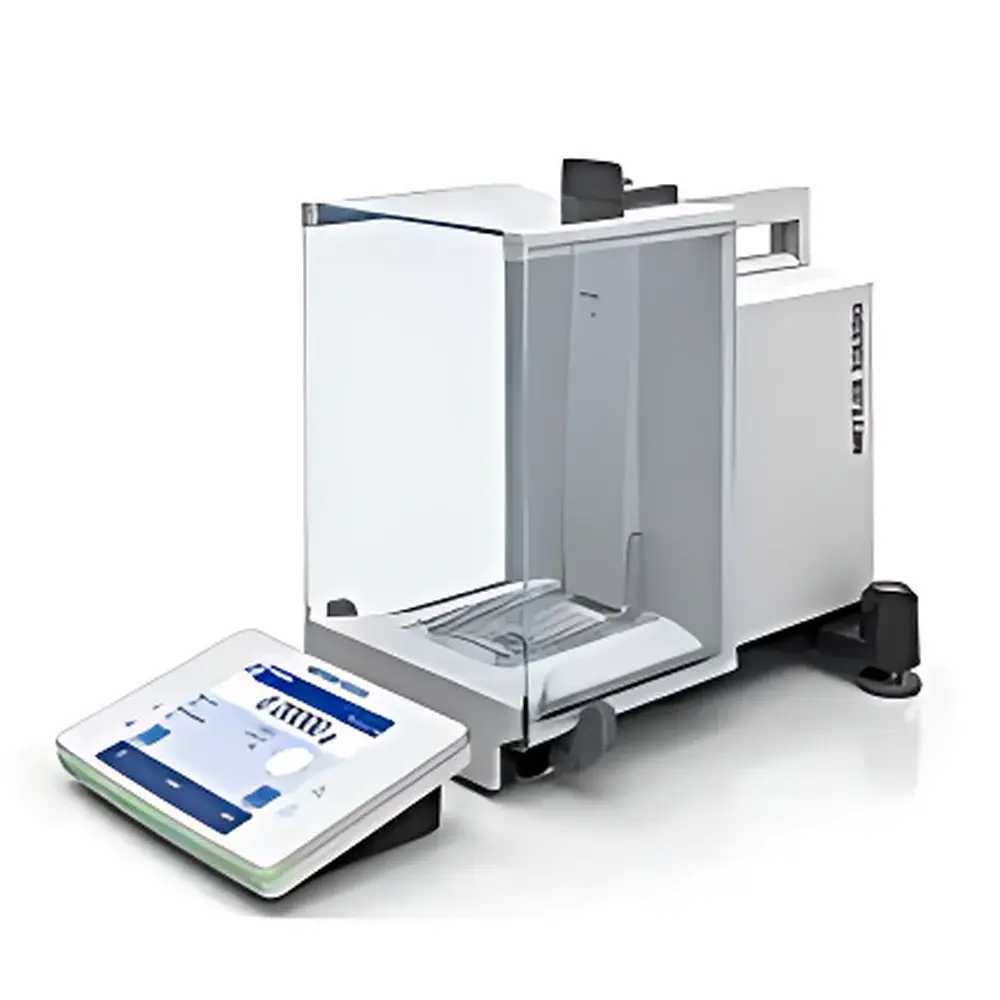
METTLER TOLEDO XSE105DU Analytical Balance
| Brand | METTLER TOLEDO |
|---|---|
| Origin | Switzerland |
| Model | XSE105DU |
| Instrument Type | Analytical Balance |
| Maximum Capacity | 41.0 g / 120.0 g (dual-range) |
| Readability | 0.01 mg / 0.1 mg (dual-resolution) |
| Minimum Weight (USP <41> typical) | 20.0 mg |
| Repeatability | 0.02 mg |
| Calibration | Internal automatic calibration with FACT (Fully Automatic Calibration Technology) |
| Construction | Swiss-engineered monolithic weighing cell, draft shield with ergonomic sliding doors, integrated level control system |
Overview
The METTLER TOLEDO XSE105DU Analytical Balance is a high-precision laboratory instrument engineered for demanding quantitative analysis in regulated and research-intensive environments. Built upon METTLER TOLEDO’s proprietary monolithic weighing cell architecture, it delivers exceptional stability, low drift, and high reproducibility under variable ambient conditions—including minor temperature fluctuations and air currents. Its dual-range capability (41.0 g / 0.01 mg and 120.0 g / 0.1 mg) enables seamless transition between ultra-micro and standard analytical workflows without compromising traceability or compliance. Designed and manufactured in Switzerland, the XSE105DU adheres to stringent ISO 9001 quality management standards and incorporates metrological features aligned with USP , EP 2.1.6, and ASTM E898–22 for balance performance verification.
Key Features
- StatusLight™ visual feedback system: A color-coded LED ring provides real-time, at-a-glance confirmation of operational readiness—green indicates stable leveling, completed internal calibration, and environmental suitability for measurement.
- FACT (Fully Automatic Calibration Technology): Integrated motorized internal calibration mass ensures drift-compensated recalibration triggered by time, temperature change (≥1.5 °C), or user-defined schedule—fully compliant with GLP/GMP documentation requirements.
- Ergonomic SmartGrid™ weighing pan: Precision-machined stainless-steel grid structure minimizes electrostatic interference and improves sample containment while enabling rapid cleaning and residue removal.
- StaticDetect™ technology: Real-time monitoring and active neutralization of electrostatic charge on samples and containers—critical for low-mass, high-surface-area materials such as powders, polymers, and lyophilized substances.
- Modular connectivity: Standard RS232, USB device/host, and Ethernet interfaces support direct integration with LIMS, ELN, and LabX® software; optional Bluetooth module available for wireless data transmission.
- LevelControl™ system: Integrated inclinometer with audible/visual alerts ensures consistent horizontal alignment—required for NIST-traceable mass measurements and essential for regulatory audit readiness.
Sample Compatibility & Compliance
The XSE105DU accommodates a wide range of sample formats—from micro-vials and filter papers to crucibles and weighing boats—thanks to its spacious draft shield (W × D × H: 210 × 170 × 230 mm) with low-resistance sliding doors and optimized airflow design. All internal surfaces are corrosion-resistant and compatible with common solvents used in pharmaceutical QC, academic synthesis, and materials science labs. The balance meets electromagnetic compatibility (EMC) per IEC 61326-1, safety standards per IEC 61010-1, and is certified for use in Class I, Division 2 hazardous locations when equipped with optional explosion-proof enclosure kits. Routine performance testing (e.g., repeatability, eccentricity, linearity) can be executed via TestManager™ software—generating PDF reports with electronic signatures and timestamped audit trails compliant with FDA 21 CFR Part 11.
Software & Data Management
LabX® software transforms the XSE105DU into a fully traceable, workflow-driven instrument. Users define step-by-step SOPs—including tare sequences, statistical calculations (e.g., % recovery, RSD), and pass/fail criteria—with embedded prompts and contextual help. All raw data, metadata (operator ID, timestamp, environment logs), and digital signatures are stored in an encrypted SQL database. LabX supports role-based access control, electronic record retention policies, and automated report generation for internal audits or regulatory submissions. For standalone operation, the built-in method library stores up to 99 user-defined procedures with customizable field labels and unit conversions.
Applications
- Pharmaceutical formulation development and stability testing (e.g., assay determination, content uniformity per USP )
- Reference standard preparation and dilution series in analytical chemistry labs
- Gravimetric analysis for elemental quantification (e.g., sulfate ash, loss on drying)
- Quality control of catalysts, nanomaterials, and battery electrode coatings
- Calibration of pipettes and volumetric glassware using gravimetric methods (ISO/IEC 17025)
- Research-scale synthesis where sub-0.1 mg mass resolution impacts reaction stoichiometry and yield prediction
FAQ
Does the XSE105DU support Good Manufacturing Practice (GMP) documentation requirements?
Yes—it provides full audit trail functionality, electronic signatures, and automated calibration/test records compatible with Annex 11 and ALCOA+ principles.
Can the balance be validated according to IQ/OQ/PQ protocols?
Absolutely. METTLER TOLEDO supplies documented validation templates, test scripts, and URS-aligned qualification packages for both factory and site acceptance testing.
Is external calibration required if FACT is enabled?
Internal FACT calibration satisfies routine performance verification; however, periodic external calibration using NIST-traceable weights remains mandatory for ISO/IEC 17025 accreditation.
What is the minimum weight threshold for reliable measurement per USP ?
The typical minimum weight is 20.0 mg at 0.01 mg readability—verified using standard deviation-based calculation per USP general chapter.
How does StaticDetect™ differ from conventional ionizers?
Unlike passive ionizers, StaticDetect™ continuously monitors surface potential and activates targeted neutralization only when charge exceeds ±0.5 kV—reducing ozone generation and extending component lifetime.