
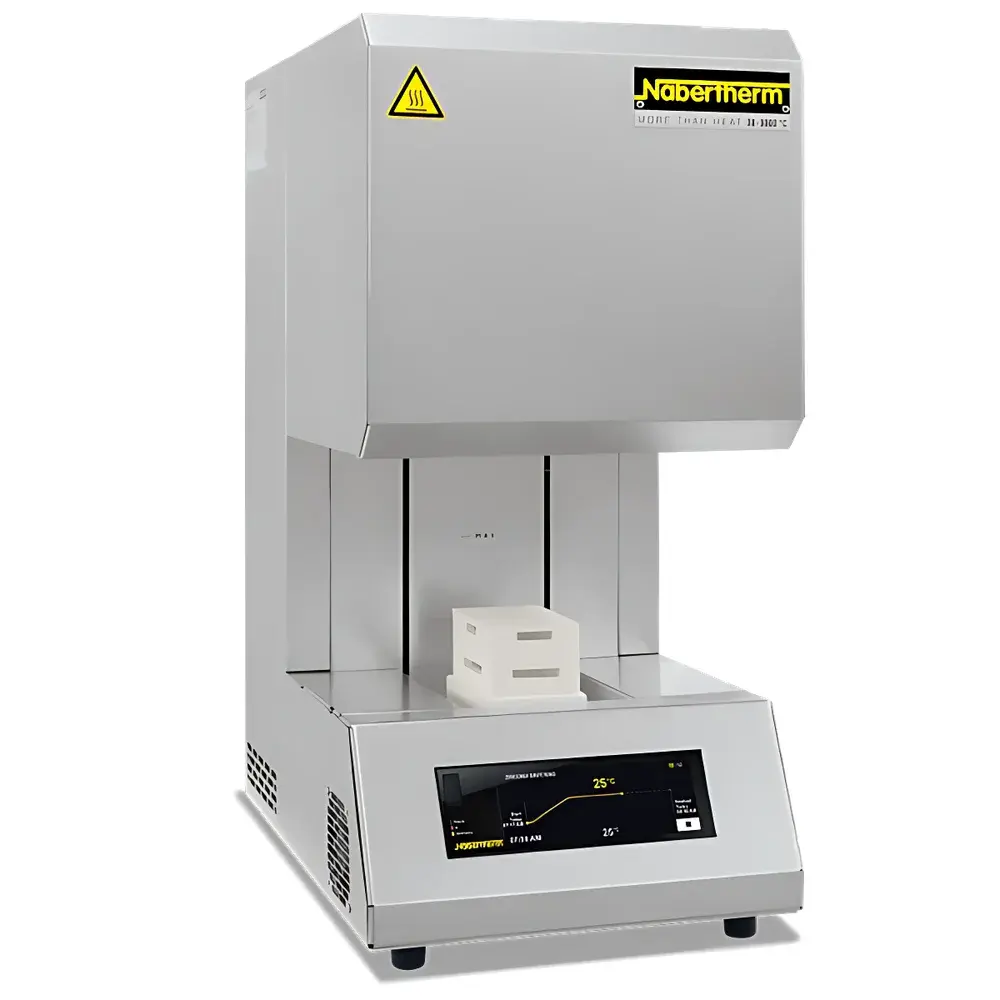
Nabertherm LHT ../17 LB Speed High-Temperature Sintering Furnace with Motorized Lift Table
| Brand | Nabertherm |
|---|---|
| Origin | Germany |
| Model | LHT 01/17 LB Speed / LHT 02/17 LB Speed |
| Type | Vertical Lift Muffle Furnace |
| Max Temperature | 1650 °C |
| Temperature Uniformity | ±1 °C |
| Heating Elements | MoSi₂ (Molybdenum Disilicide) |
| Internal Chamber Dimensions | 75 × 110 × 60 mm (L×W×H) |
| Chamber Volume | 0.5 L (LHT 01/17) or 1.0 L (LHT 02/17) |
| Max Power | 3.3 kW |
| Ramp Time to 1650 °C | ~60 min |
| Cooling Mode | Programmable Forced-Air Ventilation |
| Control System | P580 Touchscreen Controller (50 programs × 40 segments) |
| Thermocouple Type | Type S (Platinum/Rhodium) |
| Compliance | CE, EN 61000-6-3, EN 61000-6-4 |
Overview
The Nabertherm LHT ../17 LB Speed is a precision-engineered high-temperature sintering furnace designed specifically for the controlled thermal processing of advanced ceramic materials—particularly translucent and fully dense zirconia (Y-TZP) dental restorations and technical ceramics. Operating up to 1650 °C, it employs a vertical lift table architecture to enable safe, repeatable loading and unloading at elevated temperatures without manual intervention. The furnace utilizes MoSi₂ (molybdenum disilicide) heating elements mounted in a multi-face configuration—four-sided in the LHT 01/17 variant and three-sided in the LHT 02/17—ensuring exceptional radial and axial temperature homogeneity across the cylindrical hot zone. This design minimizes thermal gradients that can compromise density uniformity and optical clarity in sintered zirconia. The chamber is constructed from high-purity alumina fiber insulation and lined with recrystallized silicon carbide (SiC) or technical ceramic plates to prevent contamination and ensure long-term stability under repeated thermal cycling.
Key Features
- Motorized lift table with precision toothed-belt drive and tactile keypad control for reproducible positioning—enabling hands-free loading/unloading at ambient or elevated temperatures.
- MoSi₂ heating elements offering outstanding oxidation resistance and chemical inertness toward ZrO₂-based ceramics, eliminating elemental interdiffusion between furnace components and sintered parts.
- Programmable forced-air cooling system: initiates automatic venting sequence at user-defined temperatures, reducing total cycle time to under 2.5 hours for full zirconia sintering protocols.
- Dual-mode drying function: automatically positions the lift table to maintain a defined gap during pre-sintering ramp (e.g., up to 500 °C), ensuring effective moisture removal prior to densification.
- P580 touchscreen controller with 50 programmable profiles (each supporting up to 40 segments), including two factory-loaded zirconia sintering templates aligned with major OEM recommendations (e.g., 3M Lava, Ivoclar Vivadent IPS e.max ZirCAD, GC Initial ZR).
- Integrated Type S thermocouple with independent overtemperature protection (adjustable cut-off limit) compliant with IEC 61508 functional safety requirements for thermal process equipment.
Sample Compatibility & Compliance
The LHT ../17 LB Speed accommodates standard dental zirconia blanks (e.g., 98 mm diameter discs or 14.5 mm × 14.5 mm blocks) on technical ceramic crucibles or proprietary stacking trays. The LHT 01/17 supports dual-layer loading (up to 30 single crowns per cycle); the LHT 02/17 enables triple-layer configurations (up to 75 crowns). All internal surfaces are chemically resistant to fluorides, chlorides, and residual binder decomposition products common in CAD/CAM zirconia blanks. The furnace meets CE marking requirements under the EU Machinery Directive 2006/42/EC and Electromagnetic Compatibility Directive 2014/30/EU. Optional validation packages support IQ/OQ documentation for GLP and ISO 13485-compliant dental laboratory environments.
Software & Data Management
The P580 controller provides real-time graphical display of setpoint, actual temperature, and power output. Process data—including time-temperature profiles, lift table position logs, and alarm history—are exportable via USB to CSV format for traceability. The system supports audit trail functionality (user login, parameter changes, program execution timestamps) meeting FDA 21 CFR Part 11 requirements when paired with optional network-enabled firmware and external authentication servers. No cloud connectivity is embedded; all data remains locally stored unless explicitly exported by authorized personnel.
Applications
- Sintering of yttria-stabilized tetragonal zirconia polycrystals (Y-TZP) for monolithic dental crowns, bridges, and implant abutments.
- Densification of translucent zirconia formulations requiring precise dwell times at 1500–1600 °C to optimize translucency-to-strength balance.
- Controlled heat treatment of alumina, spinel, and lithium disilicate glass-ceramics where thermal gradient management is critical.
- Research-scale thermal studies of phase transformations, grain growth kinetics, and residual stress evolution in oxide ceramics.
- Pre-sintering binder burnout and post-sintering annealing in R&D and certified dental laboratories operating under ISO 13485 quality systems.
FAQ
What zirconia brands and formulations are compatible with this furnace?
All commercially available Y-TZP dental zirconias—including 3M Lava Plus, Ivoclar Vivadent IPS e.max ZirCAD MT, GC Initial ZR, and Zirkonzahn Prettau—are supported via programmable sintering curves matching manufacturer specifications.
Is the lift table operation synchronized with the thermal program?
Yes—the P580 controller allows conditional lift table positioning (e.g., “open at 500 °C”, “close at 1200 °C”) integrated into any segment of the thermal profile.
Can the furnace be validated for GMP/GLP compliance?
Yes—Nabertherm provides IQ/OQ documentation templates, calibration certificates for Type S thermocouples, and traceable temperature uniformity mapping reports upon request.
What maintenance is required for MoSi₂ heating elements?
MoSi₂ elements require no routine replacement under normal operation; periodic visual inspection for surface scaling and verification of electrical continuity every 200 cycles is recommended.
Is remote monitoring possible?
Local USB data export is standard; Ethernet or RS485 interfaces are available as factory options for integration into laboratory-wide SCADA or MES platforms.
Related Products



