
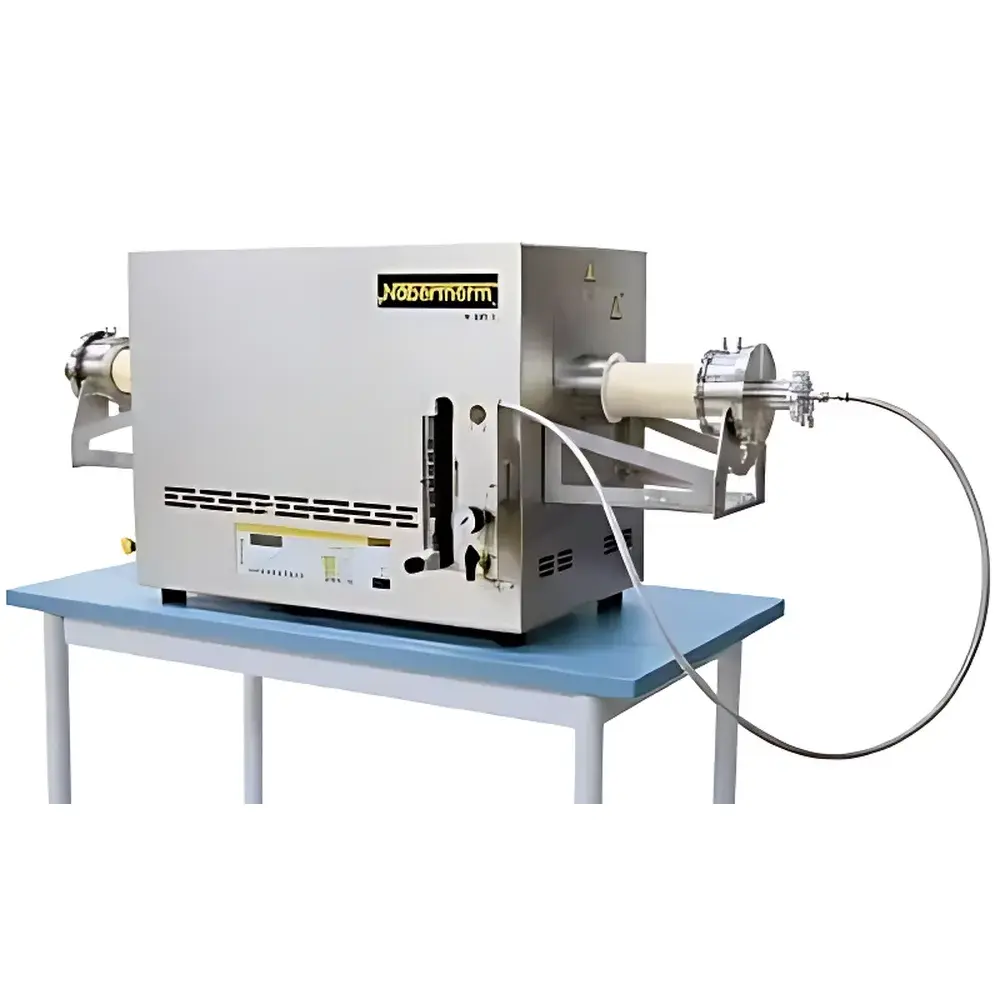
Nabertherm RHTC Series High-Temperature Tube Furnace with Silicon Carbide Heating Elements
| Brand | Nabertherm |
|---|---|
| Origin | Germany |
| Model | RHTC 80-230/15, RHTC 80-450/15, RHTC 80-710/15 |
| Max Temperature | 1500 °C |
| Tube OD | 80 mm |
| Heating Zone Length | 230 / 450 / 710 mm |
| Uniformity (ΔT ≤ 10 K) | 80 mm |
| External Dimensions (W×D×H) | 600×430×580 mm (RHTC 80-230/15) to 1070×430×580 mm (RHTC 80-710/15) |
| Power | 6.3–11.7 kW |
| Electrical Supply | 3-phase, 400 V |
| Weight | 50–90 kg |
| Insulation | High-performance ceramic fiber |
| Heating Elements | SiC rods |
| Thermocouple | Type S |
| Cooling | Active casing cooling |
| Compliance | EN 60519-2 Class 2 overtemperature protection |
Overview
The Nabertherm RHTC series represents a class of high-precision, laboratory-scale horizontal tube furnaces engineered for demanding thermal processing applications up to 1500 °C. Designed around a robust ceramic fiber insulation architecture and silicon carbide (SiC) heating elements mounted parallel to the process tube axis, these furnaces deliver exceptional radial and axial temperature uniformity—critical for reproducible sintering, annealing, calcination, and controlled-atmosphere synthesis. Unlike conventional muffle furnaces, the RHTC’s modular tube configuration enables rapid reconfiguration for varying sample geometries and process environments, including inert gas purging, vacuum operation, and water-cooled flange integration. The furnace body is constructed from brushed stainless steel (V2A grade), providing mechanical stability and corrosion resistance under prolonged thermal cycling. Active casing cooling ensures surface temperatures remain below 60 °C at maximum operating conditions, meeting occupational safety requirements per EN 60519-2.
Key Features
- High-temperature capability up to 1500 °C with long-term stability and repeatability
- Silicon carbide (SiC) heating rods arranged axially along the tube for optimal thermal homogeneity across the 80 mm uniformity zone (ΔT ≤ 10 K)
- Low-thermal-mass ceramic fiber insulation enabling rapid heating (typical ramp rates: 10–15 K/min) and controlled cooling without forced quenching
- Modular tube interface supporting interchangeable quartz, alumina, or high-purity recrystallized silicon carbide (C 799-grade) tubes
- Integrated active casing cooling system reducing external shell temperature during extended operation
- Type S platinum-rhodium thermocouples for accurate, drift-resistant temperature measurement and feedback control
- Static semiconductor relays eliminating mechanical switching noise and extending service life
- EN 60519-2 compliant dual-stage thermal protection: primary PID controller + independent overtemperature limiter (Class 2, adjustable cut-off)
- Cascade temperature regulation option—simultaneous monitoring and control of both furnace chamber and internal tube wall temperatures
- Optional water-cooled flanges, back-pressure regulated gas inlets, and check valves to prevent ambient air ingress during purge cycles
Sample Compatibility & Compliance
The RHTC series accommodates cylindrical samples and crucibles up to 75 mm in diameter within its standard 80 mm OD process tube. Compatible tube materials include fused silica (for ≤ 1100 °C), high-purity alumina (≤ 1600 °C), and recrystallized SiC (C 799 certified, suitable for reducing atmospheres and vacuum down to 10⁻³ mbar). All configurations comply with IEC/EN 61000-6-3 (EMC emissions) and EN 61000-6-2 (immunity). For regulated environments—including GLP laboratories, pharmaceutical R&D, and materials qualification per ASTM C1171 or ISO 2739—the furnace supports audit-ready operation when paired with Nabertherm’s THERMOCOMFORT controllers featuring 21 CFR Part 11-compliant electronic signatures, user access levels, and full event logging.
Software & Data Management
When equipped with Nabertherm’s TC 100 or TC 200 controllers, the RHTC furnaces support programmable multi-step thermal profiles with up to 32 segments, real-time data acquisition at 1 Hz resolution, and automatic CSV export via USB or Ethernet. Controller firmware includes built-in calibration offset adjustment, sensor break detection, and configurable alarm thresholds for temperature deviation, power failure, and cooling fan status. Data integrity is preserved through non-volatile memory storage and timestamped audit trails. Optional PC-based software (ThermoSoft Pro) enables remote supervision, batch reporting, and integration into LIMS or MES platforms via OPC UA or Modbus TCP protocols.
Applications
- Controlled-atmosphere heat treatment of advanced ceramics and refractory metals
- Pre-sintering and binder burnout of MIM and ceramic green bodies
- Thermal gravimetric analysis (TGA) coupling with mass spectrometry or FTIR gas analyzers
- Graphitization and carbonization of polymer-derived ceramics under nitrogen or argon
- Reduction of metal oxides (e.g., NiO, Co₃O₄) in hydrogen-containing atmospheres
- Crystallization studies of phase-change materials and chalcogenide glasses
- Calibration and validation of high-temperature reference materials per ISO/IEC 17025
FAQ
What tube materials are supported, and what are their maximum operating temperatures?
Standard options include fused silica (≤ 1100 °C), 99.8% alumina (≤ 1600 °C), and recrystallized silicon carbide per DIN C 799 (≤ 1500 °C in inert/vacuum; lower in oxidizing atmospheres).
Can the RHTC be operated under vacuum?
Yes—when fitted with vacuum-rated flanges, graphite gaskets, and optional vacuum feedthroughs, it achieves base pressures down to 10⁻³ mbar using turbomolecular pumping systems.
Is overtemperature protection certified to international standards?
Yes—the independent mechanical overtemperature limiter complies with EN 60519-2 Class 2, with adjustable trip point and fail-safe disconnection.
How is temperature uniformity verified and documented?
Uniformity mapping per ASTM E220 is performed during factory acceptance testing; as-built reports include axial/radial profile data at 1000 °C and 1400 °C, traceable to national metrology institutes.
Does Nabertherm provide validation documentation for GxP environments?
Upon request, IQ/OQ protocols, calibration certificates (DAkkS-accredited where applicable), and 21 CFR Part 11 compliance packages are available for regulated users.
Related Products



