
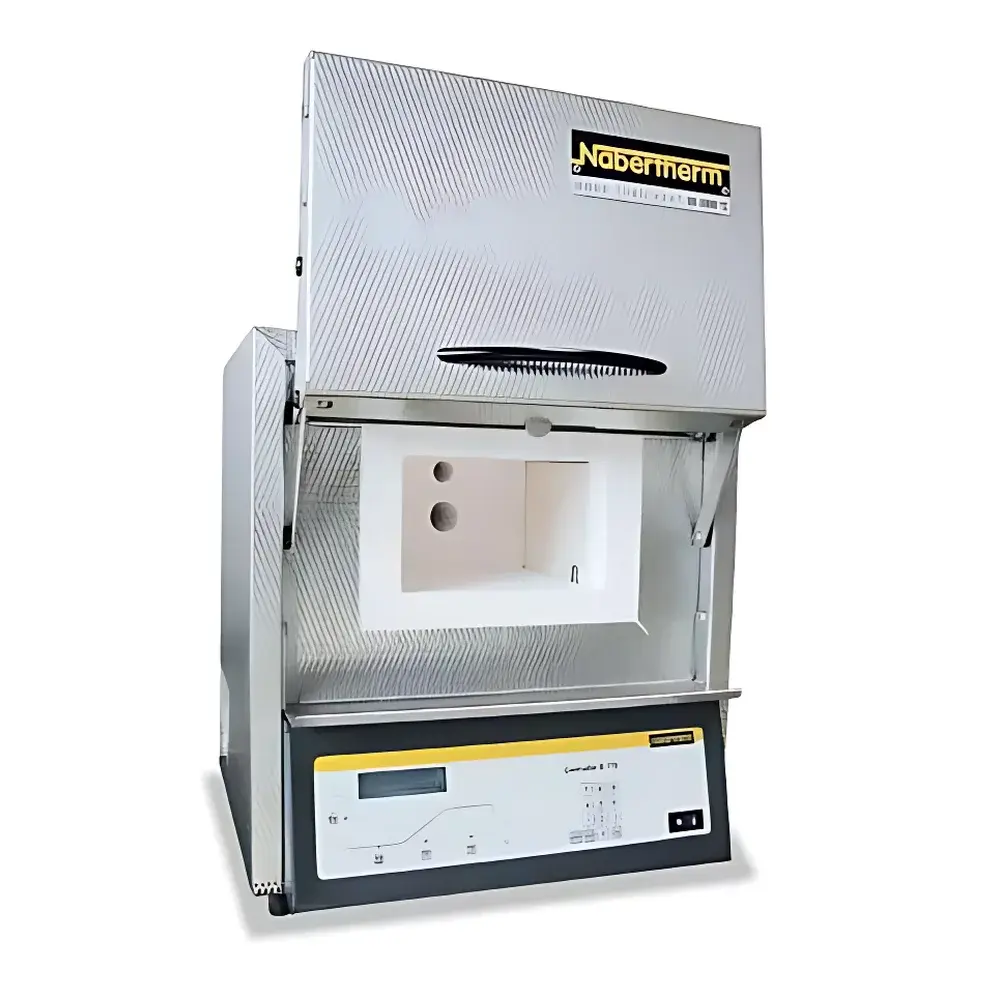
Nabertherm LT 5/11HA and LT 15/11HA Forced-Convection Muffle Furnaces
| Brand | Nabertherm |
|---|---|
| Origin | Germany |
| Model | LT 5/11HA / LT 15/11HA |
| Maximum Temperature | 1100 °C |
| Chamber Dimensions (W×D×H) | 200×160×130 mm (LT 5/11HA) / 230×330×170 mm (LT 15/11HA) |
| Chamber Volume | 5 L / 15 L |
| External Dimensions (W×D×H) | 440×470×520+220 mm (LT 5/11HA) / 480×650×570+290 mm (LT 15/11HA) |
| Power Rating | 2.4 kW / 3.6 kW |
| Electrical Supply | Single-phase |
| Weight | 36 kg / 56 kg |
| Heating Time to Max Temp | ≤60 min |
| Heating Method | Dual-sided ceramic heating plates with embedded resistance wire |
| Insulation | Vacuum-reinforced fiber modules |
| Construction | Double-walled stainless steel housing with lift-type door |
| Air Circulation | Integrated low-noise centrifugal fan |
| Safety | EN 60519-2 compliant overtemperature protection (Class 2 thermal cut-off) |
Overview
The Nabertherm LT 5/11HA and LT 15/11HA are high-precision, forced-convection muffle furnaces engineered for laboratories and industrial quality control environments requiring exceptional temperature uniformity and process repeatability. Unlike natural-convection muffle furnaces, these models integrate a precisely balanced axial fan system that actively circulates ambient air across the heated chamber—ensuring rapid heat transfer, minimized thermal gradients (<±3 °C at 1100 °C per ASTM E2203), and accelerated cooling rates post-cycle. The furnace operates on the principle of radiant and convective thermal energy delivery within a fully isolated muffle chamber, where combustion byproducts, volatile emissions, or reactive atmospheres are excluded from the sample zone. This architecture supports critical thermal processes including ashing, calcination, heat treatment of ceramics and metals, residue analysis per ISO 2171 and AOAC 942.05, and pre-conditioning of reference materials in accordance with ISO/IEC 17025 calibration requirements.
Key Features
- Dual-sided ceramic heating plates with recessed resistance wire—eliminating direct exposure to volatiles, splashes, or particulate deposition during high-temperature operation
- Vacuum-reinforced fiber insulation modules offering superior thermal retention and long-term dimensional stability at 1100 °C
- Double-walled stainless steel housing with optimized air gap design—reducing external surface temperature to <55 °C under continuous operation (per EN 60519-1)
- Lift-type door mechanism minimizing operator contact with hot surfaces and enabling unobstructed chamber access during loading/unloading
- Low-noise electronic relay control with zero-crossing switching—ensuring stable power delivery and extended component life
- Integrated rear-mounted exhaust port compatible with optional catalytic converters or active fume extraction systems for hazardous off-gas management
- EN 60519-2 Class 2 independent overtemperature protection circuit—mechanically triggered thermal limiter set to disconnect power if primary controller fails
Sample Compatibility & Compliance
These furnaces accommodate standard crucibles (alumina, platinum, silica), ceramic boats, and refractory trays up to maximum dimensions of 230 × 330 × 170 mm (LT 15/11HA). The inert muffle environment—free of flame, combustion gases, or catalytic surfaces—ensures compatibility with organic matrices, halogenated compounds, and sulfur-rich samples without cross-contamination. All units comply with EU Machinery Directive 2006/42/EC, Low Voltage Directive 2014/35/EU, and electromagnetic compatibility per EN 61326-1. For regulated laboratories, the furnace’s repeatable ramp-soak profiles and traceable temperature uniformity support GLP documentation and FDA 21 CFR Part 11–aligned electronic record systems when paired with Nabertherm’s THERMCONTROL software and optional data loggers.
Software & Data Management
While the base LT series features analog or digital single-setpoint controllers, full programmability is enabled via Nabertherm’s THERMCONTROL V6 platform—supporting up to 32 programmable segments, real-time temperature logging (0.1 s resolution), and CSV export for audit-ready reporting. Optional Ethernet or RS485 interfaces allow integration into centralized lab monitoring networks. When configured with certified thermocouple inputs (Type S or B) and calibrated reference junctions, the system meets traceability requirements per ISO/IEC 17025 Clause 6.5. Calibration certificates (including as-found/as-left data) are available upon request and conform to DKD/DAkkS guidelines. Audit trails, user access levels, and electronic signatures may be implemented through third-party LIMS or ELN platforms compliant with 21 CFR Part 11 Annex 11.
Applications
- Gravimetric ash content determination in food, feed, and pharmaceutical raw materials (AOAC 942.05, USP <281>)
- Calcination of catalyst precursors and battery cathode materials (e.g., LiCoO₂, Ni-rich NMC)
- Thermal decomposition studies in materials science research (TGA correlation, kinetics modeling)
- Pre-firing of ceramic green bodies and sintering aids in R&D labs
- Residue-on-ignition testing for environmental soil and wastewater sludge (EPA Method 9080)
- Heat treatment validation for medical device sterilization packaging components
FAQ
What is the temperature uniformity specification across the working chamber at 1100 °C?
Per Nabertherm factory verification (per EN 60519-2 Annex D), radial and axial uniformity is ±3 °C in the central 60% of the chamber volume under steady-state conditions.
Can the furnace operate under inert gas purge conditions?
Yes—the muffle design allows safe nitrogen or argon purging via the rear exhaust port; however, dedicated gas-tight versions (e.g., Nabertherm LHT series) are recommended for sustained reducing or vacuum applications.
Is routine calibration required, and what standards apply?
Annual calibration against NIST-traceable reference thermocouples is recommended; procedures follow EURAMET cg-18 and ISO/IEC 17025 requirements for thermal equipment.
What maintenance intervals are specified for the fan and insulation?
The centrifugal fan requires inspection every 1,000 operating hours; vacuum-reinforced fiber modules retain structural integrity beyond 5,000 h at 1100 °C and do not require scheduled replacement under normal use.
Does the unit support remote monitoring via Ethernet or Modbus?
Yes—when equipped with the optional THERMCONTROL COM module, full SCADA integration is supported via Modbus TCP/IP or OPC UA protocols.



