
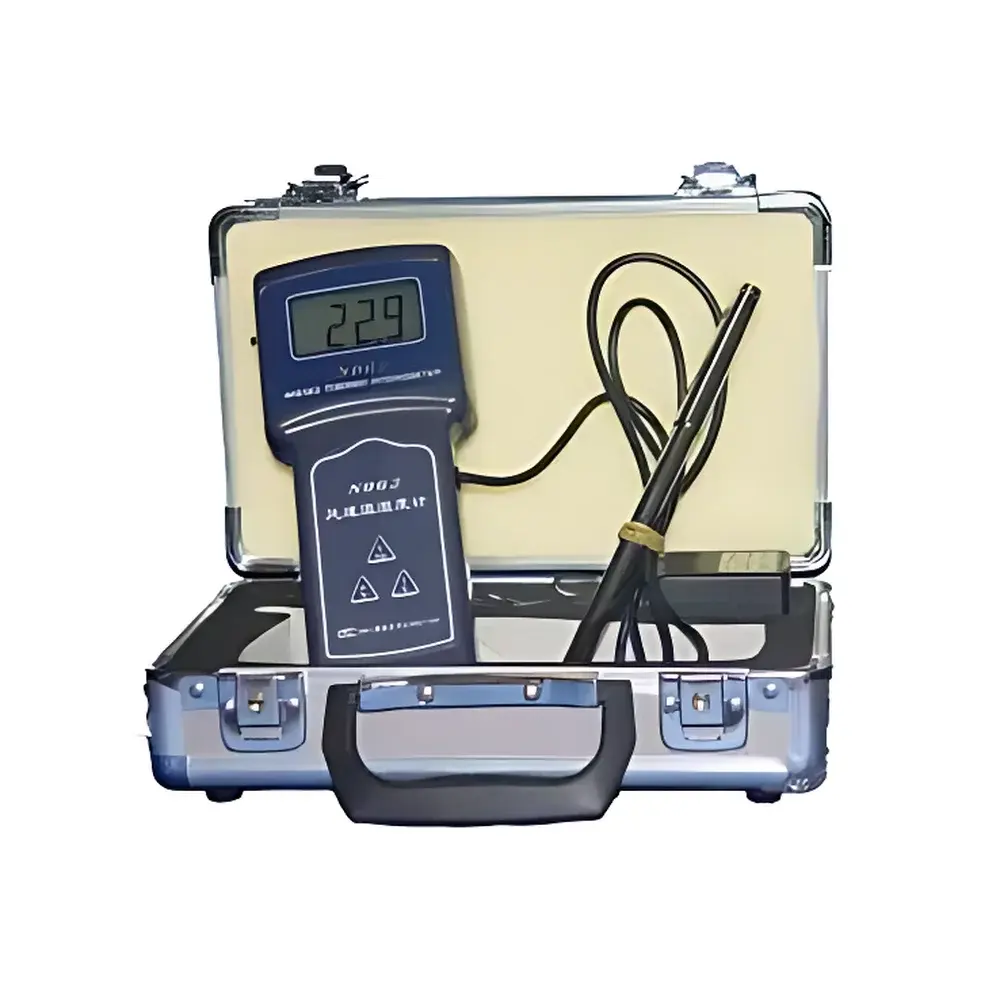
N962A Digital Hot-Wire Anemometer
| Origin | Beijing, China |
|---|---|
| Manufacturer Type | Authorized Distributor |
| Origin Category | Domestic (PRC) |
| Model | N962A |
| Instrument Type | Hot-Wire Anemometer |
| Resolution | 0.01 m/s |
| Accuracy | ≤ ±5% |
| Operating Temperature | 0–40 °C |
| Operating Relative Humidity | 0–85% RH |
| Measurement Range | 0–30 m/s (auto-ranging across 0–10 / 0–20 / 0–30 m/s) |
| Power Supply | Rechargeable Ni-MH Battery (memory-free) |
| Display | Large-format LED |
| Sensor Element | Thin-film Platinum RTD (ceramic substrate) |
| Compliance | Designed for GLP-aligned field use in occupational & environmental monitoring |
Overview
The N962A Digital Hot-Wire Anemometer is a precision-engineered instrument for quantitative measurement of low-to-moderate air velocity in ambient atmospheric conditions. It operates on the constant-temperature anemometry (CTA) principle: a thin-film platinum resistance temperature detector (RTD), mounted on a ceramic substrate, is electrically heated to a fixed temperature above ambient. As airflow passes over the sensor, convective heat loss causes a measurable reduction in resistance; this change is linearized and converted in real time to wind speed using embedded microprocessor-based calibration algorithms. The device is optimized for clean, non-corrosive, particle-free air at near-atmospheric pressure—making it suitable for indoor environmental assessment, HVAC system verification, occupational hygiene surveys, and routine public health ventilation audits. Its design excludes moving mechanical parts, eliminating bearing wear and ensuring long-term stability without recalibration drift under normal operating conditions.
Key Features
- High-resolution digital readout with large-format LED display for clear visibility under varied lighting conditions—including low-illumination field environments.
- Thin-film platinum RTD sensor fabricated on robust ceramic substrate: superior mechanical durability, thermal shock resistance, and long operational lifetime compared to traditional glass-encapsulated thermistors.
- Auto-ranging measurement capability across three selectable full-scale ranges (0–10 m/s, 0–20 m/s, 0–30 m/s), automatically optimized for signal-to-noise ratio and linearity per range.
- Integrated rechargeable nickel-metal hydride (Ni-MH) battery with memory-free chemistry—supports >8 hours continuous operation per charge and >500 charge cycles with minimal capacity degradation.
- Digital analog-to-digital conversion architecture with microcontroller-based linearization firmware, delivering response times up to three times faster than conventional analog-signal-processing anemometers.
- Zero-adjustment port and dedicated charging interface located on main unit housing for field serviceability and uninterrupted workflow continuity.
Sample Compatibility & Compliance
The N962A is validated for use with clean, dry, non-condensing ambient air at standard atmospheric pressure (±10 kPa). It is not rated for explosive atmospheres, high particulate loadings (>1 mg/m³), corrosive gases (e.g., Cl₂, H₂S, NH₃), or saturated humidity conditions exceeding 85% RH. While not certified to IECEx or ATEX standards, its construction complies with general safety requirements outlined in IEC 61010-1 for handheld portable electrical equipment used in environmental monitoring. The instrument supports documentation practices aligned with Good Laboratory Practice (GLP) and ISO/IEC 17025:2017 clause 7.7 (measurement traceability), provided users maintain records of battery charge status, zero-check frequency, and sensor visual inspection logs.
Software & Data Management
The N962A operates as a standalone, self-contained measurement tool with no proprietary software dependency or PC interface. All calibration coefficients are factory-programmed into non-volatile memory and protected against accidental overwrite. Data output is limited to real-time digital display only; no internal data logging, timestamping, or export functionality is implemented. For regulated environments requiring audit trails (e.g., FDA 21 CFR Part 11 or EU Annex 11), external manual recording or integration with third-party data acquisition systems via visual transcription is required. Users performing routine QA/QC should perform daily zero checks using the front-panel adjustment port and document deviations per organizational SOPs.
Applications
- Indoor air quality (IAQ) assessments in offices, schools, hospitals, and residential buildings per ASHRAE Standard 62.1 and WHO Air Quality Guidelines.
- Occupational exposure evaluation for ventilation rate compliance in industrial workspaces (OSHA Technical Manual Section III: Chapter 2).
- Validation of laminar flow hoods, biosafety cabinets, and cleanroom supply air velocities per ISO 14644-3 and NSF/ANSI 49.
- Field verification of HVAC duct static pressure differentials and diffuser discharge velocities during commissioning and recommissioning.
- Epidemiological studies requiring spatial mapping of airflow patterns in naturally ventilated structures.
FAQ
Is the N962A suitable for outdoor wind speed measurement?
No—it is calibrated and validated exclusively for indoor or sheltered ambient conditions where temperature remains within 0–40 °C and relative humidity does not exceed 85% RH. Outdoor use may compromise accuracy due to uncontrolled thermal gradients and moisture ingress.
Can the sensor be cleaned if contaminated?
Yes—gently wipe the ceramic probe surface with lint-free tissue moistened with deionized water; allow full drying before reuse. Do not use solvents, abrasives, or compressed air.
Does the instrument meet NIST-traceable calibration requirements?
The unit ships with a manufacturer’s calibration certificate referencing traceable standards. For formal metrological traceability, users must arrange third-party calibration against NIST SRM 2034 or equivalent accredited reference anemometers.
What maintenance schedule is recommended?
Perform visual inspection of probe integrity and zero-check prior to each use. Recharge battery after every 8 hours of cumulative operation. Full functional verification recommended annually or after physical impact.
Is firmware upgrade supported?
No—the device contains fixed-function embedded firmware with no user-accessible update pathway. Calibration parameters are immutable post-manufacture.







