
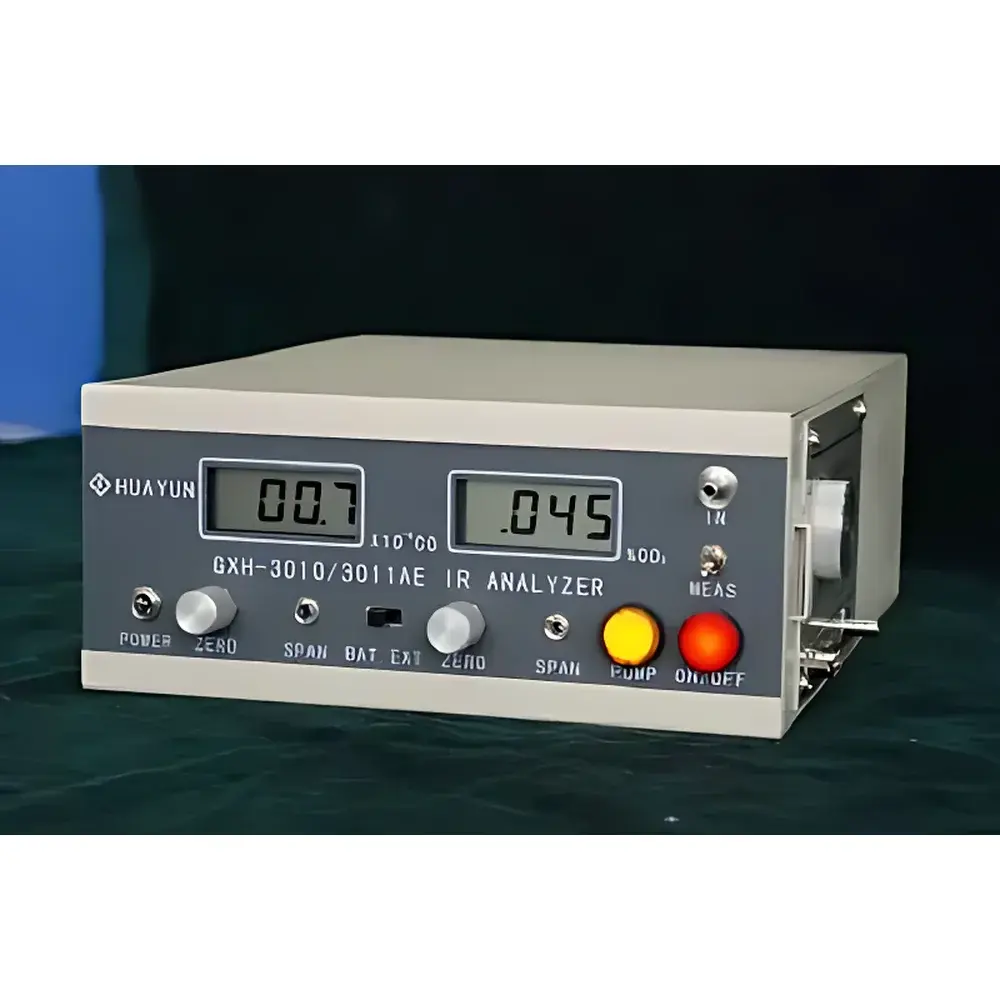
Huayun GXH-3010/3011AE Portable Dual-Component NDIR Gas Analyzer for CO and CO₂
| Brand | Huayun |
|---|---|
| Origin | Beijing, China |
| Manufacturer Type | Manufacturer |
| Country of Origin | Domestic (China) |
| Model | GXH-3010/3011AE |
| Instrument Type | Portable |
| Detection Target | Multi-component |
| Minimum Range | 0–50 ppm |
| Repeatability | ≤1% F.S. |
| Resolution | 0.1 ppm |
| Response Time | ≤30 s |
| Zero Drift | ≤±2% F.S./4 h |
| Span Drift | ≤±2% F.S./4 h |
| Linearity Error | ≤±2% F.S. |
| Measurement Principle | Non-Dispersive Infrared (NDIR) |
| Sampling Method | Built-in Pump-aspiration |
| Flow Rate | 0.5–1.2 L/min |
| Power Supply | AC 220 V (±10%) or Rechargeable Battery |
| Dimensions | 260 × 210 × 90 mm |
| Weight | ≤3.5 kg |
Overview
The Huayun GXH-3010/3011AE is a field-deployable, dual-channel non-dispersive infrared (NDIR) gas analyzer engineered for simultaneous, real-time quantification of carbon monoxide (CO) and carbon dioxide (CO₂) in ambient air, indoor environments, occupational settings, and industrial exhaust streams. Based on the fundamental absorption spectroscopy principle—where target gases exhibit characteristic infrared absorption bands at specific wavelengths (e.g., 4.6 µm for CO and 4.26 µm for CO₂)—this analyzer employs dedicated optical paths with thermopile detectors and precision interference filters to ensure selective, interference-resistant detection. Its compact, battery-operated architecture supports rapid deployment without external infrastructure, making it suitable for compliance verification, leak detection, ventilation assessment, and routine environmental health & safety (EHS) monitoring. The instrument complies with key Chinese national standards including GB/T 18204.2–2014 (Public Place Hygiene Testing), GBZ/T 300.37–2017 (Workplace Air Toxicants), GB/T 9801–1988 (Ambient CO by NDIR), and JJG 635–2011 (Metrological Verification Regulation for CO/CO₂ Infrared Analyzers). It meets Class II accuracy requirements per national metrological specifications and is eligible for official calibration certification from the National Institute of Metrology (NIM), China.
Key Features
- Simultaneous dual-gas measurement: Independent NDIR channels for CO (0–50 ppm or 0–200 ppm selectable) and CO₂ (0–0.5% or 0–1.0% selectable), enabling cross-calibrated, co-located data acquisition
- Integrated zeroing system: Onboard catalytic zero filter combined with a six-port rotary valve for automated zero-reference switching—eliminating manual calibration gas cylinders during routine operation
- High-stability optical design: Sealed, temperature-compensated optical bench with dual-beam referencing to minimize thermal drift and enhance long-term signal fidelity
- Rapid response performance: t0–90 ≤45 s for CO and ≤15 s for CO₂, supporting dynamic sampling in transient emission scenarios
- Robust environmental tolerance: Validated operation across 10–45 °C ambient range with temperature-induced error ≤±2% F.S./10 °C
- Portable operational readiness: Weighing ≤3.5 kg with integrated rechargeable battery, AC/DC power flexibility, and ruggedized carry case for field logistics
Sample Compatibility & Compliance
The GXH-3010/3011AE is optimized for gaseous samples drawn directly from ambient air, ducts, chambers, or confined workspaces via its built-in pump (0.5–1.2 L/min flow control). It accommodates particulate-laden or moderately humid samples when used with optional inline particulate filters and moisture traps—though condensation must be avoided upstream of the optical cell. The analyzer satisfies metrological traceability requirements under JJG 635–2011 and aligns with internationally recognized measurement principles referenced in ISO 4223-1:2021 (Gas analysis — Vocabulary) and ASTM D6216–22 (Standard Practice for Calibration of NDIR Instruments). While not pre-certified for FDA 21 CFR Part 11 or EU CE marking, its documented repeatability (≤1% F.S.), linearity (≤±2% F.S.), and drift stability (≤±2% F.S./4 h) support use in GLP-aligned field studies and internal QA/QC protocols where regulatory-grade documentation is maintained manually.
Software & Data Management
Data output is provided via RS232 serial interface (standard) supporting ASCII-formatted real-time readings (CO ppm, CO₂ %, timestamp, battery status). Optional PC software enables time-synchronized logging, basic trend visualization, and export to CSV for further statistical analysis. The device stores up to 2,000 measurement records internally with timestamp and operator ID fields. Although it does not feature embedded audit trail or electronic signature capabilities, all stored data include immutable acquisition metadata—supporting retrospective review in accordance with ISO/IEC 17025:2017 clause 7.7 (Ensuring validity of results) when paired with documented chain-of-custody procedures.
Applications
- Indoor air quality (IAQ) assessment in offices, schools, and healthcare facilities per ASHRAE Standard 62.1
- Occupational exposure monitoring in welding, combustion, and confined-space entry operations
- Verification of HVAC system performance and demand-controlled ventilation (DCV) logic
- Field validation of fixed-site continuous emission monitoring systems (CEMS)
- Environmental health surveys in urban microenvironments and near-roadway monitoring
- Educational laboratory demonstrations of gas-phase infrared absorption and stoichiometric combustion relationships
FAQ
What gases does the GXH-3010/3011AE measure, and are other gases supported?
It measures CO and CO₂ exclusively using dedicated NDIR channels. No additional gases (e.g., CH₄, SO₂) are detectable without hardware modification.
Is external calibration gas required for daily operation?
No—zero calibration is performed automatically using the internal catalytic filter; span calibration requires certified gas only at scheduled intervals (e.g., quarterly or per JJG 635–2011 recommendations).
Can the instrument operate continuously on battery power?
Yes—the rechargeable battery supports ≥4 hours of continuous sampling and analysis under typical load conditions.
Does the analyzer meet international regulatory requirements such as EPA or EN standards?
It conforms to Chinese national standards and metrological practices. For EPA Method 10 or EN 14792 compliance, third-party validation against those specific protocols is required.
What maintenance is recommended for sustained accuracy?
Bi-weekly zero checks, annual optical path inspection, and replacement of the internal zero filter every 12 months or after 2,000 operating hours—whichever occurs first.







