
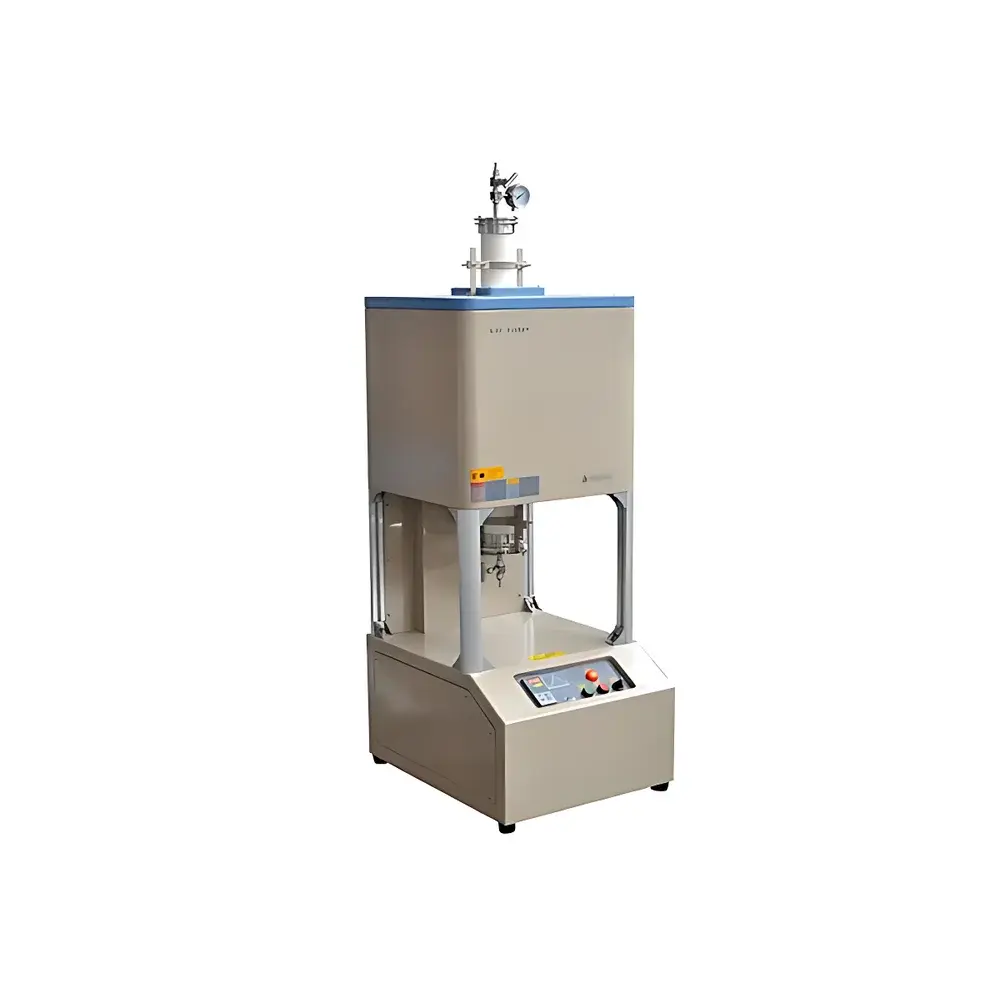
Hefei Kejing GSL-1700X-VT Vertical High-Temperature Tube Furnace
| Brand | Hefei Kejing |
|---|---|
| Origin | Anhui, China |
| Model | GSL-1700X-VT |
| Type | Vertical Tube Furnace |
| Max Temperature | 1700 °C (≤1 h) |
| Control Accuracy | ±1 °C |
| Max Power | 4 kW |
| Heating Rate to Max Temp | 10 °C/min |
| Heating Element | Four U-shaped MoSi₂ Rods |
| Chamber Dimensions | OD 60 mm × ID 54 mm × L 800 mm |
| Certification | CE, UL/MET/CSA (components >24 V), TUV/CAS optional |
Overview
The Hefei Kejing GSL-1700X-VT is a vertically oriented high-temperature tube furnace engineered for precise thermal processing under controlled atmosphere or vacuum conditions. Designed around the fundamental principles of resistive heating via silicon molybdenum (MoSi₂) elements and optimized heat transfer through high-purity alumina insulation, this furnace supports reproducible high-temperature synthesis, sintering, annealing, and calcination of advanced ceramics, battery materials, catalysts, and refractory compounds. Its vertical orientation enables gravity-assisted sample handling—particularly advantageous for suspended crucible configurations, fiber drawing, or vapor-phase deposition experiments where axial thermal uniformity and minimal convection interference are critical. The dual-layer steel housing with integrated air-cooling ensures surface temperatures remain below 60 °C during operation, meeting industrial safety benchmarks for laboratory environments.
Key Features
- Vertical configuration with top-loading design for simplified sample insertion and in-situ suspension using stainless-steel lifting fixtures
- Four U-shaped MoSi₂ heating rods delivering stable power distribution across a 150 mm heating zone and 50 mm effective isothermal region
- High-purity α-alumina (99.8%) tube (OD 60 mm × ID 54 mm × L 800 mm) coated with US-imported 1750 °C-rated alumina ceramic layer—enhancing emissivity and extending service life by reducing thermal degradation
- PID-based temperature controller with 30-segment programmable ramp-soak profiles; B-type thermocouple feedback loop ensures ±1 °C control accuracy over the full operating range (800–1600 °C continuous, up to 1700 °C for ≤1 hour)
- Integrated stainless-steel vacuum flange assembly pre-fitted with needle valve, analog pressure gauge, and lifting ring—compatible with KF25 quick-connect vacuum fittings and 1/4″ VCR-style gas inlet ports
- UL/MET/CSA-certified electrical components (>24 V); CE-marked per EN 61000-6-3 and EN 61000-6-4; optional TÜV or CSA single-unit certification available upon request
Sample Compatibility & Compliance
The GSL-1700X-VT accommodates cylindrical samples up to 50 mm in diameter and 700 mm in length within its high-purity alumina tube. It supports inert (Ar, N₂), reducing (H₂/N₂ mixtures), oxidizing (O₂), and vacuum environments down to 10⁻³ mbar when paired with compatible pumps. All structural and sealing materials—including the flange gasket (flexible graphite), valve seats, and thermocouple feedthroughs—are selected for chemical inertness at elevated temperatures. The system complies with ISO/IEC 17025-relevant operational traceability requirements when used with calibrated thermocouples and validated procedures. For regulated applications (e.g., ASTM C1161 flexural strength testing of ceramics or ISO 11202 noise emission assessments of furnace cooling fans), documentation packages—including calibration certificates, material declarations, and CE technical files—are provided upon delivery.
Software & Data Management
While the standard unit employs a dedicated digital PID controller with local keypad interface, optional RS485 Modbus RTU communication enables integration into centralized lab automation systems. Users may log temperature profiles, ramp rates, hold times, and alarm events via third-party SCADA or LabVIEW platforms. When deployed in GLP/GMP-aligned laboratories, the furnace supports audit-trail-capable data recording when connected to compliant data acquisition hardware—ensuring alignment with FDA 21 CFR Part 11 requirements for electronic records and signatures. Firmware updates and parameter backups are performed via USB port; no cloud connectivity or proprietary vendor software is required.
Applications
- Sintering of oxide and non-oxide ceramics (e.g., Al₂O₃, SiC, ZrO₂) under argon or nitrogen
- Thermal treatment of lithium-ion battery cathode precursors (NMC, LFP) with precise oxygen partial pressure control
- Growth of 2D materials (e.g., MoS₂, h-BN) via chemical vapor transport (CVT) using sealed quartz ampoules inside the alumina tube
- High-temperature annealing of optical fibers and specialty glass preforms
- Thermogravimetric analysis (TGA) support—when coupled with microbalance feedthroughs and differential pressure compensation
- Preparation of metal-organic frameworks (MOFs) and porous carbons via controlled pyrolysis under inert sweep gas
FAQ
What vacuum level can be achieved with the standard flange assembly?
With a compatible two-stage rotary vane pump, the system typically reaches 1×10⁻³ mbar within 30 minutes. For lower base pressures (<1×10⁻⁵ mbar), a turbomolecular pump with appropriate foreline trap is recommended.
Is the furnace suitable for hydrogen-atmosphere processing?
Yes—provided proper leak-checking, purge protocols, and explosion-proof auxiliary equipment (e.g., hydrogen sensors, ventilation interlocks) are implemented per NFPA 55 and local safety codes.
Can the thermocouple measurement point be positioned directly at the sample surface?
Yes—using the optional armored flange adapter, a mineral-insulated (MI) thermocouple sheath can be inserted axially to contact or closely approach the sample, enabling direct temperature validation independent of furnace setpoint.
What maintenance intervals are recommended for consumables?
MoSi₂ rods should be inspected every 200 operational hours above 1400 °C; alumina tubes require visual inspection for microcracks before each high-temperature run; graphite gaskets are replaced after three thermal cycles exceeding 1500 °C.
Does the CE marking cover electromagnetic compatibility (EMC) and low-voltage directives?
Yes—the CE declaration includes conformity with both the EMC Directive 2014/30/EU and the Low Voltage Directive 2014/35/EU, verified through third-party testing at an EU-notified body.



