
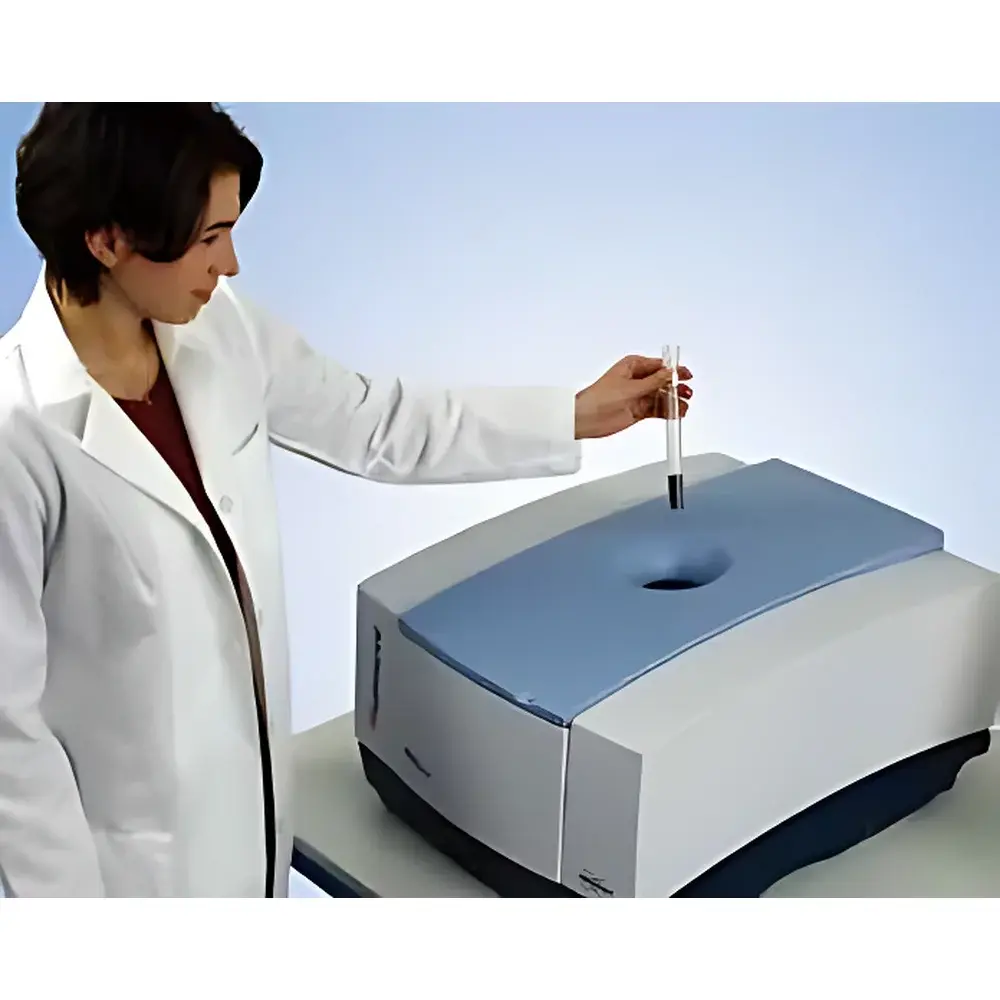
Bruker minispec HF-20 Total Hydrogen Analyzer for Hydrocarbons and Fuels
| Brand | Bruker |
|---|---|
| Origin | France |
| Instrument Type | Low-Field Time-Domain Nuclear Magnetic Resonance (TD-NMR) Analyzer |
| Sample Type | Liquid |
| Operating Frequency | 20 MHz |
| Sample Preparation | None required |
| Compliance | ASTM D 7171, ASTM D 4808, ASTM D 3701 |
Overview
The Bruker minispec HF-20 Total Hydrogen Analyzer is a dedicated time-domain nuclear magnetic resonance (TD-NMR) instrument engineered for rapid, non-destructive, solvent-free quantification of total hydrogen content in liquid hydrocarbon streams—including diesel, jet fuel (Jet A/A-1), kerosene, naphtha, biodiesel, and plant-based oils. Unlike conventional combustion or elemental analysis techniques, the minispec HF-20 exploits the intrinsic magnetic moment of 1H nuclei under a stable 0.47 T static magnetic field (corresponding to 20 MHz Larmor frequency). It measures the transverse relaxation decay (T2) of hydrogen protons following a standardized 90°–180° pulse sequence. Since all hydrogen atoms in organic molecules contribute proportionally to the integrated NMR signal amplitude—and given the fixed stoichiometric relationship between molecular mass and hydrogen count—the instrument delivers absolute hydrogen mass percentage (wt%) with traceable metrological rigor. This principle forms the technical foundation of ASTM D 7171, which explicitly prescribes TD-NMR as the primary method for hydrogen determination in middle-distillate petroleum products.
Key Features
- Compliance with three major international standards: ASTM D 7171 (2023 edition), ASTM D 4808, and ASTM D 3701—validated for regulatory reporting and process certification.
- Zero-sample-prep operation: Liquids are introduced directly into standard 18 mm or 40 mm OD glass or PTFE-lined tubes; no dilution, digestion, or derivatization required.
- High throughput: Typical measurement time is ≤ 60 seconds per sample, enabled by strong signal-to-noise ratio (SNR) from high-proton-density fuels and optimized RF coil design.
- Robust thermal management: Integrated metal-block heater maintains precise sample temperature (±0.1 °C) during acquisition—critical for reproducibility across ambient fluctuations.
- Two-point calibration flexibility: Supports both certified reference hydrocarbons (e.g., n-dodecane, cetane) and user-defined reference samples with certified H-content values.
- Low-maintenance architecture: Solid-state magnet with passive shimming; no cryogens, no vacuum systems, no moving parts in the probe assembly.
Sample Compatibility & Compliance
The minispec HF-20 is validated for homogeneous liquid-phase samples with viscosity ≤ 500 cSt at measurement temperature. Compatible matrices include mineral-based fuels (diesel, heating oil, aviation turbine fuel), synthetic hydrocarbons (Fischer–Tropsch liquids), biofuels (FAME, HVO), and refined vegetable oils (e.g., rapeseed methyl ester, soybean oil). Excluded are emulsions, suspensions, or highly paramagnetic samples that induce excessive T2 shortening. All measurements adhere to GLP-aligned data integrity protocols: full audit trail, electronic signatures, and 21 CFR Part 11–compliant software configuration (optional). Calibration traceability follows ISO/IEC 17025 requirements when performed using NIST-traceable reference materials.
Software & Data Management
The minispec Analysis Software (v3.x) provides guided workflows for method setup, calibration curve generation, batch processing, and report export (PDF, CSV, XML). Each measurement stores raw FID data, processed T2 decay fit parameters, integration limits, and environmental metadata (temperature, date/time, operator ID). Built-in statistical tools calculate repeatability (RSD ≤ 0.15% for diesel), intermediate precision, and linearity (r² ≥ 0.9999 over 10–15 wt% H range). Data archives are encrypted and support network backup via SMB or SFTP. Optional LIMS integration enables automated result transfer to enterprise QA/QC databases.
Applications
- Refinery process control: Real-time monitoring of hydrotreating severity via hydrogen uptake tracking—directly correlating H-content to catalyst activity and feedstock saturation level.
- Fuel specification compliance: Verification of hydrogen content against mandatory limits in Jet Fuel Specification DEF STAN 91-91, ASTM D1655, and EN 590.
- Alternative fuel development: Quantifying hydrogen saturation in renewable diesel (HVO) and green diesel pathways to assess cold flow properties and oxidation stability.
- Feedstock characterization: Determining total hydrogen in crude fractions, bitumen, oil sands extracts, and coal-derived liquids per ASTM D5291.
- Lubricant base stock evaluation: Correlating H/C ratio with saturates/aromatics balance and NOACK volatility performance.
FAQ
What physical principle does the minispec HF-20 use to quantify hydrogen?
It employs time-domain pulsed NMR to measure the integrated echo amplitude of 1H spins after a Carr–Purcell–Meiboom–Gill (CPMG) sequence; signal intensity is linearly proportional to total hydrogen atom count in the active volume.
Can the instrument analyze solid or semi-solid samples?
No—only low-viscosity, homogeneous liquids are supported. Waxy or gelled fuels must be pre-heated above their cloud point and homogenized prior to loading.
Is daily recalibration required?
No. With stable temperature control and reference-standard verification every 24 hours (or per ASTM D 7171 Section 8.2), calibration drift remains below ±0.02 wt% H over one week.
How is measurement uncertainty estimated?
Uncertainty budget includes contributions from signal noise (Type A), calibration standard purity (Type B), temperature stability (Type B), and tube positioning repeatability—typically yielding expanded uncertainty (k=2) of ±0.05 wt% H for diesel.
Does the system meet FDA or pharmaceutical regulatory requirements?
While not intended for drug substance testing, its 21 CFR Part 11–enabled software option supports GMP-compliant environments where hydrogen content serves as a critical quality attribute (CQA) for excipients or lipid-based formulations.
Related Products





