
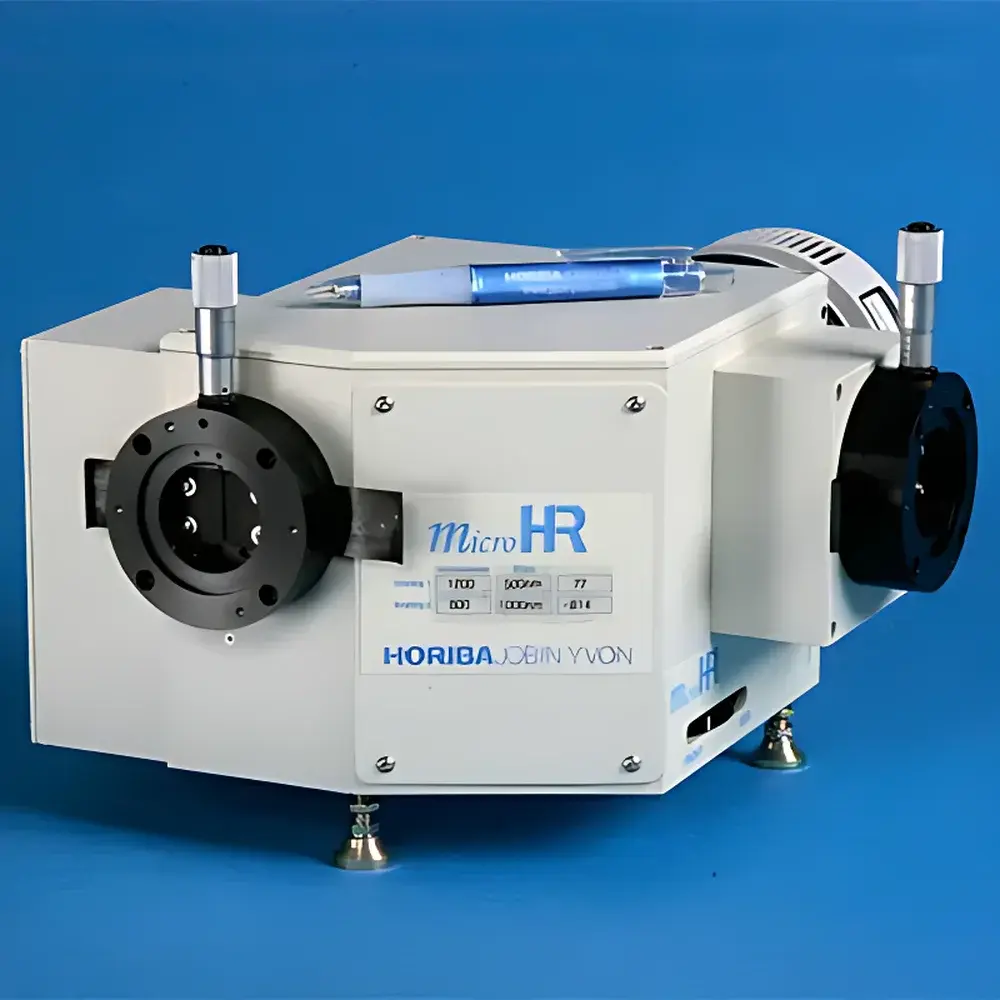
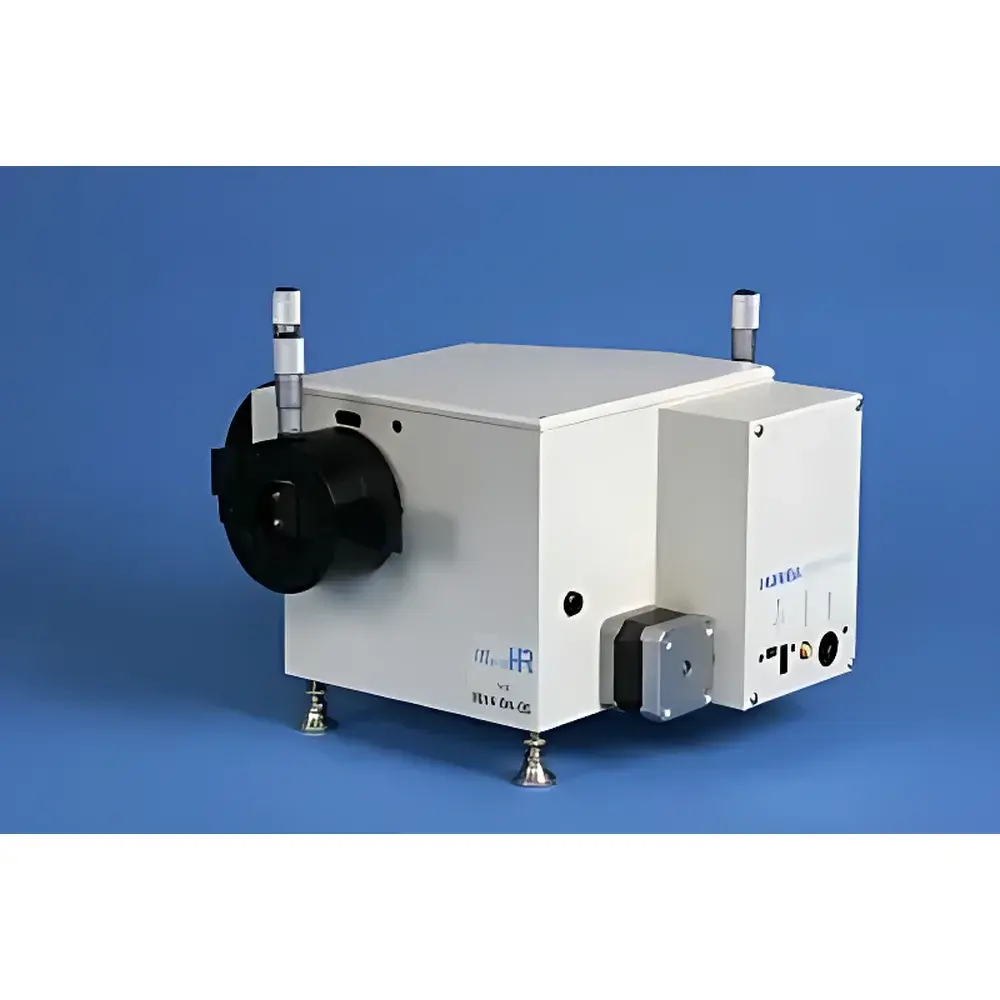
HORIBA MicroHR Grating Spectrometer Monochromator
| Brand | HORIBA |
|---|---|
| Origin | USA |
| Manufacturer Type | Manufacturer |
| Origin Category | Imported |
| Model | MicroHR |
| Price | Upon Request |
Overview
The HORIBA MicroHR Grating Spectrometer Monochromator is a compact, high-performance Czerny–Turner imaging spectrometer engineered for precision wavelength selection and spectral analysis across an exceptionally broad optical range—from deep ultraviolet (180 nm) to far-infrared (20 µm). Its optical architecture employs a 140 mm focal length with f/3.88 throughput, optimized for high light-gathering efficiency and minimal aberration. The instrument operates on the principle of angular dispersion via interchangeable ruled or holographic diffraction gratings mounted on a manual or motorized dual-grating turret. This design enables rapid reconfiguration for varying resolution, spectral bandwidth, and wavelength coverage requirements—making it suitable for both laboratory-based research and field-deployable spectroscopic diagnostics. Unlike fixed-geometry monochromators, the MicroHR integrates an off-axis toroidal mirror system that delivers superior image quality, reduced astigmatism, and improved spatial resolution at the detector plane—critical for coupling with array detectors such as back-illuminated CCDs or scientific CMOS sensors.
Key Features
- Compact Czerny–Turner design with 140 mm focal length—ideal for space-constrained optical setups and portable instrumentation platforms.
- Motorized or manual dual-grating turret accommodating two 32 mm × 32 mm gratings, enabling seamless switching between UV-VIS-NIR-MIR spectral ranges without realignment.
- Toroidal focusing optics delivering high-fidelity spectral imaging with minimized coma and astigmatism—essential for quantitative line profile analysis and high signal-to-noise ratio measurements.
- Universal detector interface compatible with multi-channel detectors (e.g., CCD, sCMOS) and single-channel devices (e.g., PMT, InGaAs photodiode, MCT detector), supporting both scanning and simultaneous acquisition modes.
- Modular flange-mounting configuration (standard 3-inch or custom CF/ISO-K interfaces) facilitating integration into vacuum chambers, cryostats, or OEM optical systems.
Sample Compatibility & Compliance
The MicroHR supports direct coupling to diverse sample interaction geometries—including transmission cells, integrating spheres, fiber-optic probes, and free-space beam paths—enabling application-specific configurations for absorbance, fluorescence, reflectance, Raman excitation filtering, and plasma emission monitoring. Its mechanical stability and thermal inertia meet ISO 14644-1 Class 5 cleanroom handling standards when installed in controlled environments. While the spectrometer itself does not carry intrinsic regulatory certification, its design complies with mechanical and optical safety requirements outlined in IEC 61010-1 for laboratory equipment. When integrated into analytical workflows governed by GLP or GMP, the MicroHR—paired with validated software and calibrated detectors—supports traceable spectral data generation compliant with FDA 21 CFR Part 11 audit trail requirements.
Software & Data Management
The MicroHR is fully supported by HORIBA’s Synapse and LabSpec software suites, which provide instrument control, spectral acquisition, real-time calibration, and advanced post-processing (e.g., background subtraction, peak deconvolution, spectral fitting). Software drivers are available for LabVIEW, MATLAB, Python (via PyVISA), and .NET environments, enabling custom automation and integration into larger experimental control frameworks. All spectral datasets are stored in vendor-neutral formats (e.g., ASCII, HDF5) with embedded metadata—including grating ID, slit width, integration time, and wavelength calibration coefficients—ensuring long-term reproducibility and interoperability with third-party analysis tools.
Applications
- UV-Vis-NIR absorption and transmission spectroscopy of thin films, nanoparticles, and semiconductor materials.
- Laser-induced fluorescence (LIF) and time-resolved photoluminescence characterization in condensed matter physics and optoelectronics.
- In-situ and remote process monitoring—including combustion diagnostics, exhaust gas analysis, and industrial plasma characterization.
- Microspectroscopy when coupled with microscope objectives and fiber-coupled probes for spatially resolved chemical mapping.
- Calibration source characterization and monochromatic light generation for radiometric and photometric standards laboratories.
FAQ
What wavelength ranges can the MicroHR cover with standard gratings?
With appropriate grating selection (e.g., 1200 g/mm for UV-VIS, 150 g/mm for NIR-MIR), the MicroHR achieves continuous coverage from 180 nm to 20 µm.
Is the MicroHR compatible with vacuum or purged optical paths?
Yes—the housing supports optional vacuum-compatible versions (down to 10⁻⁶ mbar) and nitrogen-purged configurations for deep-UV operation below 200 nm.
Can the MicroHR be used with a fiber optic input?
Absolutely—the entrance slit accepts standard SMA905 or FC/PC fiber connectors; optional fiber collimators and focusing optics are available for optimal coupling efficiency.
Does HORIBA provide NIST-traceable wavelength calibration services?
Yes—factory calibration using Hg/Ar/Ne emission lamps is provided; optional NIST-traceable recalibration with uncertainty reporting is available upon request.
How is spectral resolution determined for a given grating configuration?
Resolution depends on grating groove density, slit width, and focal length; typical resolving power (λ/Δλ) ranges from ~1,200 (with 30 µm slits and 150 g/mm grating) to >8,000 (with 10 µm slits and 2400 g/mm grating) under ideal conditions.





