
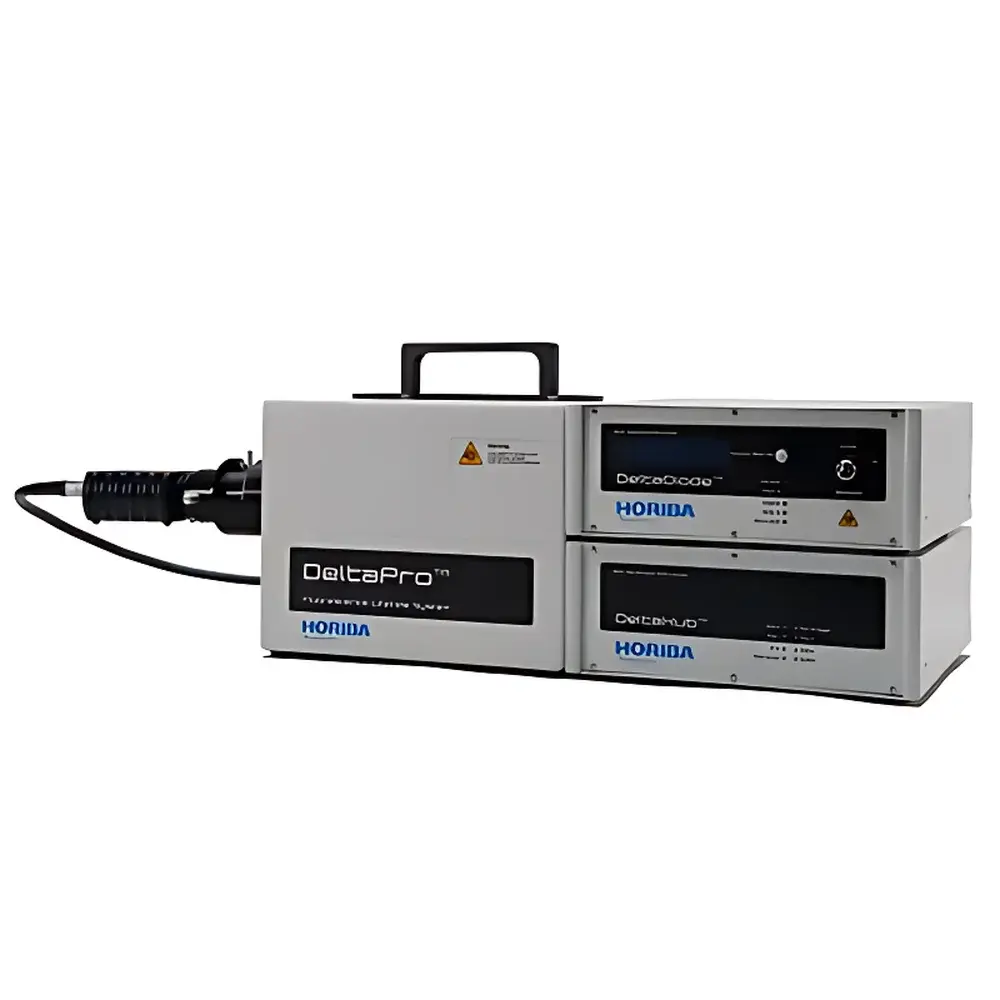
HORIBA DeltaPro Ultrafast Time-Resolved Fluorescence Spectrometer
| Brand | HORIBA |
|---|---|
| Origin | United Kingdom |
| Manufacturer Type | Original Equipment Manufacturer (OEM) |
| Import Status | Imported |
| Model | DeltaPro |
| Dispersion Element | Grating |
| Slit Width / Spectral Bandpass | Not Specified |
| Resolution | Not Specified |
| Sensitivity | Not Specified |
| Wavelength Accuracy | Not Specified |
Overview
The HORIBA DeltaPro Ultrafast Time-Resolved Fluorescence Spectrometer is a modular, high-performance time-correlated single photon counting (TCSPC) system engineered for precision fluorescence and phosphorescence lifetime measurements across an exceptionally broad dynamic range—from 25 picoseconds to over 1 second. Developed by HORIBA Scientific (incorporating legacy Jobin Yvon spectroscopic expertise), the DeltaPro represents the culmination of over five decades of dedicated TCSPC instrumentation design and manufacturing. Its core architecture centers on the DeltaHub timing electronics module, featuring a dead time of just 10 ns—enabling lossless photon detection even at high repetition rates—and supporting synchronization with ultrafast pulsed excitation sources. The system operates on the fundamental principle of TCSPC: recording the arrival time of individual photons relative to a precisely timed laser or LED excitation pulse, then reconstructing decay profiles via histogram accumulation. This approach delivers exceptional signal-to-noise ratio, sub-nanosecond temporal resolution, and quantitative fidelity essential for advanced photophysical characterization in academic research, pharmaceutical development, and materials science laboratories.
Key Features
- DeltaHub timing electronics with 10 ns dead time and <1 ps timing jitter, optimized for high-repetition-rate excitation sources
- Modular excitation platform: supports NanoLED (up to 1 MHz repetition rate), DeltaDiode (up to 100 MHz), and SpectraLED (multi-wavelength, noise-free, phosphorescence-optimized) sources—all software-controlled without hardware reconfiguration
- Integrated PPD (Photon Pulse Detection) module as standard; field-upgradeable to NIR detectors (e.g., PPD-850C, PPD-900C) extending spectral response to ~1700 nm
- F-link plug-and-play interface enabling seamless USB 2.0 communication—no internal PCI cards required
- Large-volume sample chamber with UV-grade optical components, compatible with temperature-controlled liquid cells, solid sample holders, and polarization accessories (manual or motorized)
- Flexible wavelength selection via interference filters; optional motorized monochromators available for full spectral scanning
Sample Compatibility & Compliance
The DeltaPro accommodates diverse sample formats including cuvette-based solutions (standard 10 mm path length), powdered solids, thin films, and optically dense suspensions. Its open optical architecture allows integration with cryostats, microscopes, and custom sample environments. All firmware and acquisition software comply with GLP/GMP documentation requirements, supporting audit trails, electronic signatures, and data integrity protocols aligned with FDA 21 CFR Part 11. Instrument calibration traceability follows ISO/IEC 17025 principles where applicable, and lifetime analysis routines adhere to IUPAC-recommended deconvolution methodologies for instrument response function (IRF) correction.
Software & Data Management
The system is operated via HORIBA’s FluoroHub software—a native 64-bit application offering real-time acquisition monitoring, multi-exponential decay fitting (including global and distributed lifetime analysis), anisotropy calculation, and spectral-temporal cross-correlation. Raw TCSPC histograms are stored in vendor-neutral, metadata-rich HDF5 format. Export options include ASCII, CSV, and industry-standard JCAMP-DX for third-party analysis. Software supports automated batch processing, script-driven experiment sequencing, and integration with LIMS via RESTful API endpoints. All analysis parameters—including IRF measurement, chi-square minimization criteria, and residual inspection—are fully configurable and logged with timestamped revision history.
Applications
- Ultrafast photoinduced electron transfer kinetics in conjugated polymers and perovskite solar cell materials
- Conformational dynamics of biomolecules via tryptophan lifetime heterogeneity and FRET efficiency mapping
- Phosphorescent triplet-state characterization in OLED emitters and metal–organic frameworks (MOFs)
- Time-resolved emission spectra (TRES) for solvation dynamics studies in micellar and ionic liquid environments
- Quality control of fluorescent dyes and quantum dots in diagnostic assay development
- Temperature- and pH-dependent lifetime thermometry using ratiometric probes
FAQ
What is the shortest measurable lifetime with DeltaPro?
The system achieves reliable decay reconstruction down to 25 ps when paired with NanoLED or DeltaDiode excitation sources and appropriate IRF deconvolution.
Can DeltaPro measure both fluorescence and phosphorescence lifetimes in a single instrument?
Yes—by selecting SpectraLED excitation (for µs–s range) or DeltaDiode/NanoLED (for ps–µs range), users cover the full 25 ps to >1 s dynamic range without hardware modification.
Is NIR detection supported natively?
The base configuration includes visible-range PPD detection; NIR extension to ~1700 nm requires optional PPD-850C or PPD-900C modules, installed post-purchase.
Does the software support compliance with regulatory data integrity standards?
FluoroHub implements full 21 CFR Part 11 functionality—including user access controls, electronic signatures, and immutable audit trails—for regulated environments.
How is wavelength selection implemented?
Standard operation uses interference filters; motorized monochromators are available as add-on modules for continuous spectral scanning and excitation/emission profiling.





