
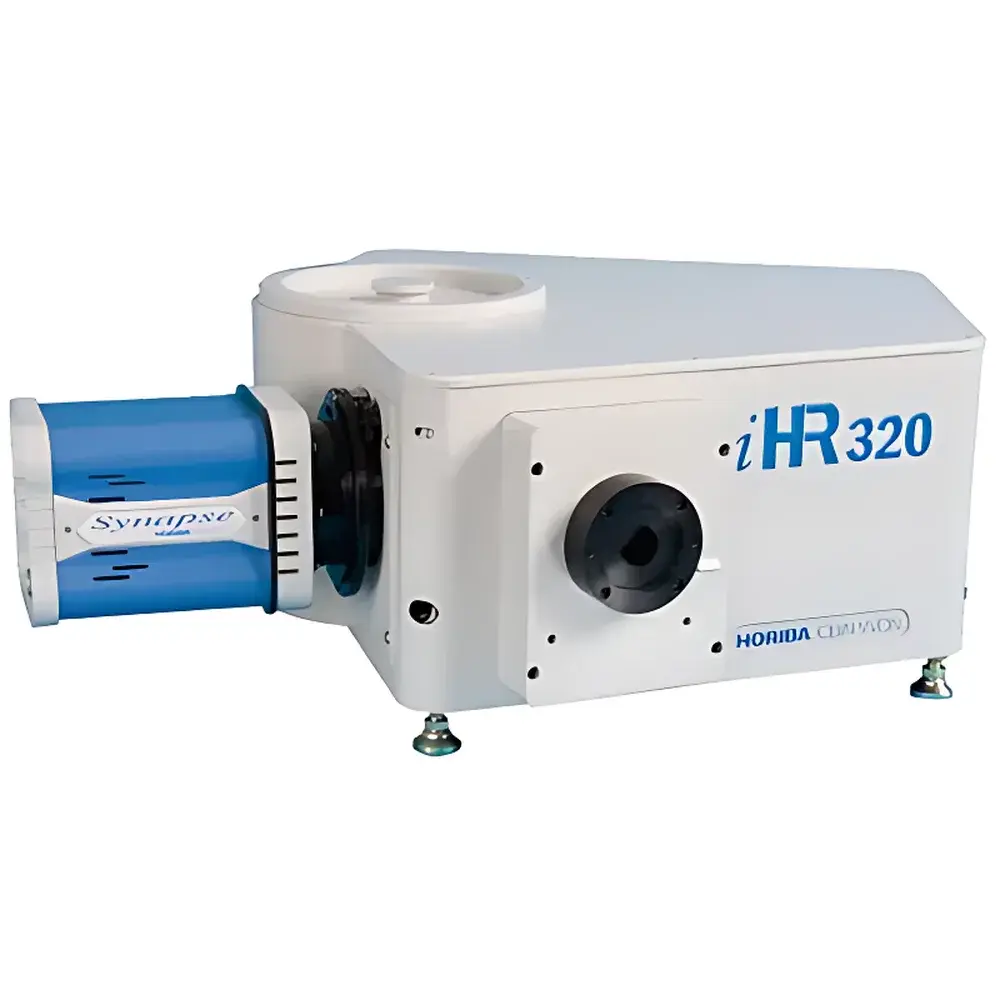
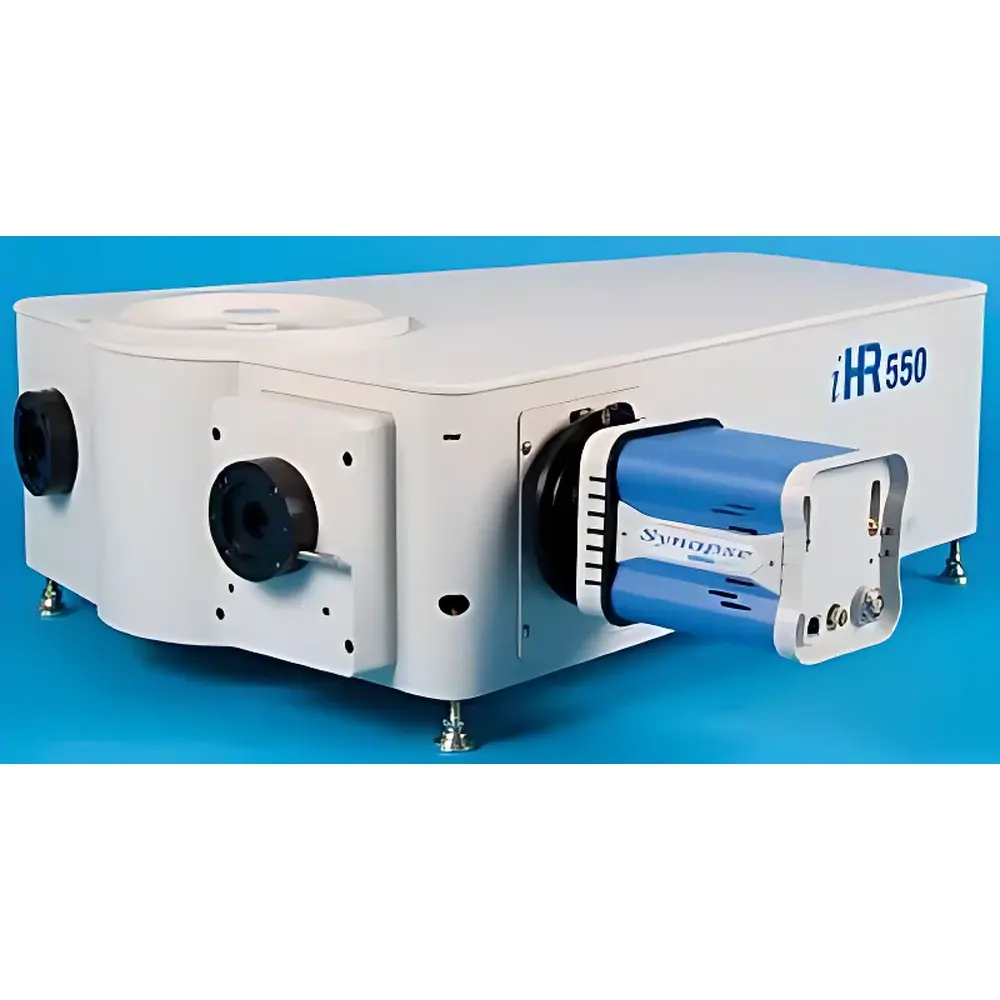
HORIBA iHR320 and iHR550 Imaging Spectrographs
| Brand | HORIBA |
|---|---|
| Origin | USA |
| Manufacturer Type | Original Equipment Manufacturer (OEM) |
| Import Status | Imported |
| Model | iHR320 / iHR550 |
| Application System | Universal |
| Grating Mount | Dual-grating turret (motorized, selectable) |
| Spectral Resolution | 0.06 nm (iHR320), 0.025 nm (iHR550) |
| Linear Dispersion | 2.31 nm/mm (iHR320), 1.34 nm/mm (iHR550) |
| Wavelength Range | 150 nm – 40 µm |
| F-number | f/4.1 (iHR320), f/6.4 (iHR550) |
| Wavelength Accuracy | ±0.20 nm |
| Stray Light | 1.5 × 10⁻⁴ (iHR320), 1.0 × 10⁻⁵ (iHR550) |
Overview
The HORIBA iHR320 and iHR550 are high-performance, imaging-optimized Czerny–Turner spectrographs engineered for precision spectral acquisition across ultraviolet, visible, near-infrared, and mid-infrared regions (150 nm – 40 µm). Designed specifically for demanding applications in Raman spectroscopy, photoluminescence, time-resolved spectroscopy, and synchrotron beamline instrumentation, these spectrographs integrate optical design rigor with mechanical stability to deliver diffraction-limited imaging performance. Their core architecture employs off-axis parabolic and toroidal mirrors to correct astigmatism and coma, while the patented in-axis grating scanning mechanism ensures constant illumination of the grating’s active surface—maximizing diffraction efficiency and minimizing wavelength-dependent signal loss. Unlike conventional monochromators, the iHR series is optimized for multi-channel detection (e.g., CCD, sCMOS, InGaAs arrays), supporting simultaneous spectral acquisition across extended focal planes without vignetting or field curvature.
Key Features
- Diffraction-Limited Imaging Performance: Toroidal focusing mirrors and asymmetric optical path geometry suppress astigmatism, coma, and field curvature. The focal plane is fully flat and uniformly illuminated—even at edges—due to a larger focusing mirror relative to the collimating mirror.
- In-Axis Grating Scanning: Motorized grating turret maintains incident light incidence at the grating’s geometric center during wavelength scanning. This preserves diffraction efficiency, minimizes polarization dependence, and enhances long-term spectral reproducibility.
- Stray Light Suppression: Optimized baffling, blackened internal surfaces, and computer-modeled non-symmetric optical layout reduce stray light to ≤1.5 × 10⁻⁴ (iHR320) and ≤1.0 × 10⁻⁵ (iHR550), critical for high-dynamic-range measurements such as weak Raman bands adjacent to strong elastic peaks.
- Modular Flexibility: Dual-port configuration (input/output interchangeable), motorized slit control, optional filter wheels, fiber-optic coupling adapters, and vacuum/purged housing options enable seamless integration into custom optical setups—including confocal microscopes, cryostats, and ultrafast laser systems.
- Mechanical Robustness: Monolithic aluminum alloy baseplate, stress-relieved optical mounts, and pre-aligned kinematic mirror cells ensure thermal and vibrational stability. All drive mechanisms undergo dual-stage calibration for repeatability better than ±0.005 nm over 10⁴ scan cycles.
Sample Compatibility & Compliance
The iHR320/550 supports diverse sample interfaces—from free-space beams and multimode optical fibers (SMA905, FC/PC) to vacuum-compatible flanges (CF-35, CF-63) for UHV environments. Its broad spectral coverage accommodates samples ranging from wide-bandgap semiconductors (UV) to low-energy phonon modes in 2D materials (mid-IR). The spectrograph complies with ISO 17025 calibration traceability requirements when used with NIST-traceable emission/absorption standards. Optional vacuum purging (to <10⁻³ mbar) enables oxygen- and moisture-sensitive measurements below 200 nm, satisfying ASTM E275 and ISO 8573-1 purity class specifications for optical path integrity.
Software & Data Management
HORIBA’s LabSpec 6 software provides full instrument control, real-time spectral preview, automated calibration (pixel-to-wavelength mapping using Hg/Ar/Ne lamps), and batch processing with spectral subtraction, peak fitting (Gaussian/Lorentzian/Voigt), and multivariate analysis (PCA, cluster analysis). Raw data export supports HDF5, SPE, and ASCII formats; metadata embedding includes timestamp, grating position, slit width, detector temperature, and environmental conditions. For regulated environments, optional 21 CFR Part 11-compliant audit trail modules log all parameter changes, user actions, and calibration events with digital signatures and immutable timestamps—fully aligned with GLP and GMP documentation workflows.
Applications
- Raman spectroscopy of nanomaterials, pharmaceutical polymorphs, and battery electrode interfaces
- Photoluminescence quantum yield (PLQY) and lifetime mapping in perovskite thin films
- Time-resolved emission spectroscopy (TRES) with gated ICCD or SPAD arrays
- Synchrotron-based X-ray absorption fine structure (XAFS) beamline spectrometers
- Gas-phase emission analysis in plasma diagnostics and combustion research
- FT-Raman complementary dispersion verification and calibration reference
FAQ
What detector types are compatible with the iHR320/550?
Standard configurations support back-illuminated, deep-depletion CCDs (200–1100 nm), TE-cooled sCMOS (400–900 nm), InGaAs linear/area arrays (900–2500 nm), and bolometric detectors (2–40 µm). All detectors interface via standardized 16-pin D-sub or LVDS connectors.
Can the iHR be operated under vacuum or inert gas purge?
Yes. Optional vacuum housing versions (up to 10⁻⁶ mbar) and nitrogen-purged variants are available. UV-enhanced optics (MgF₂ coatings) and fused silica windows extend transmission down to 150 nm.
How is wavelength calibration performed and maintained?
Calibration uses Hg/Ar/Ne spectral lines with sub-pixel centroiding algorithms. LabSpec 6 stores multiple calibration files per grating; drift compensation is enabled via periodic reference lamp checks with automatic correction applied to acquired spectra.
Is remote operation supported for integration into automated labs?
Yes. Full TCP/IP and RS-232 command sets are documented in the Programmer’s Manual. Python, MATLAB, and LabVIEW drivers are provided, enabling integration into SCADA systems and automated QC workflows compliant with ISO/IEC 17025 Annex A.2.
What maintenance is required for long-term spectral stability?
No routine optical alignment is needed. Recommended annual verification includes grating encoder linearity check, slit width calibration using calibrated wire gauges, and detector dark current profiling—all supported by HORIBA’s certified service centers worldwide.





