
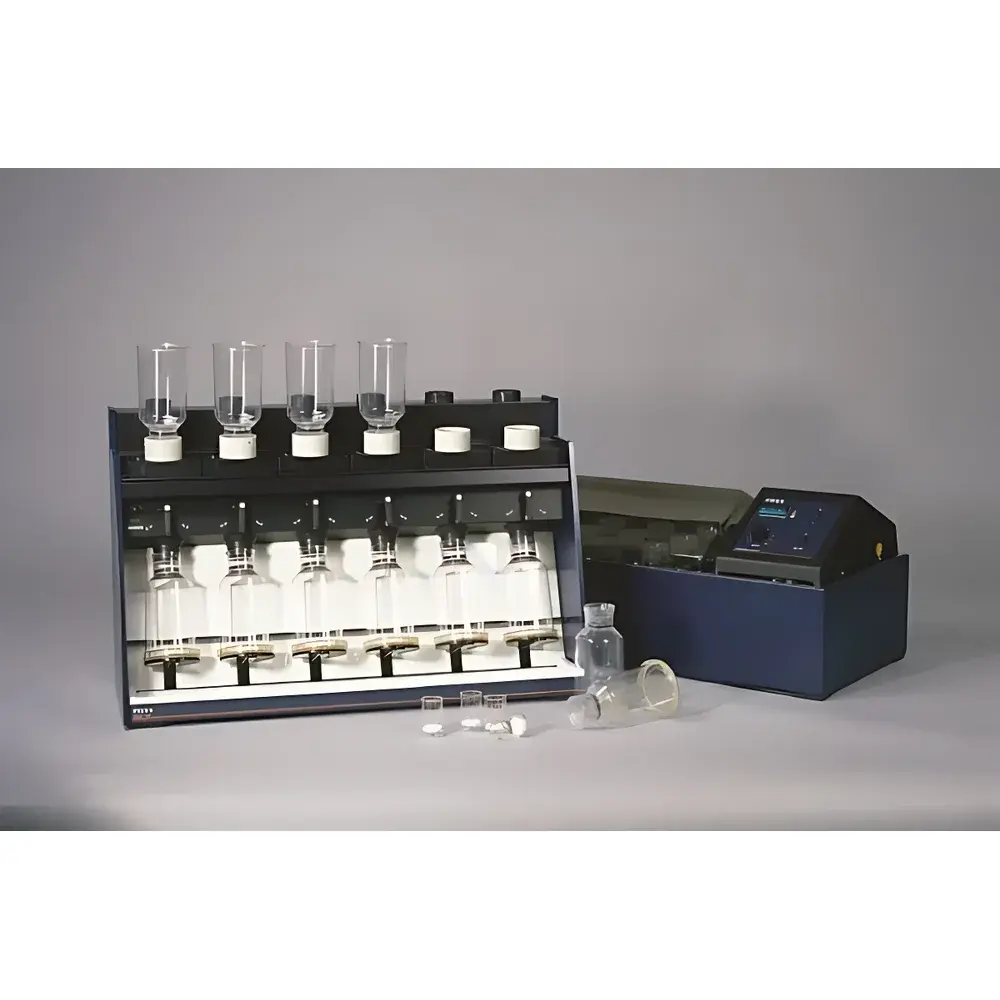
FOSS Fibertec™ 1023 Dietary Fiber Analysis System
| Brand | FOSS |
|---|---|
| Origin | Denmark |
| Model | Fibertec™ 1023 |
| Application Principle | Enzymatic-gravimetric method per AOAC 991.43, AOAC 2009.01, AACC 32–07, NMKL 158, and ASP methods |
| Sample Capacity | 12 samples per digestion batch, 6 samples per filtration batch |
| Digestion Vessel Volume | 600 mL |
| Water Bath Temperature Range | Ambient to 80 °C |
| Temperature Accuracy | ±0.1 °C |
| Oscillation Speed | 0–150 cycles/min |
| Oscillation Amplitude | 0–50 mm |
| Filtration Throughput | 2–4 min per 100 mL digested slurry |
| Reproducibility | RSD < 0.5% for total dietary fiber (TDF) across replicate analyses |
| Compliance | Fully aligned with AOAC Official Methods of Analysis®, ISO 13905:2014, and USP <2040> for dietary fiber quantification |
Overview
The FOSS Fibertec™ 1023 Dietary Fiber Analysis System is an automated, benchtop enzymatic-gravimetric platform engineered for precise, standardized quantification of total, soluble, and insoluble dietary fiber in food, feed, and nutritional supplement matrices. It implements the internationally harmonized sequential enzymatic hydrolysis protocol—first with heat-stable α-amylase, followed by protease and amyloglucosidase—to remove starch and protein, then isolates fiber residues via alcohol precipitation, enzymatic debranching, and controlled digestion. The resulting residue is gravimetrically determined after drying and ash correction, fully compliant with AOAC 991.43 (total dietary fiber), AOAC 2009.01 (soluble/insoluble fractionation), AACC 32–07, NMKL 158, and ASP-approved methodologies. Designed for routine QC laboratories and regulatory testing facilities, the system integrates tightly coupled digestion and filtration workflows to minimize manual intervention while ensuring metrological traceability and inter-laboratory comparability.
Key Features
- Modular dual-stage operation: 12-position oscillating water bath for synchronized enzymatic digestion, followed by a dedicated 6-sample vacuum/pressure-assisted filtration unit
- Precisely regulated temperature control (±0.1 °C) across ambient to 80 °C, with programmable multi-step thermal profiles supporting complex AOAC-compliant digestion sequences
- Adjustable mechanical agitation (0–150 cycles/min, 0–50 mm amplitude) ensures uniform suspension of fibrous particulates during enzymatic treatment, preventing sedimentation and enhancing enzyme accessibility
- Dual-pressure filtration architecture—combining positive-pressure assisted slurry transfer and negative-pressure vacuum draw—eliminates filter cake formation and enables consistent, rapid separation of fiber residues (2–4 min per 100 mL digest)
- 600 mL high-borosilicate digestion vessels with optimized geometry for efficient mixing, minimal evaporation loss, and easy residue recovery
- Gravimetric accuracy validated against NIST-traceable reference materials; repeatability confirmed at RSD < 0.5% for TDF across ≥10 independent replicates on homogenous cereal-based standards
Sample Compatibility & Compliance
The Fibertec™ 1023 accommodates diverse sample types including cereals, legumes, fruits, vegetables, bakery products, infant formulas, and dietary supplements. Its enzymatic workflow is validated for matrices containing resistant starch, β-glucans, pectins, cellulose, hemicelluloses, and lignin. All operational protocols adhere strictly to AOAC Official Methods of Analysis® (OMA), ISO 13905:2014 (Cereals and cereal products — Determination of dietary fibre), and USP (Dietary Fiber). The system supports full GLP documentation requirements, including audit trails for method selection, parameter logging, and operator identification—enabling compliance with FDA 21 CFR Part 11 when integrated with validated LIMS or FOSS WinISI software environments.
Software & Data Management
While the Fibertec™ 1023 operates as a hardware-dedicated platform without embedded touchscreen controls, it is fully compatible with FOSS’s WinISI IV software suite for method configuration, run scheduling, and result compilation. WinISI IV provides electronic recordkeeping with time-stamped parameter logs, user access controls, and export-ready reports in CSV, PDF, and XML formats. All data files are structured to support automated import into laboratory information management systems (LIMS) and satisfy internal QA/QC review cycles. Raw weight data from analytical balances can be directly interfaced via RS-232 or USB, enabling closed-loop calculation of TDF, SDF, and IDF values per AOAC equations—including ash and protein corrections.
Applications
- Regulatory compliance testing for nutrition labeling (e.g., FDA Nutrition Facts panel, EU Regulation No. 1169/2011)
- Raw material qualification and in-process monitoring in breakfast cereal, pasta, and functional food manufacturing
- Method validation and reference laboratory benchmarking under ISO/IEC 17025 accreditation
- Preparative isolation of fiber fractions for downstream characterization (e.g., HPLC analysis of oligosaccharides, FTIR spectroscopy of cell wall polysaccharides)
- Research applications in gut microbiota studies requiring reproducible, method-defined fiber substrates
FAQ
Does the Fibertec™ 1023 comply with AOAC 2017.16 for resistant starch?
No—the Fibertec™ 1023 is configured exclusively for dietary fiber analysis per AOAC 991.43 and 2009.01. Resistant starch quantification requires distinct enzymatic conditions and is supported by FOSS’s separate Fibertec™ ST system.
Can the system be used for animal feed fiber analysis?
Yes—method AOAC 991.43 is applicable to feedstuffs; however, users must validate recovery using appropriate certified reference materials (e.g., NIST SRM 1849a) and document matrix-specific performance per ISO 5725.
Is method programming user-editable?
Temperature setpoints, oscillation parameters, and timing sequences are configurable within WinISI IV, but all modifications must be formally documented and re-validated to maintain compliance with standard methods.
What maintenance is required for long-term filtration consistency?
Routine cleaning of filtration manifolds and replacement of glass fiber filters (GF/F grade) after each batch is mandatory; pressure transducers and vacuum pumps undergo annual calibration per FOSS Service Protocol SP-FIB-1023.
How does the system handle high-fat or high-sugar samples?
Samples exceeding 10% fat or 20% sucrose require pre-extraction with petroleum ether or ethanol prior to digestion—per AOAC 991.43 Annex A—to prevent emulsion formation and filter clogging.





