
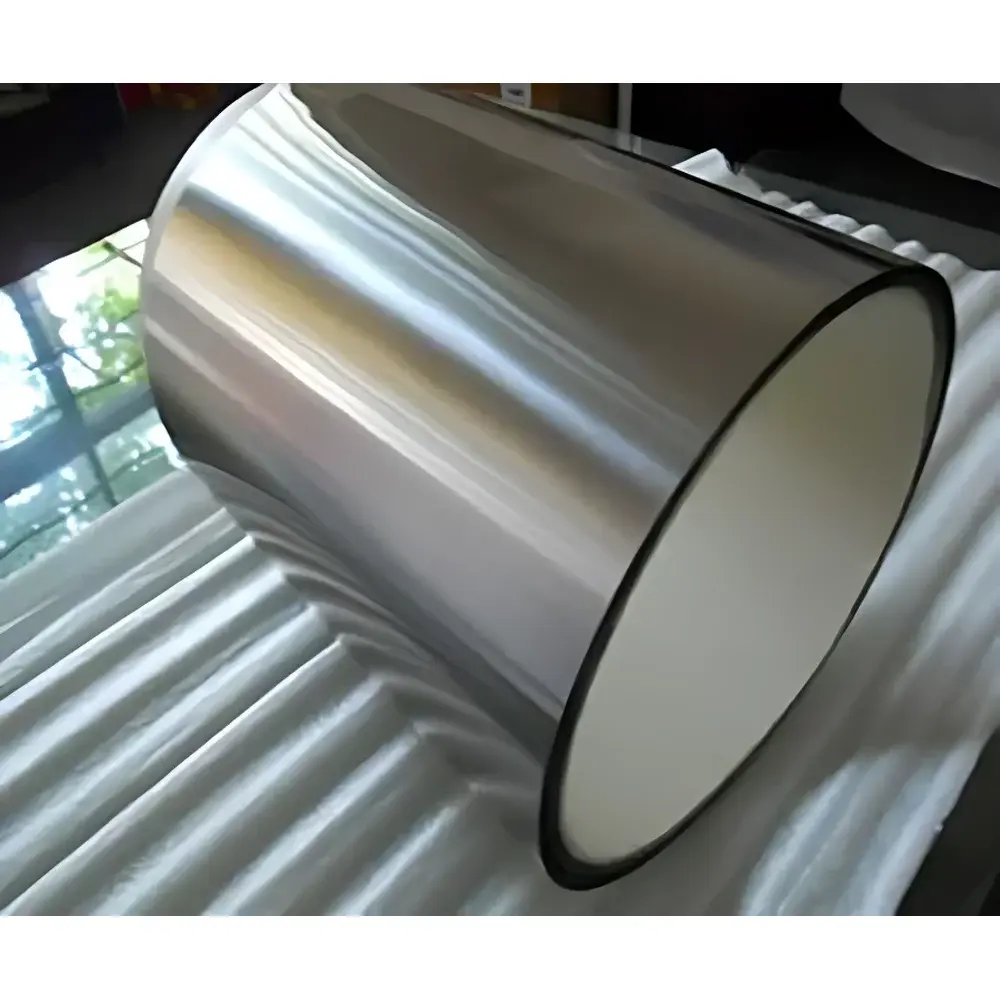
Tungsten (W) Foil for Quartz Crystal Microbalance Electrodes
| Brand | Hefei Kejing |
|---|---|
| Origin | Anhui, China |
| Manufacturer Type | Authorized Distributor |
| Origin Classification | Domestic (China) |
| Model | W Foil |
| Price Range | USD 0.15 – 1,500 (FOB) |
| Thickness | 0.01–1 mm (customizable) |
| Packaging | Vacuum-sealed in Class 100 cleanroom bags, stored and shipped from Class 1000 cleanroom environment |
Overview
Tungsten (W) foil is a high-purity, ultra-thin metallic substrate engineered specifically for use as electrode material in quartz crystal microbalance (QCM) systems operating under demanding electrochemical and ultra-high-vacuum (UHV) conditions. Tungsten’s exceptional thermal stability (melting point: 3422 °C), low sputtering yield, high electrical resistivity (~5.6 µΩ·cm at 20 °C), and chemical inertness toward aggressive electrolytes—including acidic, alkaline, and molten salt media—make it a preferred alternative to gold or platinum in applications requiring long-term stability under anodic polarization or elevated temperature cycling. In QCM-based mass-sensing configurations, the tungsten foil serves as both working electrode and acoustic coupling layer; its high density (19.25 g/cm³) and elastic modulus (~411 GPa) contribute to predictable acoustic impedance matching with AT-cut quartz crystals (fundamental frequency: 5–10 MHz), enabling sub-nanogram-level mass resolution (< 0.1 ng/cm²) when integrated into temperature-controlled, shielded flow cells.
Key Features
- High-purity tungsten (≥99.95% W, trace metals < 5 ppm each) certified per ASTM B351-21 for wrought tungsten sheet/foil
- Thickness tolerance: ±5% across 0.01–1.0 mm range; surface roughness Ra < 0.05 µm (as-rolled), optionally electropolished to Ra < 0.02 µm
- Edge integrity maintained via precision slitting in nitrogen-purged environment to prevent oxidation during processing
- Dimensional stability: coefficient of thermal expansion (CTE) = 4.5 × 10⁻⁶ /°C (20–100 °C), minimizing interfacial stress during thermal cycling in QCM-electrochemical cells
- Compatible with standard QCM sensor holder geometries (e.g., 14 mm diameter, 5 MHz fundamental mode) and vacuum-compatible mounting fixtures (e.g., copper-clad Kovar clamps)
Sample Compatibility & Compliance
This tungsten foil is validated for integration into electrochemical QCM (EQCM) platforms used in corrosion science, battery interface studies (e.g., solid-electrolyte interphase formation on Li-metal anodes), and thin-film electrodeposition kinetics. It complies with ISO 14644-1 Class 5 (ISO Class 5 = Federal Standard 209E Class 100) cleanroom handling protocols during final packaging. All batches undergo helium leak testing (sensitivity ≤1 × 10⁻⁹ mbar·L/s) prior to vacuum sealing. The material meets RoHS Directive 2011/65/EU and REACH Annex XIV SVHC screening criteria. While not inherently FDA-approved, tungsten substrates are referenced in USP Analytical Instrument Qualification for non-contact conductive components in GxP-compliant electrochemical sensor assemblies.
Software & Data Management
The foil itself is hardware-only and requires integration with third-party QCM control systems such as QCM-I (Ivium Technologies), eQCM 10M (Gamry Instruments), or custom LabVIEW-based acquisition platforms. When used in GLP/GMP environments, raw frequency (Δf) and dissipation (ΔD) data generated during tungsten-electrode experiments must be recorded with full audit trail—including operator ID, timestamp, environmental chamber log (temperature/humidity), and calibration certificate references—for compliance with 21 CFR Part 11 electronic record requirements. Metadata tagging (e.g., “W_foil_batch_KEJ-WF-2024-087”) is recommended for traceability across multi-instrument studies.
Applications
- In situ monitoring of passive film growth on tungsten surfaces in simulated nuclear coolant environments (e.g., high-purity water at 250 °C, pH 10.2)
- Real-time mass tracking during electrodeposition of Ni–W nanocomposites for wear-resistant coatings
- Interfacial water structure analysis at W|electrolyte interfaces using QCM-D with simultaneous Raman spectroelectrochemistry
- Reference electrode support matrix in dual-QCM differential configurations for drift-compensated biosensing
- Substrate for atomic layer deposition (ALD) of TiN or Al₂O₃ barrier layers in MEMS-QCM resonator fabrication
FAQ
Is this tungsten foil pre-patterned or lithographically defined?
No — this is a continuous, unpatterned foil supplied in flat sheets or discs. Custom photolithographic patterning or lift-off processing must be performed by the end user or a qualified microfabrication foundry.
Can it be bonded directly to quartz crystals using conductive epoxy?
Yes, provided the epoxy (e.g., EPO-TEK H20E) is fully outgassed and cured under inert atmosphere to avoid carbon residue-induced frequency drift. Silver paste bonding is discouraged due to interdiffusion at >150 °C.
What is the maximum recommended operating temperature in air?
Short-term exposure up to 400 °C is permissible; prolonged use above 300 °C in ambient air will induce surface oxidation (WO₃ formation), degrading QCM sensitivity. For >300 °C operation, inert or reducing atmospheres are required.
Do you provide certificates of conformance (CoC) and elemental analysis reports?
Yes — each shipment includes a CoC referencing ASTM B351-21 and ICP-MS trace element report (detection limit: 0.1 ppb for Fe, Ni, Cr, Mo).
Is tungsten foil compatible with HF-based etchants used in QCM sensor cleaning?
No — hydrofluoric acid rapidly attacks tungsten oxide layers and causes pitting. Use only dilute nitric acid (2% v/v) or plasma ashing (O₂/Ar) for post-fabrication cleaning.



