
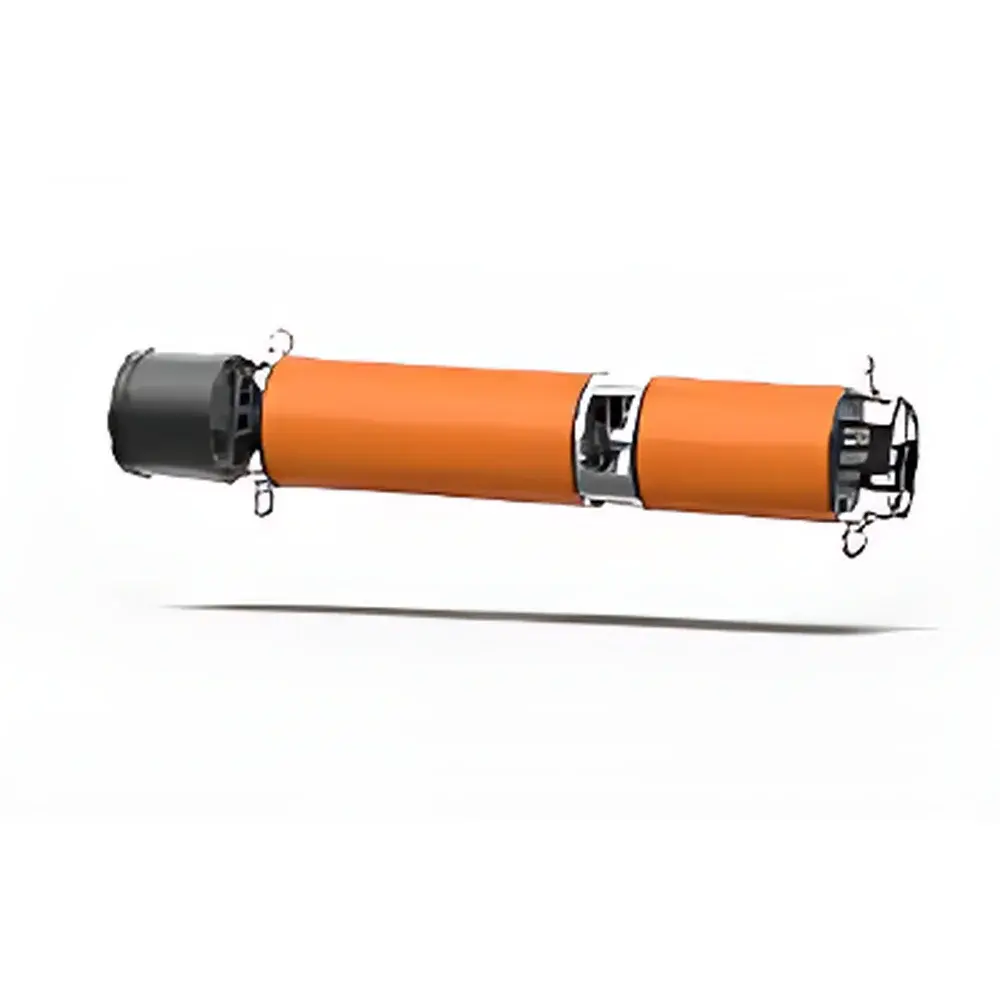
Bettersize BT-Inline300 Submersible In-Line Laser Sediment Analyzer
| Brand | Bettersize |
|---|---|
| Origin | Liaoning, China |
| Manufacturer Type | Original Equipment Manufacturer (OEM) |
| Instrument Type | In-line Laser Particle Size Analyzer |
| Repeatability | ≤2% (D50, GB Standard Reference Material) |
| Particle Size Range | 0.1–2000 µm |
| Sediment Concentration Range | 0.001–100 kg/m³ |
| Optical Path Adjustment | Auto-adaptive 0.5–40 mm |
| Max Submersion Depth | 800 m (customizable) |
| IP Rating | IP68 |
| Operating Temperature | 0–55 °C |
| Depth Sensor Range | 0–200 m (±0.01 m accuracy) |
| Temperature Sensor Range | −20–85 °C (±0.01 °C accuracy) |
| Laser Source | High-power fiber-coupled polarized laser |
| Detector Array | 80-element forward + side-scatter detector (0.0163°–42° angular coverage) |
| Data Transmission Modes | Wired (real-time), 4G Wireless (real-time), Offline (SD card storage, 16 GB) |
| Battery Standby Time | ≥24 h |
| Compliance | GB/T 15966–2017 |
Overview
The Bettersize BT-Inline300 Submersible In-Line Laser Sediment Analyzer is an engineered solution for real-time, in-situ measurement of suspended sediment particle size distribution (PSD) and mass concentration in natural aquatic environments. Based on Mie scattering theory and optimized laser diffraction principles, the instrument performs direct optical interrogation of particles within a dynamically adjustable measurement zone—eliminating the need for sample extraction, dilution, or pre-calibration. Its core architecture integrates a high-stability polarized fiber laser, an 80-channel angular scatter detector array, and adaptive optical path control that automatically modulates the effective measurement volume (0.5–40 mm) in response to local sediment concentration. This ensures optimal signal-to-noise ratio across an exceptionally wide operational range—from ultra-low turbidity (0.001 kg/m³) to hyper-concentrated flows (100 kg/m³)—while mitigating multiple scattering artifacts at high concentrations and weak signal loss at low concentrations. Designed for long-term deployment in rivers, lakes, estuaries, and coastal zones, the BT-Inline300 operates autonomously underwater for up to 24 hours on internal battery power and meets IP68 ingress protection and GB/T 15966–2017 hydrological instrumentation requirements.
Key Features
- Auto-adaptive optical path control: Real-time adjustment of measurement zone length (0.5–40 mm) based on instantaneous sediment concentration to maintain measurement fidelity across 5 orders of magnitude (0.001–100 kg/m³).
- Background-independent data processing: Proprietary algorithm eliminates requirement for prior background acquisition—even with minor lens fouling—ensuring stable PSD and concentration output without manual intervention.
- Integrated automatic lens cleaning system: Electromechanically actuated wiper mechanism activates upon detection of optical attenuation, restoring transmittance without retrieval or maintenance.
- Self-balancing hydraulic compensation: Dual-ended metal bellows (50 mm stroke, ≥2 MPa pressure rating) counteract hydrostatic load during depth variation, preserving optical alignment and mechanical integrity at depths up to 800 m (custom configuration).
- Triple-mode data transmission: Simultaneous support for hardwired RS-485/Ethernet output, 4G LTE wireless telemetry, and offline logging to internal 16 GB flash memory with timestamped, structured binary files.
- Onboard embedded OS with RTC and file system: Enables autonomous operation—including auto-alignment, self-diagnostic routines, scheduled measurements, and metadata tagging (depth, temperature, time)—without external supervision.
Sample Compatibility & Compliance
The BT-Inline300 is validated for direct in-situ analysis of natural suspended sediments including silt, clay, fine sand, and organic particulates in freshwater and marine systems. It measures both volumetric particle size distribution (0.1–2000 µm) and mass concentration (kg/m³) without calibration transfer or matrix-matching. The instrument complies with GB/T 15966–2017 “General Technical Requirements and Basic Parameters for Hydrological Instruments” and supports traceable verification using certified reference materials per ISO 13320:2020 (Laser Diffraction Particle Size Analysis). Its measurement uncertainty for D50 is ≤2% repeatability and ≤5% accuracy against national standard sediment samples. All sensor outputs—including depth (0–200 m, ±0.01 m), water temperature (−20–85 °C, ±0.01 °C), and optical density—are digitally logged with synchronized timestamps. No user calibration or background subtraction is required prior to deployment, fulfilling GLP-aligned field operation protocols.
Software & Data Management
Data acquisition and post-processing are managed via Bettersize SedimentView™ desktop software (Windows 10/11), which ingests raw scatter patterns, applies Mie-based inversion with refractive index presets (1.54 @ 635 nm for quartz-rich sediments), and exports ASTM E2457-compliant PSD reports (D10, D50, D90, span, skewness) alongside mass concentration time series. The software supports batch processing of offline SD card logs, spectral quality flagging, and overlay comparison with historical or laboratory-derived grain-size distributions. All data files include embedded audit trails compliant with FDA 21 CFR Part 11 requirements when operated in networked mode with user authentication and electronic signature options enabled. Raw scatter data (.bin) and processed results (.csv, .xlsx, .pdf) are stored with SHA-256 checksums for integrity verification.
Applications
- River sediment monitoring: Continuous tracking of suspended load dynamics in the Yangtze and Yellow River basins, supporting sediment transport modeling and reservoir sedimentation forecasting.
- Lake and reservoir turbidity profiling: Vertical and horizontal mapping of particle size evolution related to stratification, algal bloom events, and watershed runoff inputs.
- Coastal and estuarine suspended matter characterization: Quantification of fluvial plume dispersion, dredging impact assessment, and sediment source fingerprinting via modal grain-size shifts.
- Wastewater treatment plant effluent compliance: Real-time verification of solids removal efficiency and optimization of coagulation-flocculation dosing.
- Drinking water intake monitoring: Early detection of upstream sediment pulses or turbidity spikes affecting filtration performance and disinfection byproduct formation potential.
- Industrial discharge surveillance: Regulatory reporting for mining, construction, and aquaculture operations under national water quality standards (e.g., GB 3838–2002).
FAQ
Does the BT-Inline300 require periodic recalibration in the field?
No. The instrument uses background-independent signal processing and factory-traceable optical alignment; no field recalibration is needed between deployments.
Can it operate in saline or brackish water?
Yes. Its titanium housing, IP68-rated seals, and corrosion-resistant optics are rated for continuous operation in seawater (up to 3.5% salinity) and estuarine conditions.
How is optical alignment maintained under varying hydrostatic pressure?
Through dual-ended metal bellows compensation and rigid monolithic optical bench design—validated to maintain beam collimation and detector focus stability from surface to 800 m depth.
Is the 16 GB internal memory sufficient for long-term unattended operation?
At default 1-minute sampling interval, 16 GB supports >18 months of continuous logging; users may configure lower-resolution modes to extend capacity further.
What refractive index assumptions does the inversion algorithm use?
Default setting assumes 1.54 (quartz), but users may input custom complex refractive indices (n + ik) for organic, calcareous, or metallic particulates per ISO 13320 guidelines.



