
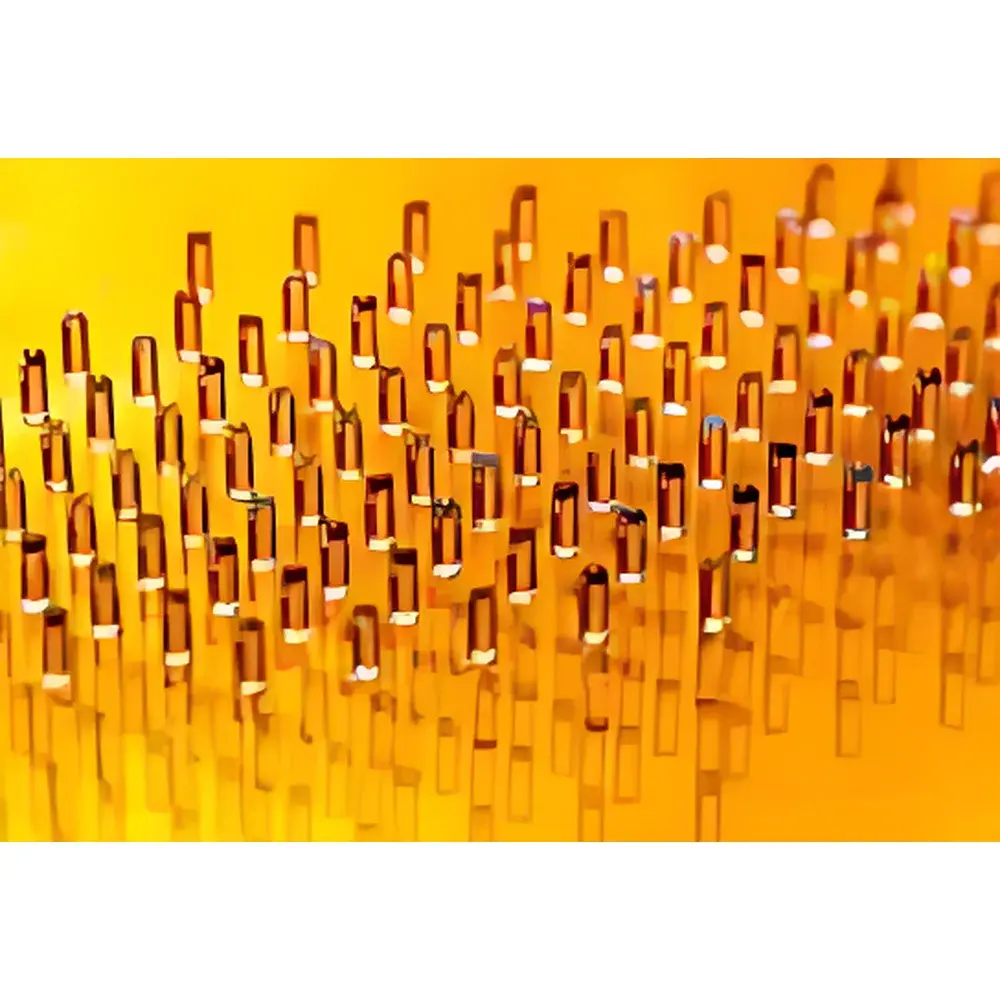
GRINTECH GRIN Cylindrical Lens – Gradient Index Micro-Optic Element
| Brand | GRINTECH |
|---|---|
| Origin | Canada |
| Manufacturer Type | Authorized Distributor |
| Origin Category | Imported |
| Model | GRIN Cylindrical Lens |
| Price | Upon Request |
| Core Application | Solid-State Laser Systems & Beam Shaping |
Overview
The GRINTECH GRIN Cylindrical Lens is a precision-engineered gradient-index (GRIN) micro-optical component designed for high-fidelity beam shaping, fiber coupling, and collimation in solid-state laser systems. Unlike conventional refractive or diffractive optics, GRIN lenses rely on a radially varying refractive index profile—typically fabricated via silver-ion exchange in thermally stable borosilicate glass—to achieve focusing and collimating functionality without curved surfaces. This intrinsic axial symmetry and planar geometry enable robust integration into compact optomechanical assemblies, especially where space constraints, alignment stability, and thermal drift resistance are critical. The lens operates on paraxial ray propagation principles within the GRIN medium, delivering diffraction-limited performance with numerical apertures up to NA = 0.5. Its design inherently minimizes spherical and chromatic aberrations across defined wavelength bands, making it suitable for demanding applications in laser diode collimation, fiber pigtailing, optical coherence tomography (OCT) light engines, and miniature endoscopic imaging systems.
Key Features
- Planar input/output surfaces—eliminates need for anti-reflective coating alignment and simplifies active/passive alignment in micro-optical modules
- Non-toxic silver-exchanged glass substrate—compliant with RoHS and REACH directives; no lead or arsenic content
- Standard diameters: 0.5 mm, 1.0 mm, 1.8 mm, and 2.0 mm—with custom diameters available upon request
- NA options: 0.2 (for extended depth-of-field applications) and 0.5 (for high-light-gathering efficiency)
- Tailorable working distance, focal length, and lens length—subject to GRIN profile optimization and manufacturing feasibility
- Optional angled input surface (8° wedge) to suppress back-reflections in high-sensitivity interferometric or cavity-based configurations
Sample Compatibility & Compliance
The GRIN cylindrical lens is compatible with single-mode and multimode optical fibers (SMF-28, HI1060, PM980), laser diodes (635–1550 nm), and VCSEL arrays. It meets ISO 10110-7 surface quality specifications (scratch-dig 20–10) and conforms to MIL-PRF-13830B for optical component cleanliness and handling. All standard variants comply with IEC 61290-4-1 for passive optical component testing and are qualified for use in Class 1 laser safety environments per IEC 60825-1. When integrated into medical or diagnostic instruments, the lens supports traceability under ISO 13485 quality management systems and may be included in FDA 510(k)-cleared optical subassemblies.
Software & Data Management
While the GRIN cylindrical lens itself is a passive optical element, its performance parameters—including effective focal length (EFL), beam waist position, and M²-dependent divergence—are fully modelable using industry-standard ray-tracing tools such as Zemax OpticStudio (non-sequential mode), CODE V, and FRED. GRINTECH provides detailed .ZBF (Zemax Binary File) and .DAT files containing measured GRIN index profiles for simulation fidelity. For system-level validation, users may integrate lens characterization data into LabVIEW or Python-based calibration workflows supporting NIST-traceable power metering and beam profiler (e.g., Ophir Pyrocam, Thorlabs BC106N) synchronization. Audit trails for lens selection, mounting orientation, and environmental exposure history can be maintained in accordance with GLP/GMP documentation requirements.
Applications
- Fiber-to-laser-diode coupling in telecom transceivers and pump combiners
- Beam circularization of elliptical laser diode outputs (e.g., 980 nm pump diodes)
- Miniaturized OCT probe optics requiring low-dispersion, high-NA line focus generation
- Microscopy illumination optics for structured light projection and confocal line scanning
- Free-space interconnects in photonic integrated circuit (PIC) test fixtures
- Alignment reference elements in ultrafast amplifier seed stages and regenerative cavity injection
FAQ
What is the typical operating wavelength range for standard GRIN cylindrical lenses?
Standard variants support three primary AR-coating bands: C1 (670 nm), C2 (800–960 nm), and C5 (1310–1550 nm). Uncoated versions (NC) exhibit ~12% Fresnel loss per surface.
Can GRIN cylindrical lenses be used in vacuum or high-humidity environments?
Yes—the silver-exchanged glass exhibits negligible outgassing (per ASTM E595) and maintains structural integrity at RH ≤ 95% non-condensing. Vacuum-compatible mounting requires indium or Kovar-compatible solder preforms.
Is there a maximum permissible power density for continuous-wave laser operation?
For uncoated lenses at 1064 nm, damage threshold is ≥ 500 MW/cm² (10 ns, 10 Hz); AR-coated versions sustain ≥ 1 GW/cm² under identical conditions.
How is focal length tolerance specified and verified?
EFL tolerance is ±1.5% over batch production, measured interferometrically using a Twyman–Green setup referenced to NIST-traceable standards.
Do you provide mounting solutions or kinematic adapters?
GRINTECH offers precision-machined stainless-steel lens tubes (SM05/SM1 compatible) and custom flexure mounts for active alignment; OEM integration kits include fiducial marks and alignment lasers.




