
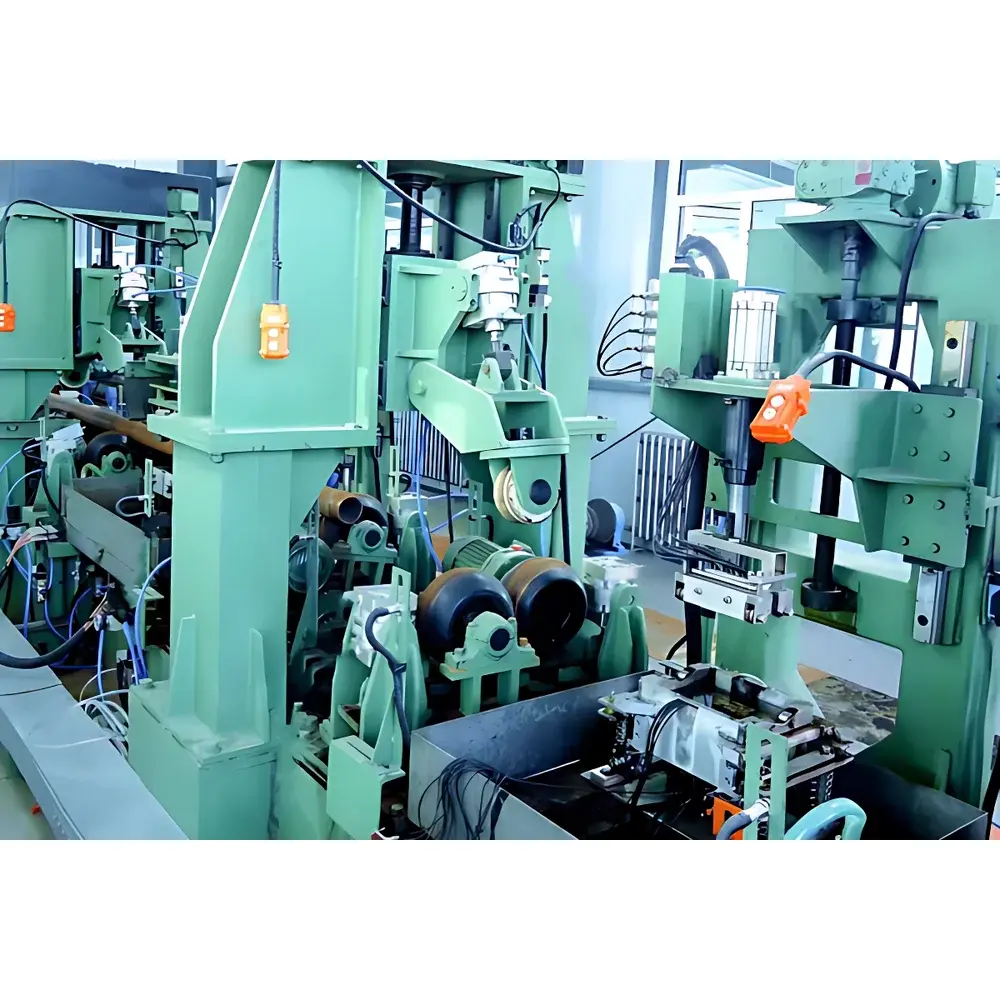
NC-GUFT Series Local Water-Immersion Ultrasonic & Magnetic Flux Leakage Testing System
| Brand | NCS (China Iron and Steel Research Institute Group) |
|---|---|
| Origin | Beijing, China |
| Manufacturer Type | OEM Manufacturer |
| Country of Origin | China |
| Model | NC-GUFT Series |
| Pricing | Available Upon Request |
Overview
The NC-GUFT Series Local Water-Immersion Ultrasonic & Magnetic Flux Leakage (MFL) Testing System is an integrated dual-mode non-destructive testing (NDT) platform engineered for high-reliability inspection of ferromagnetic and non-ferromagnetic metallic tubular and bar stock. It combines two complementary physical principles: localized water-coupled ultrasonic pulse-echo and through-transmission techniques for volumetric flaw detection (e.g., internal voids, inclusions, laminations), and magnetic flux leakage sensing for surface and near-surface discontinuities (e.g., pitting, grooves, cracks ≤ 0.1 mm depth) in magnetically permeable materials. Unlike full-immersion systems, the local water immersion design minimizes fluid volume, reduces maintenance overhead, and enables on-line or near-line integration into production lines—particularly where space, water recycling, or material handling constraints exist. The system operates under controlled transducer standoff, stable coupling pressure, and real-time acoustic impedance matching to ensure consistent signal-to-noise ratio across variable diameters (Φ6–Φ325 mm) and wall thicknesses (1.5–40 mm).
Key Features
- Hybrid NDT architecture integrating high-frequency ultrasonic transducers (2–10 MHz) with multi-channel MFL sensor arrays for concurrent defect characterization
- Modular scanning carriage with programmable X-Y-Z motion control, enabling precise positioning over complex geometries including tapered, bent, or threaded sections
- Real-time A-scan, B-scan, and C-scan data fusion via synchronized acquisition hardware; raw RF data preserved for post-processing
- Adaptive gain compensation and time-variable gain (TVG) algorithms to normalize echo amplitude across varying material attenuation and curvature
- Self-calibrating MFL probe head with Hall-effect sensor arrays and temperature-compensated magnetic yoke excitation (0.8–1.6 T field strength)
- Ruggedized IP65-rated enclosure suitable for industrial floor environments; CE-compliant electromagnetic compatibility per EN 61326-1
Sample Compatibility & Compliance
The NC-GUFT system supports seamless inspection of seamless and welded steel, stainless steel, aluminum, copper, titanium, and nickel-alloy tubes and bars—regardless of heat treatment condition (annealed, quenched & tempered, cold-drawn). It accommodates round, square, and rectangular cross-sections with outer diameters from 6 mm to 325 mm and lengths up to 12 m. All test protocols are traceable to internationally recognized standards, including ASTM E273 (longitudinal ultrasonic testing of pipe), ASTM E1444/E1444M (magnetic particle testing), ISO 10893-5 (MFL for seamless and welded steel tubes), ISO 10893-11 (ultrasonic testing of seamless and welded steel tubes), and GB/T 5777 (ultrasonic inspection of stainless steel tubes). Full compliance documentation—including calibration certificates per ISO/IEC 17025, uncertainty budgets, and audit-ready configuration records—is provided for GLP/GMP-regulated environments.
Software & Data Management
The proprietary NCS-Insight™ software suite provides comprehensive test setup, execution, analysis, and reporting capabilities. It supports automated parameter optimization based on material grade, geometry, and specification requirements (e.g., API 5L PSL2, ASTM A53 Grade B). All inspection data—including raw waveform files (.bin), encoded position metadata, and defect maps—are stored in a structured SQLite database with configurable retention policies. Role-based user access, electronic signatures, and full 21 CFR Part 11 audit trails—including operator ID, timestamp, parameter changes, and result approvals—are enabled by default. Export formats include ASTM E2371-compliant XML reports, PDF certificates with embedded digital signatures, and CSV-compatible defect logs for integration with enterprise MES/QMS platforms.
Applications
This system serves critical quality assurance functions across multiple regulated sectors: incoming material verification for power generation tubing (ASME Section II, SA-178/SA-213); in-process inspection of OCTG (oil country tubular goods) per API RP 5A5 and DEP 31.40.20.37; final acceptance testing of aerospace hydraulic lines (AMS 2630, NAS 410); and periodic integrity assessment of nuclear fuel cladding tubes (ASTM E1067). It is routinely deployed in rolling mills, tube finishing lines, and third-party certification laboratories requiring repeatable, specification-driven pass/fail decisions—not just visualization.
FAQ
What types of defects can the NC-GUFT system detect simultaneously?
It detects volumetric flaws (e.g., transverse/longitudinal internal voids, delaminations) via ultrasound and surface-breaking or subsurface discontinuities (e.g., fatigue cracks, corrosion pits, grinding burns) via MFL—within a single scan pass.
Is the system compatible with automated production line integration?
Yes. It features EtherCAT and Modbus TCP interfaces for PLC synchronization, encoder-triggered data acquisition, and real-time pass/fail output signals to upstream/downstream equipment.
Does it support custom inspection protocol development?
Yes. NCS-Insight™ includes a scriptable test sequence editor compliant with IEC 61131-3 Structured Text, allowing users to define dynamic gating, multi-zone sensitivity mapping, and conditional logic for adaptive scanning.
How is system performance validated between calibrations?
Built-in reference standard tracking uses NIST-traceable notched and drilled flat-bottom hole (FBH) reference blocks per ASTM E127 and E317, with automated sensitivity drift monitoring and alerting.
Can inspection data be exported for regulatory submission?
Yes. Reports comply with FDA eCTD Module 5 requirements and include full metadata, chain-of-custody logs, and digitally signed PDFs meeting ISO 19011 audit criteria.



