
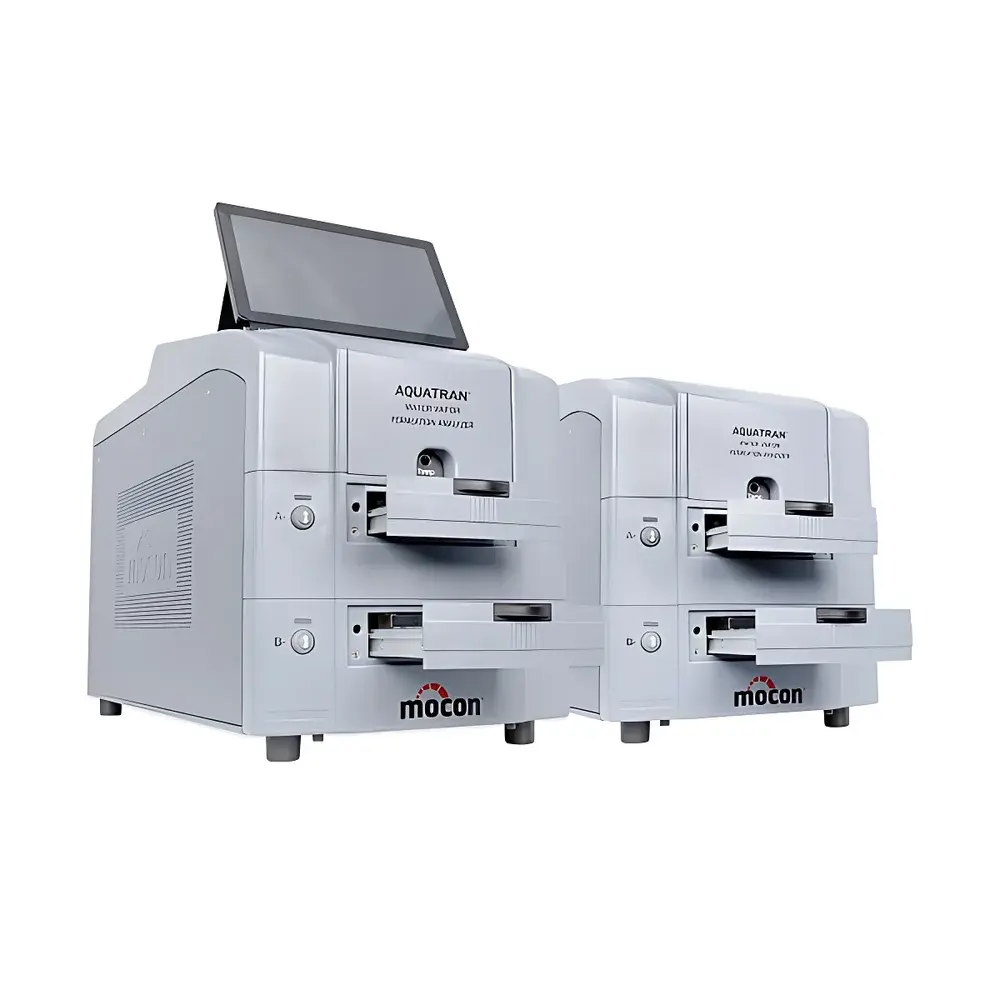
MOCON AQUATRAN-W® 3/38 H Water Vapor Transmission Rate Tester
| Brand | MOCON |
|---|---|
| Origin | USA |
| Model | AQUATRAN-W® 3/38 H |
| Detection Limit | 0.05 g/(m²·day) |
| Measurement Range | 0.05–200 g/(m²·day) |
| Test Chambers | 4 independent horizontal dual-membrane chambers |
| Compliance | ASTM F1249 |
| Sensor Type | Modulated Infrared (Patented MOCON) |
| Environmental Control | Automated temperature, RH, and N₂ flow |
| Sealing Technology | TruSeal nitrogen purge ring |
| Software Interface | Local PC GUI or optional touchscreen HMI |
| Test Mode Options | QC pass/fail mode, reference film validation, triplicate testing |
Overview
The MOCON AQUATRAN-W® 3/38 H is a high-throughput, laboratory-grade water vapor transmission rate (WVTR) analyzer engineered for precision, reproducibility, and regulatory compliance in packaging R&D and quality control environments. It operates on the principle of modulated infrared detection—a patented MOCON technology that measures water vapor concentration downstream of a conditioned test specimen using phase-sensitive signal processing. This method enables highly selective and stable quantification of water vapor flux across barrier films under controlled temperature and relative humidity gradients, fully satisfying the measurement requirements of ASTM F1249–23 (“Standard Test Method for Water Vapor Transmission Rate Through Plastic Film and Sheeting Using a Modulated Infrared Sensor”). Unlike traditional coulometric or gravimetric methods, the AQUATRAN-W® 3/38 H delivers real-time, non-destructive, and zero-point-free measurements—eliminating drift-related recalibrations and significantly reducing total assay time.
Key Features
- Four independent horizontal dual-membrane test chambers enable concurrent analysis of up to four specimens—doubling throughput versus single-chamber instruments and supporting triplicate testing with or without reference standards.
- Patented TruSeal nitrogen ring-sealing system eliminates edge leakage and removes the need for frequent zero-point verification, enhancing measurement robustness and shortening test cycles.
- Modulated infrared sensor with <0.05 g/(m²·day) detection limit and full-range linearity from 0.05 to 200 g/(m²·day), suitable for both ultra-high-barrier (e.g., AlOx-coated PET, SiOx-laminates) and moderate-barrier materials (e.g., LDPE, PP, EVOH blends).
- Fully automated environmental control: precise regulation of test temperature (15–40 °C), relative humidity (10–90% RH), and carrier gas flow (ultra-pure N₂), ensuring strict adherence to ASTM F1249 conditioning protocols.
- Intuitive software interface—available via local Windows-based GUI or optional integrated touchscreen HMI—with real-time graphical overlay of measured WVTR against user-defined specification limits (QC pass/fail mode).
- Automated method execution: one-click initiation of standardized test sequences, including preconditioning, equilibration, data acquisition, and report generation with audit-trail-capable metadata logging.
Sample Compatibility & Compliance
The AQUATRAN-W® 3/38 H accommodates rigid and flexible flat-sheet specimens up to 100 mm × 100 mm, including monolayer polymers, coextruded structures, metallized films, vacuum-deposited oxide coatings, and pharmaceutical blister lidding materials. Its horizontal chamber design facilitates rapid sample loading and minimizes handling-induced stress or creasing. All hardware and firmware are designed to support GLP and GMP-aligned workflows: instrument calibration records, user access logs, electronic signatures (via optional 21 CFR Part 11-compliant software module), and traceable reference film validation (e.g., NIST-traceable permeability standards) are fully supported. The system complies with ASTM F1249, ISO 15106-3, and JIS Z 0237, and its measurement uncertainty profile has been validated per ISO/IEC 17025 guidelines in third-party accredited laboratories.
Software & Data Management
Control and analysis are performed via MOCON’s proprietary WinWVTR™ software, which runs on a dedicated Windows PC or embedded touchscreen platform. The software provides full method definition (temperature setpoint, RH gradient, test duration, acceptance criteria), real-time curve visualization, automatic outlier detection, and customizable reporting templates compliant with internal SOPs and external audit requirements. Raw data—including timestamped sensor voltage, calculated flux, chamber conditions, and seal integrity metrics—are stored in encrypted SQLite databases with immutable audit trails. Export options include CSV, PDF, and XML formats compatible with LIMS integration. Optional 21 CFR Part 11 modules provide electronic signature capability, role-based access control, and change history tracking for regulated pharmaceutical and medical device packaging applications.
Applications
- Development and qualification of high-barrier flexible packaging for moisture-sensitive pharmaceuticals (e.g., lyophilized injectables, oral solid doses).
- Accelerated shelf-life prediction for food packaging—correlating WVTR data with product stability endpoints under defined storage conditions.
- Comparative evaluation of coating performance (e.g., SiOx, AlOx, DLC) on polymer substrates across production batches.
- QC release testing of incoming rollstock and finished pouches in contract manufacturing organizations (CMOs) and brand owners’ internal labs.
- Root-cause analysis of delamination or seal failure events linked to moisture ingress pathways.
- Regulatory submission support: generating GLP-compliant data packages for FDA, EMA, and PMDA dossier filings.
FAQ
What standards does the AQUATRAN-W® 3/38 H comply with?
It is fully compliant with ASTM F1249–23 and supports ISO 15106-3 and JIS Z 0237 methodologies through configurable test parameters and environmental controls.
Can it measure ultra-low WVTR values below 0.1 g/(m²·day)?
Yes—the instrument’s detection limit is 0.05 g/(m²·day), and its signal-to-noise ratio enables reliable quantification down to this threshold when used with appropriate reference standards and proper chamber sealing.
Is the system suitable for testing metallized or coated barrier films?
Absolutely. Its modulated IR detection is insensitive to optical interference, making it ideal for reflective, opaque, or multi-layered structures where optical or electrochemical methods fail.
Does it require daily zero-point calibration?
No—TruSeal nitrogen purging suppresses ambient moisture intrusion at the seal interface, eliminating the need for routine zero checks and improving long-term measurement stability.
Can test data be integrated into an existing LIMS?
Yes—WinWVTR™ supports structured data export (CSV/XML) and optional OPC UA or REST API interfaces for seamless LIMS or MES connectivity.





