
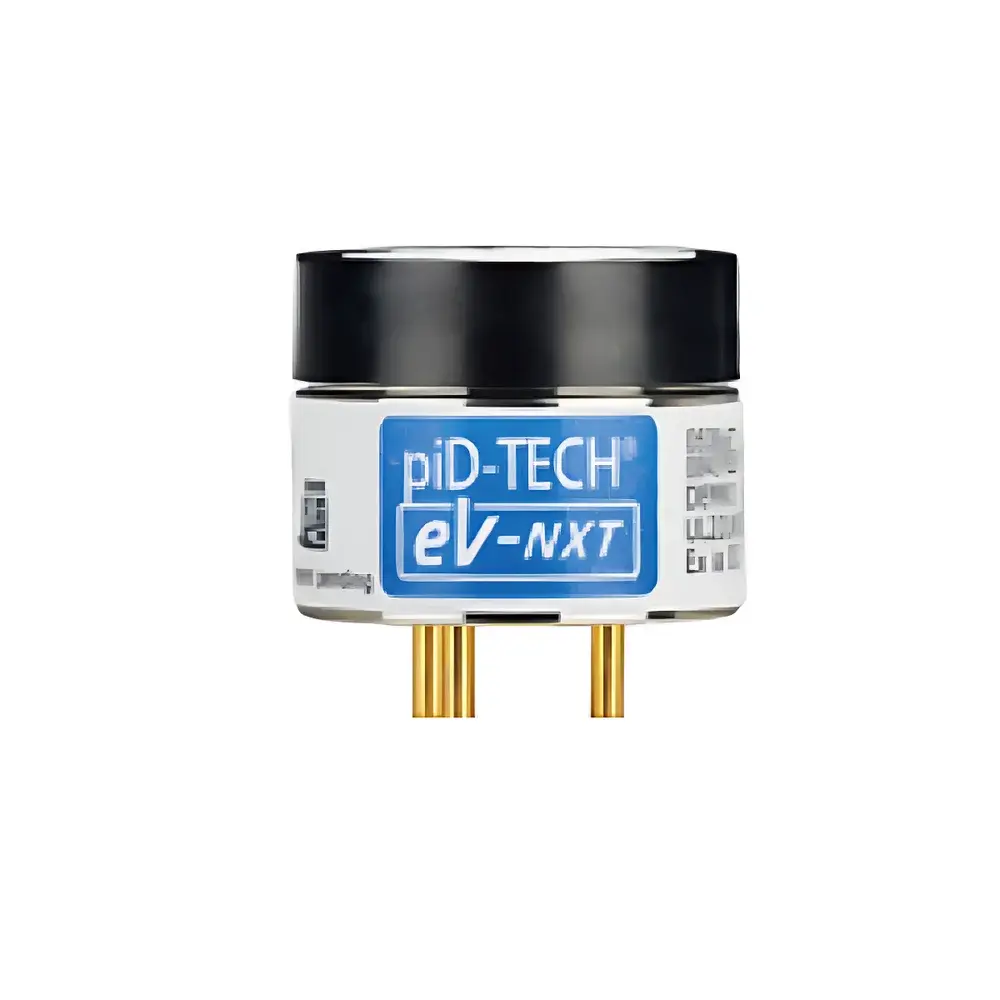
Baseline eV-NXT 045-114 Blue PID Sensor Module
| Brand | Baseline |
|---|---|
| Origin | USA |
| Model | eV-NXT 045-114 |
| Detection Range | 4 ppm |
| LOD | 0.5 ppb |
| T90 | < 6.5 s |
| Typical Sensitivity | 545 mV/ppm |
| Measurement Condition | 1 ppm |
Overview
The Baseline eV-NXT 045-114 Blue is a high-performance, miniature photoionization detector (PID) sensor module engineered for precision volatile organic compound (VOC) monitoring in demanding environmental and industrial applications. Unlike conventional PIDs relying on fixed-lamp energy or non-temperature-compensated electronics, the eV-NXT platform employs a stabilized 10.6 eV UV lamp with active thermal regulation and proprietary electrode geometry to deliver consistent ionization efficiency across variable ambient conditions. Its core measurement principle is based on photoionization: VOC molecules entering the detection chamber are ionized by ultraviolet photons; the resulting ion current is linearly proportional to analyte concentration and converted into a calibrated analog output (typically 0–5 V or 4–20 mA). Designed for integration into portable gas monitors, fixed-site air quality stations, and OEM instrumentation, the eV-NXT 045-114 Blue meets intrinsic safety requirements (Class I, Division 1, Groups A–D per UL 913) and supports continuous operation in outdoor environments where temperature fluctuations and humidity gradients challenge sensor stability.
Key Features
- Enhanced inter-sensor reproducibility (< ±5% full-scale deviation at 1 ppm isopropanol), enabling true plug-and-play replacement without individual calibration revalidation
- Extended operational range: −30 °C to +50 °C ambient temperature and 0–95% RH non-condensing, with baseline drift < 2% FS/°C and < 0.8% FS/%RH
- Low-power architecture: nominal operating voltage 3.3 VDC ±5%, average current draw < 45 mA during active measurement, supporting >12-month battery life in typical portable configurations
- Fast dynamic response: T90 ≤ 6.5 seconds for common VOCs including benzene, toluene, xylene, and formaldehyde under standard test conditions (23 °C, 50% RH)
- Onboard diagnostic circuitry continuously monitors lamp intensity, electrode bias stability, and signal-to-noise ratio, flagging degradation or contamination events prior to measurement drift
- Blue-coded housing denotes factory-configured 4 ppm full-scale range optimized for ambient air quality monitoring and low-level industrial hygiene screening
Sample Compatibility & Compliance
The eV-NXT 045-114 Blue detects over 200 VOCs with ionization potentials below 10.6 eV, including aliphatic/aromatic hydrocarbons, ketones, esters, amines, and sulfur-containing compounds. It does not respond to methane, ethane, CO, CO₂, NOₓ, or most chlorinated solvents with IP > 10.6 eV (e.g., trichloroethylene). The sensor complies with IEC 60079-0:2017 (Explosive Atmospheres – General Requirements) and carries UL certification for Class I, Division 1 hazardous locations. While not a standalone certified instrument, it satisfies component-level requirements for systems seeking EPA Method TO-15, ASTM D5466, and ISO 16000-6 compliance when integrated into validated analytical platforms. All units undergo 72-hour burn-in and individual sensitivity verification against NIST-traceable isopropanol standards.
Software & Data Management
The eV-NXT module outputs a ratiometric analog signal compatible with industry-standard ADC interfaces (12–16 bit resolution recommended). Baseline provides reference firmware libraries for ARM Cortex-M and ESP32 microcontrollers, including automatic temperature/humidity compensation algorithms derived from empirical characterization across 150+ environmental test points. For regulatory data integrity, the sensor supports optional digital UART output with embedded audit trail metadata (lamp hours, self-test timestamps, calibration epoch ID). When deployed in networked systems, it aligns with FDA 21 CFR Part 11 expectations through external data loggers that enforce electronic signatures, change control, and secure storage—no onboard memory or user-accessible configuration registers are present to minimize validation burden.
Applications
- Ambient air quality networks measuring background VOC levels in urban, suburban, and peri-urban zones per EU Directive 2008/50/EC
- Industrial hygiene surveys for OSHA PEL and ACGIH TLV compliance in manufacturing, painting, and printing facilities
- Indoor air quality (IAQ) diagnostics in schools, hospitals, and office buildings following ASHRAE Standard 62.1
- Leak detection and fugitive emission monitoring in petrochemical and pharmaceutical production sites
- OEM integration into unmanned aerial vehicles (UAVs) and mobile ground units for spatial VOC mapping
FAQ
What VOCs does the eV-NXT 045-114 Blue detect?
It responds to all VOCs with ionization potential ≤ 10.6 eV, including benzene, styrene, acetone, ethanol, and limonene—but not methane, ethane, or fully halogenated compounds.
Is field calibration required?
Zero calibration is recommended before each deployment using clean, humidified zero air; span calibration with certified 1 ppm isopropanol gas is advised every 30 days for critical applications.
Can this sensor be used in explosive atmospheres?
Yes—when installed per manufacturer wiring diagrams and housed in an approved IS barrier system, it meets Class I, Div 1, Groups A–D requirements.
Does it require warm-up time?
Full stabilization occurs within 90 seconds of power-on under ambient conditions; lamp thermal equilibrium is achieved in < 45 s.
How is humidity compensated?
Compensation is implemented algorithmically in host firmware using real-time RH input from a co-located SHT45 sensor; Baseline provides coefficient tables and lookup functions in its SDK.
Related Products







