
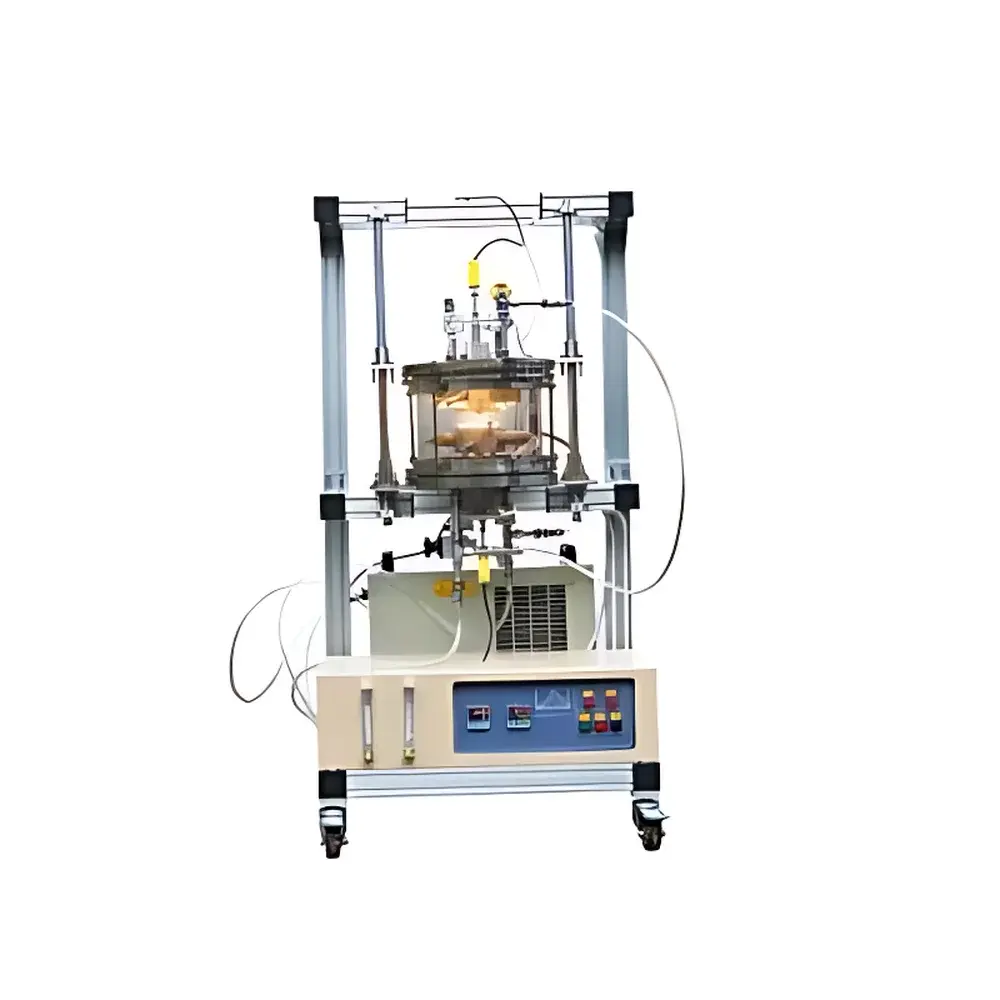
OTF-1200X-RTP-II CSS Rapid Thermal Evaporation Furnace by合肥科晶 (Hefei Kejing)
| Key | Brand=Hefei Kejing |
|---|
Overview
The OTF-1200X-RTP-II is a precision-engineered horizontal rapid thermal processing (RTP) tube furnace designed specifically for close-spaced sublimation (CSS) and physical vapor deposition (PVD) of thin-film materials. Unlike conventional resistance-heated tube furnaces, this system employs dual-zone infrared (IR) heating—comprising two independently controlled arrays of high-intensity IR lamps mounted at the top and bottom of the quartz reaction chamber—to achieve fast, uniform, and highly reproducible thermal profiles essential for stoichiometric film growth (e.g., CdTe, CZTS, perovskites). The furnace operates under low-pressure inert or reactive atmospheres (down to 1×10⁻² torr), enabling precise control over vapor transport kinetics, nucleation density, and grain morphology. Its architecture supports both top-down substrate heating (via AlN-coated 3″ carrier plate) and bottom-up source evaporation (using graphite crucible), fulfilling the fundamental geometric and thermal requirements of the CSS method as defined in ASTM F2553–21 (Standard Guide for Thin-Film Deposition Process Characterization).
Key Features
- Dual independent IR heating zones (top and bottom), each rated at 800 W, enabling programmable thermal gradients up to 350 °C across the sample zone—critical for optimizing vapor supersaturation and interfacial condensation dynamics.
- High-purity fused quartz tube (279 mm OD × 274 mm ID × 229 mm L) with KF25 vacuum flanges (316 stainless steel), double O-ring sealed with silicone elastomer gaskets, and integrated digital vacuum gauge (0.001–1000 torr range).
- Water-cooled IR lamp housings minimize thermal radiation leakage and support rapid cooling (>10 °C/s from 600 °C to 100 °C), reducing thermal budget and mitigating interdiffusion in multilayer stacks.
- 3″ diameter aluminum nitride (AlN) substrate holder (3″ × 0.5 mm) mounted directly beneath the upper IR array ensures exceptional lateral temperature uniformity (±2 °C across wafer surface) during ramp-hold-cool cycles.
- 30-segment PID temperature controller with RS485 communication port; compatible with optional PC-based software for full program logging, real-time curve visualization, and export of .csv/.txt temperature profiles compliant with GLP audit trails.
- Integrated gas handling interface: dual 1/4″ VCR-style inlet/outlet ports on bottom/top flanges support multi-gas purging (N₂, Ar, H₂, forming gas); optionally configurable with KEJING’s mass-flow-controlled 2-channel gas mixing system (MFC range: 0–100 sccm per line).
Sample Compatibility & Compliance
The OTF-1200X-RTP-II accommodates standard 3″ circular wafers or 2″ × 2″ square substrates, including Si, glass, stainless steel, molybdenum, and flexible metal foils. The quartz chamber geometry and IR spectral output (peak ~1.2 µm) are optimized for absorption by common precursor materials such as CdCl₂, Te, S, Se, and organic halides. All structural components meet CE safety directives (2014/35/EU Low Voltage Directive and 2014/30/EU EMC Directive). Vacuum integrity and thermal stability have been validated per ISO 10437:2021 (Industrial furnaces — Performance testing procedures), and the control firmware supports time-stamped event logging required for FDA 21 CFR Part 11–aligned environments when paired with validated third-party software.
Software & Data Management
The embedded temperature controller supports ASCII protocol over RS485 for bidirectional communication with host PCs. Optional KEJING LabControl™ software (v3.2+) provides full remote configuration of ramp rates, dwell times, and zone offsets; records synchronized thermocouple data (two K-type sensors, one per flange); and generates timestamped .csv files containing temperature, setpoint, and elapsed time columns. Exported datasets include metadata headers (operator ID, batch number, atmospheric conditions) and support automated integration into LIMS platforms via Python API or OPC UA gateways. Audit trail functionality includes user login tracking, parameter change history, and electronic signature prompts for critical steps—fully traceable for ISO/IEC 17025 accreditation workflows.
Applications
- Growth of polycrystalline CdTe absorber layers for thin-film photovoltaics (IEC 61215-2 MQT 14.2 compliant process development).
- Deposition of Cu₂ZnSnS₄ (CZTS) and related kesterite compounds under sulfur/selenium vapor pressure control.
- Rapid thermal annealing (RTA) of solution-processed perovskite precursors (e.g., MAPbI₃) to suppress PbI₂ residuals while preserving crystal orientation.
- Thermal evaporation of organic small molecules (e.g., Alq₃, NPB) in OLED R&D where substrate temperature modulation directly influences film morphology and exciton confinement.
- In-situ study of solid-state phase transformations (e.g., α↔β SnS, orthorhombic↔tetragonal BiFeO₃) under controlled partial pressures using residual gas analysis coupling.
FAQ
What vacuum level can the OTF-1200X-RTP-II achieve without additional pumping hardware?
The system reaches ≤1×10⁻² torr using only the standard KF25 connection and a typical two-stage rotary vane pump (e.g., Edwards RV8). For lower base pressures (<1×10⁻⁴ torr), a turbomolecular pump is recommended.
Can the furnace operate under reactive gas atmospheres such as H₂ or NH₃?
Yes—provided appropriate gas flow controllers, leak-tested fittings, and compatible furnace tube materials are used. Quartz is stable under H₂ up to 650 °C; NH₃ requires pre-baking to remove moisture and verification of seal integrity.
Is the AlN substrate holder replaceable, and what is its thermal conductivity specification?
The AlN carrier plate (3″ × 0.5 mm, ≥170 W/m·K) is a field-replaceable consumable. Spare units are available with certified thermal diffusivity test reports per ASTM E1461.
Does the system support simultaneous monitoring of substrate and source temperatures?
Yes—two independent K-type thermocouples are factory-mounted: one on the top flange (substrate proximity) and one on the bottom flange (crucible vicinity), each routed to separate PID channels with configurable alarm thresholds.
What maintenance intervals are recommended for IR lamps and O-rings?
IR lamps typically last ≥2000 hours under nominal cycling; O-rings should be inspected before each vacuum run and replaced every 6 months or after 50 thermal cycles above 400 °C, whichever occurs first.
Related Products



