
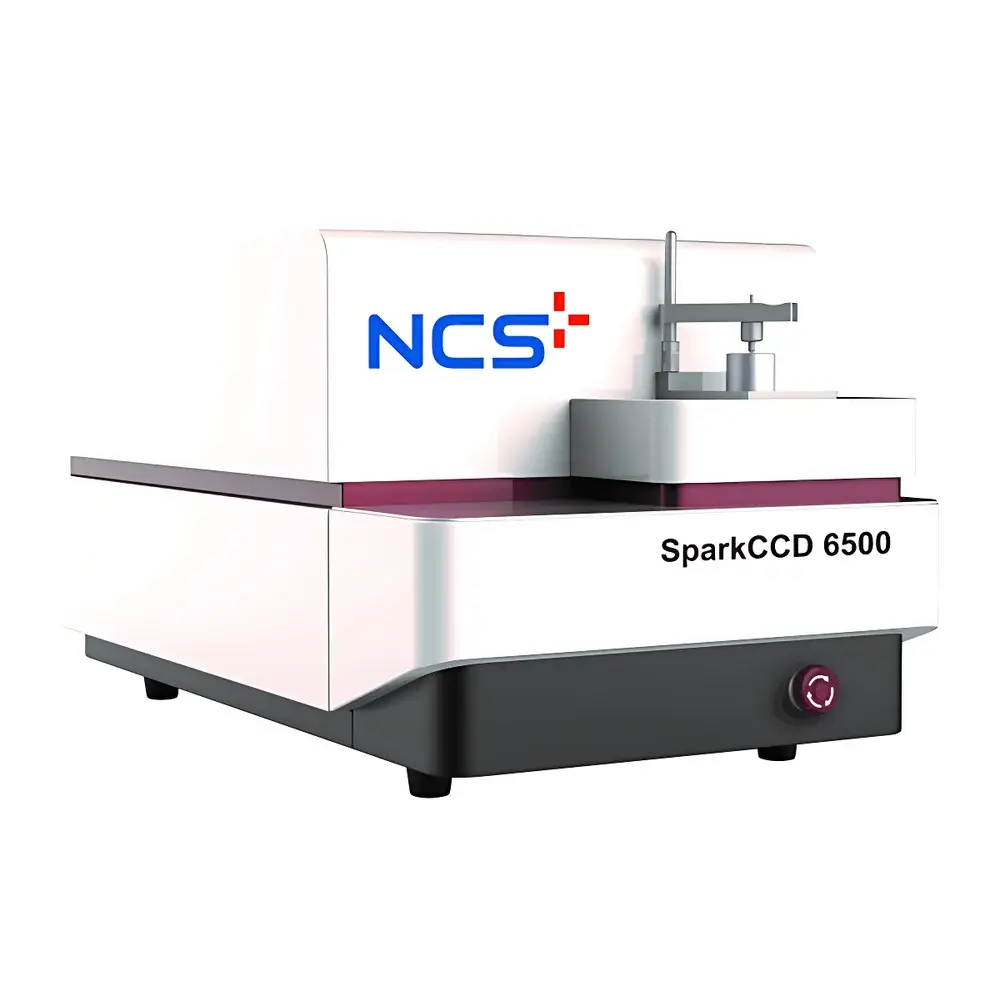
NCS SparkCCD 6500 Full-Spectrum Spark Optical Emission Spectrometer
| Brand | NCS |
|---|---|
| Origin | Jiangsu, China |
| Manufacturer Type | Direct Manufacturer |
| Instrument Type | Benchtop |
| Excitation Method | Spark Discharge |
| Detector Type | Charge-Coupled Device (CCD) |
| Focal Length | 500 mm |
| Grating Groove Density | 2700 lines/mm |
| Wavelength Range | 160–500 nm |
| Number of Detection Channels | 128 |
| Power Supply | 220 V ±10%, Single-Phase, 10 A, 2.5 kVA |
| Weight | 80 kg |
| Dimensions (W×D×H) | 470 × 872 × 435 mm |
| CCD Pixel Count | 3648 + 46 |
| Pixel Size | 8 µm |
| Optical Design | Paschen–Runge Mount with Holographic Concave Grating |
| Spectral Resolution (Pixel Level) | 0.005926 nm |
| Linear Dispersion | 0.7407 nm/mm |
| Argon Consumption | 60 mL/min (Standby), Tidal Purge Mode Enabled |
Overview
The NCS SparkCCD 6500 is a benchtop full-spectrum spark optical emission spectrometer engineered for precise, reproducible elemental analysis of metallic samples via spark discharge atomic emission spectroscopy (OES). Based on the Paschen–Runge optical configuration, it integrates a high-fidelity 500 mm focal length holographic concave grating (2700 lines/mm) and a back-thinned, UV-enhanced CCD detector array (3648 + 46 pixels, 8 µm pixel pitch) to deliver uniform spectral resolution across its operational range of 160–500 nm. Designed in a Class 10,000 cleanroom environment, its optical path is sealed and isolated from the spark stand via an integrated lens isolation valve—preventing contamination-induced signal drift and ensuring long-term photometric stability. The instrument complies with ISO 11577, ASTM E415, ASTM E1086, and GB/T 4336–2016—the national standard for multi-element determination in carbon and low-alloy steels, for which NCS served as primary drafting entity.
Key Features
- Full-spectrum acquisition architecture enabling simultaneous detection of all 128 analytical channels without mechanical wavelength scanning.
- Digital spark source with adjustable frequency up to 1000 Hz, optimized per matrix (Fe, Al, Cu, Ni, Co, Mg, Ti, Zn, Pb, Sn) to maximize excitation efficiency and signal-to-noise ratio.
- Coaxial rotating gas-flow spark stand featuring self-cleaning ignition geometry—enabling >1000 consecutive sparks without electrode cleaning or maintenance intervention.
- Intelligent spectral line hopping algorithm: dynamically selects optimal emission lines for each element based on real-time intensity feedback, improving accuracy and robustness across wide concentration ranges.
- Tidal argon purge control system: intelligently modulates argon flow during standby (60 mL/min) and analysis cycles, extending single-cylinder usage to ≥70 days at 24-hour standby—reducing operational cost and environmental footprint.
- Segmented exposure mode: independently configurable integration times per CCD segment allow enhanced sensitivity for trace elements (e.g., C, P, S, N, B) while maintaining dynamic range for major constituents.
Sample Compatibility & Compliance
The SparkCCD 6500 supports solid conductive metal samples—including cast iron, carbon steel, stainless steel, aluminum alloys, copper alloys, nickel-based superalloys, titanium grades, zinc die-castings, and lead–tin solders. Sample preparation follows standardized flat-surface grinding (ISO 11577 Annex A) with optional automated sample changers for high-throughput labs. All calibration and validation protocols align with GLP and GMP requirements. Data integrity safeguards include audit-trail-enabled software (compliant with FDA 21 CFR Part 11 principles), electronic signature support, and version-controlled method storage. Instrument performance verification adheres to ISO/IEC 17025:2017 metrological traceability frameworks, with documented repeatability (RSD < 0.5% for major elements), long-term stability (<1.5% intensity drift over 8 h), and limit-of-detection values validated per ICH Q2(R2) guidelines.
Software & Data Management
NCS SpectraSuite™ v5.x provides intuitive workflow-driven operation—from sample registration and spark parameter assignment to calibration curve management and QC charting. The interface supports multilingual localization (EN/DE/FR/ES/ZH), customizable report templates (PDF/XLS/CSV export), and seamless LIMS integration via ASTM E1384-compliant HL7 and ODBC drivers. Advanced features include automatic inter-element interference correction (using internal reference lines), drift compensation via internal standard normalization (e.g., Fe II 238.204 nm), and batch statistical analysis (X-bar/R charts, capability indices Cp/Cpk). Raw spectral data (.spe binary format) and processed results are stored with immutable timestamps, user IDs, and instrument configuration snapshots—ensuring full forensic traceability for regulatory audits.
Applications
The SparkCCD 6500 serves routine quality control and R&D laboratories in foundries, metalworking facilities, automotive Tier-1 suppliers, aerospace component manufacturers, shipbuilding yards, and academic metallurgy departments. It delivers certified-grade quantitative analysis for composition verification (e.g., grade identification per ASTM A743/A744, EN 10088), incoming material inspection, melt-process optimization, heat-treatment validation, and failure analysis root-cause investigation. Its low detection limits (e.g., C: ≤15 ppm, P: ≤8 ppm, S: ≤10 ppm in steel matrices) support compliance with stringent specifications such as AMS 2301 (aerospace), DIN 50049 (automotive), and RoHS-restricted substance screening. Educational institutions utilize its modular architecture for teaching atomic spectroscopy fundamentals, plasma physics, and chemometrics.
FAQ
What standards does the SparkCCD 6500 comply with for steel analysis?
It fully supports GB/T 4336–2016, ASTM E415, ISO 11577, and EN ISO 10723 for carbon and alloy steel analysis, including certified reference material (CRM) traceability and uncertainty budgeting per ISO/IEC 17025.
Can the instrument analyze non-ferrous metals without hardware modification?
Yes—matrix-specific excitation parameters and calibration curves for Al, Cu, Ni, Mg, Ti, Zn, Pb, and Sn are pre-installed; no optical or detector reconfiguration is required.
How is argon consumption minimized during extended operation?
The tidal purge system monitors inter-analysis intervals and replenishes argon only when necessary, reducing standby flow to 60 mL/min—achieving >70 days per standard cylinder under continuous idle conditions.
Is remote diagnostics and software update supported?
Yes—via secure TLS-encrypted connection to NCS Cloud Service; includes firmware version control, predictive maintenance alerts, and over-the-air calibration updates.
What documentation is provided for regulatory submissions?
Factory-issued IQ/OQ/PQ protocols, 3Q validation kits, raw spectral archives, electronic audit trails, and ISO 17025-compliant uncertainty reports are included with each delivery.
Related Products






