
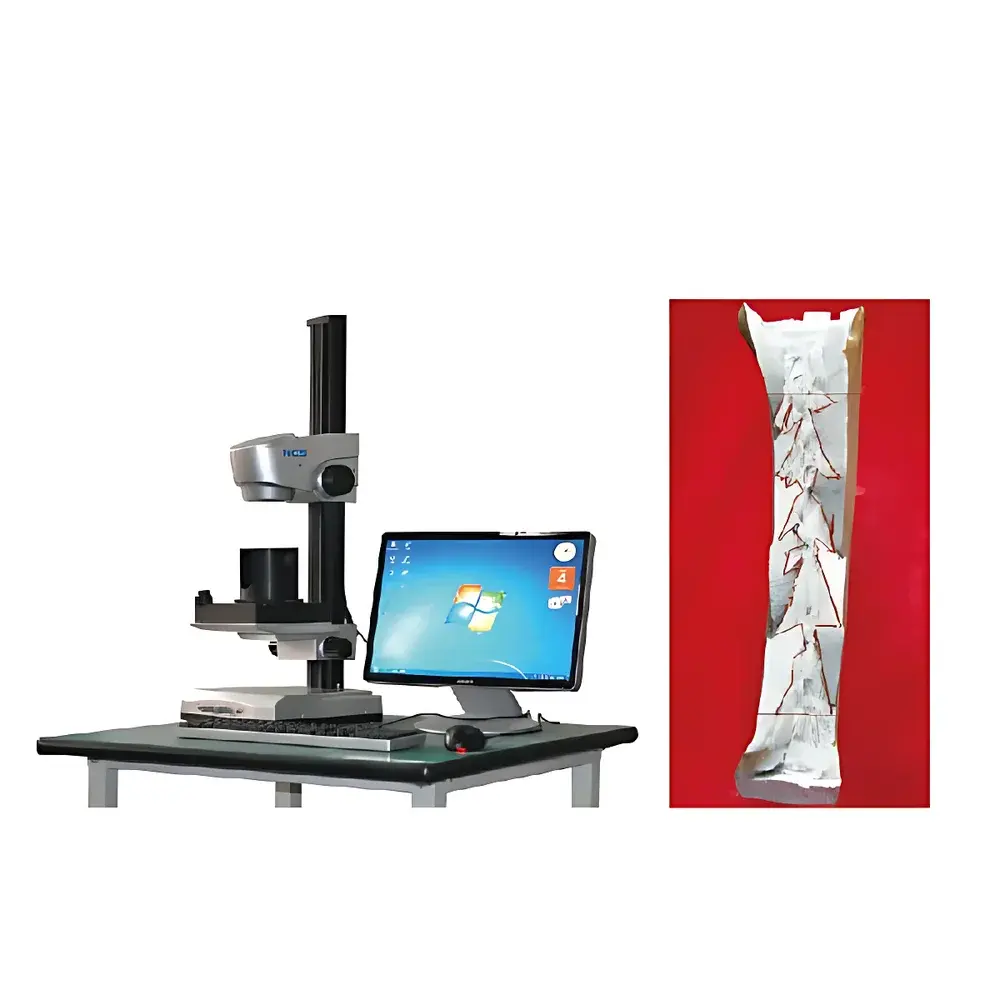
NCS DFAI Impact Fracture Image Analyzer
| Brand | NCS |
|---|---|
| Origin | Beijing, China |
| Manufacturer | NCS (Steel Research Institute) |
| Type | Pendulum Impact Testing Machine |
| Model | NCS DFAI |
| Imaging Sensor | 3-Megapixel CCD |
| Measurement Accuracy | ±0.02 mm |
| Compliance | Designed for ASTM E436, ASTM E23, ISO 148-1, ISO 83, GB/T 229, GB/T 8363 |
| Software | Proprietary fracture morphology analysis suite with audit trail and data export (CSV, TIFF, PDF) |
Overview
The NCS DFAI Impact Fracture Image Analyzer is an integrated digital metrology system engineered for quantitative microstructural assessment of fracture surfaces generated in standardized impact testing—specifically pendulum-based Charpy and Izod tests, Dynamic Tear (DT) tests, and Drop Weight Tear Tests (DWTT) on ferritic steels. Unlike conventional manual or semi-automated visual estimation methods, the DFAI employs high-resolution optical imaging coupled with deterministic edge-detection algorithms to objectively quantify critical fracture morphology parameters: fibrous area percentage (FA%), shear area fraction (SA%), lateral expansion (LE), and crack length in static/dynamic fracture mechanics specimens. Its core measurement principle relies on calibrated pixel-to-length mapping of digitized fracture surface images, where contrast-enhanced segmentation isolates ductile (fibrous) and brittle (crystalline) zones based on grayscale texture variance and spatial continuity—enabling reproducible, operator-independent evaluation compliant with international metallurgical testing standards.
Key Features
- High-fidelity 3-megapixel CCD imaging subsystem with adjustable coaxial illumination and anti-glare optical path—optimized for low-contrast fracture surface topography without saturation or shadow loss.
- Digital measurement accuracy of ±0.02 mm across full field-of-view (FOV), traceable to NIST-traceable calibration standards and verified per ISO/IEC 17025 procedures.
- Dedicated fracture analysis software featuring automated FA% and SA% segmentation using adaptive thresholding, morphological filtering, and region-growing algorithms—validated against reference micrographs from round-robin interlaboratory studies.
- Integrated measurement report generator supporting dual-unit output (mm / mils), statistical summary (mean, SD, CV%), and compliance tagging for ASTM E436 (DT test), ASTM E23 (Charpy), ISO 148-1 (pendulum impact), and GB/T 8363 (DWTT).
- Robust mechanical stage with motorized Z-axis focus control and X-Y translation—designed for repeatable positioning of irregularly shaped fracture specimens up to 120 × 80 mm.
- Fully compliant architecture supporting 21 CFR Part 11–ready audit trails, electronic signatures, and role-based user access control—suitable for GLP/GMP-regulated environments.
Sample Compatibility & Compliance
The NCS DFAI accommodates standard Charpy V-notch (10 × 10 × 55 mm), DT specimens (76 × 204 mm), and DWTT coupons (305 × 76 mm) as defined in ASTM E436, ISO 83, and GB/T 8363. Specimen mounting fixtures are precision-machined from anodized aluminum to minimize thermal drift and ensure orthogonal image capture geometry. All measurement workflows adhere to documented standard operating procedures (SOPs) aligned with ISO/IEC 17025 accreditation requirements. The system supports both as-fractured and etched (e.g., 2% nital) surfaces, with software-configurable contrast enhancement profiles optimized for ferritic microstructures and cleavage facet differentiation.
Software & Data Management
The proprietary NCS FractureVision™ software provides a validated, stand-alone Windows application with version-controlled release history and full metadata logging—including operator ID, timestamp, environmental conditions (optional via external sensor integration), calibration status, and raw image checksums. Data export supports CSV (for LIMS integration), TIFF (lossless archival), and PDF/A-2 (compliant reporting). Audit trail records all parameter changes, measurement re-runs, and annotation edits—retained for minimum 10 years per internal QA policy. Optional API enables direct integration with laboratory information management systems (LIMS) via RESTful endpoints adhering to HL7 FHIR conventions.
Applications
- Quantitative evaluation of ductile-to-brittle transition behavior in pipeline steels, pressure vessel plates, and nuclear-grade austenitic/ferritic alloys.
- Quality assurance of heat-treated structural components where fracture toughness correlation with microstructure (e.g., grain size, inclusion distribution) is required.
- Research-grade fracture surface characterization in materials science laboratories investigating hydrogen embrittlement, temper embrittlement, or irradiation-induced degradation.
- Third-party certification testing for API 5L, EN 10228-3, and ASME Section II material acceptance protocols.
- Failure analysis laboratories performing root cause assessment of in-service component fractures under impact loading conditions.
FAQ
Does the NCS DFAI require external calibration services?
No—the system includes an onboard calibration target and self-validation routine compliant with ISO 13528; annual verification by an ISO/IEC 17025-accredited provider is recommended but not mandatory for routine operation.
Can the software process images acquired from third-party microscopes or scanners?
Yes—FractureVision™ accepts TIFF, BMP, and PNG files with embedded scale bars or known pixel-to-mm ratios; however, optimal accuracy is achieved using native NCS DFAI-captured images due to controlled illumination and geometric consistency.
Is DWTT shear area measurement fully automated?
Yes—SA% calculation follows ISO 83 Annex A methodology with automatic delineation of shear lip boundaries and crystalline fracture zone exclusion; manual override tools are available for edge-case validation.
What cybersecurity protocols does the system support?
The software implements TLS 1.2+ encryption for network data transfer, AES-256 encryption for local database storage, and integrates with enterprise Active Directory for centralized authentication.
Is training included with purchase?
Yes—NCS provides on-site installation qualification (IQ), operational qualification (OQ), and two-day operator certification training covering SOP execution, software navigation, and audit-ready reporting generation.



