
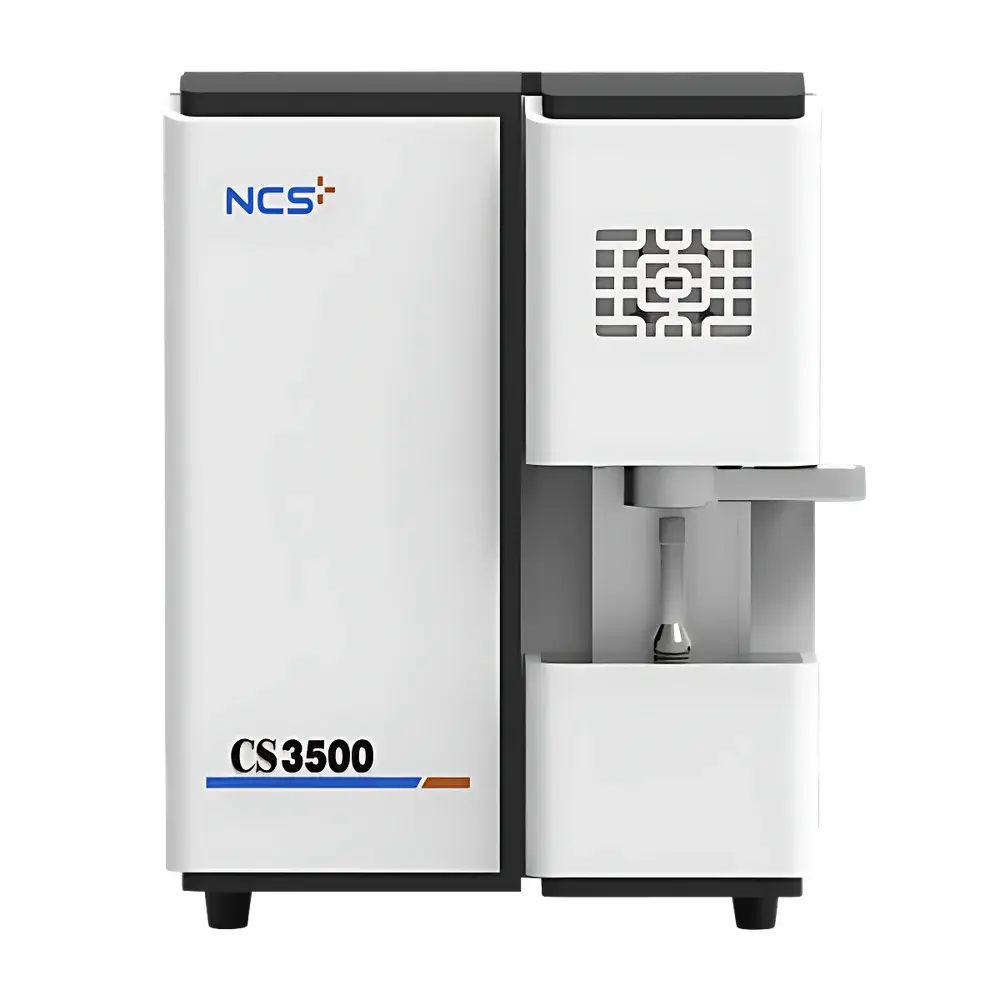
NCS CS3500 High-Frequency Infrared Carbon-Sulfur Analyzer
| Brand | NCS |
|---|---|
| Origin | Beijing, China |
| Manufacturer Type | Direct Manufacturer |
| Model | CS3500 |
| Measurement Principle | Non-Dispersive Infrared (NDIR) Absorption |
| Heating System | High-Frequency Induction Furnace (18 MHz, 2.7 kVA) |
| Carbon Range | Low-C: 0.6 ppm–0.1 % |
| High-C | 0.1 %–50 % |
| Sulfur Range | Low-S: 0.6 ppm–0.3 % |
| High-S | 0.3 %–30 % |
| Sensitivity | 0.01 ppm |
| Precision | C: ±1 ppm or RSD < 0.5 % |
| S | ±1 ppm or RSD ≤ 1.0 % |
| Analysis Time | 30–40 s |
| Detector | Imported Pyroelectric Solid-State IR Detector (Germany) |
| Optical Source | Imported IR Source (USA) |
| Gas Flow Control | Micro-Pressure Differential Electronic Mass Flow Control |
| Catalytic Conversion | CuO Oxidation Furnace (optional), SO₂-to-SO₃ Conversion with SO₃ Trap |
| Software Platform | Windows 10/11 Native GUI with LIMS Integration Support |
| Compliance | Designed for ISO/IEC 17025-compliant labs |
Overview
The NCS CS3500 High-Frequency Infrared Carbon-Sulfur Analyzer is an industrial-grade elemental analyzer engineered for precise, rapid, and reproducible quantification of total carbon and sulfur in solid inorganic matrices. It operates on the principle of non-dispersive infrared (NDIR) absorption spectroscopy, where combustion gases—CO₂ (from carbon oxidation) and SO₂ (from sulfur oxidation)—are swept through dedicated optical cells and measured via wavelength-specific infrared absorption. The instrument integrates a high-efficiency 18 MHz, 2.7 kVA high-frequency induction furnace to ensure complete and homogeneous sample combustion across diverse material classes, including ferrous alloys, metal powders, rare-earth magnets, battery cathode materials, ceramics, geological samples, and refractory compounds. Its dual-range detection architecture enables seamless transition between trace-level (ppm) and bulk-level (wt%) analysis without manual recalibration—critical for laboratories serving metallurgical QC, advanced materials R&D, and third-party certification testing.
Key Features
- Triple-channel NDIR detection system (standard), expandable to four independent optical paths—including dedicated high-sulfur channel—to accommodate wide dynamic range requirements.
- German-sourced pyroelectric solid-state infrared detectors with auto-zero compensation controlled by embedded PC firmware, ensuring long-term baseline stability and signal repeatability.
- US-imported infrared light sources with inert encapsulation, delivering consistent spectral output and extended operational lifetime (>10,000 h typical).
- Thermally stabilized gas cells maintained at constant temperature to eliminate thermal drift effects on absorbance measurement accuracy.
- High-frequency furnace featuring triple-layer electromagnetic shielding, isolated power supply, and feedthrough decoupling capacitors—meeting IEC 61000-4-3 immunity standards and minimizing EMI interference with adjacent instrumentation.
- Tool-free ceramic-filtered dust trap with dual-stage automatic cleaning: mechanical brush sweep + vacuum-assisted particulate removal + reverse-purge gas flow—reducing maintenance downtime and preserving combustion efficiency over >50,000 analyses.
- Dual-gas inlet design (carrier + auxiliary) prevents sample splatter during ignition while optimizing oxygen availability for stoichiometric combustion of refractory or low-density specimens.
Sample Compatibility & Compliance
The CS3500 accommodates solid samples weighing 0.1–1.0 g in standard ceramic or graphite crucibles, compatible with common fluxes (e.g., tungsten, tin, copper oxide). It meets analytical requirements for ASTM E1019 (Standard Test Methods for Determination of Carbon, Sulfur, Nitrogen, and Oxygen in Steel, Iron, Nickel, and Cobalt Alloys), ISO 15350 (Steel — Determination of Total Carbon Content — Infrared Absorption Method after Combustion in High-Frequency Induction Furnace), and GB/T 20123–2006 (Chinese national standard equivalent). Its hardware architecture and software logic support GLP/GMP-aligned workflows: full electronic signatures, configurable user roles, immutable audit trails, and timestamped parameter logs—all compliant with FDA 21 CFR Part 11 when deployed on validated Windows OS environments.
Software & Data Management
The native Windows 10/11 application provides intuitive method setup, real-time release curve visualization, and automated calibration management. It supports unlimited method storage with per-sample parameter presets (e.g., power ramp profiles, delay times, catalyst activation sequences). Data are stored in a relational SQLite database with SQL-query capability; reports can be exported to Excel (.xlsx), PDF, or CSV formats. Integrated TCP/IP communication enables bidirectional data exchange with laboratory information management systems (LIMS) using HL7 or ASTM E1384-compliant protocols. System diagnostics include live monitoring of valve actuation status, analog signal integrity, high-frequency preheat progression, baseline deviation trends, and detector auto-zero performance—accessible without service mode entry.
Applications
This analyzer serves quality control laboratories in integrated steel mills verifying ladle chemistry prior to casting; powder metallurgy facilities validating carbon retention in sintered components; battery material producers certifying sulfur impurity levels in LiCoO₂ or Ni-rich NMC precursors; rare-earth magnet manufacturers controlling interstitial carbon in NdFeB alloys; and geochemical labs quantifying organic carbon and sulfide-bound sulfur in sediment cores. Its robustness and multi-matrix adaptability also support accreditation under ISO/IEC 17025 for testing laboratories engaged in contract analysis for aerospace, nuclear, and automotive supply chains.
FAQ
What sample types require optional CuO catalytic conversion?
Catalytic oxidation is recommended for samples containing significant CO-forming species (e.g., carbides, nitrides, or incompletely oxidized carbon phases) to ensure quantitative conversion of CO → CO₂ prior to infrared detection.
Can the CS3500 be operated in unattended batch mode?
Yes—the software supports scheduled analysis queues, auto-cleaning cycles between runs, and failure-recovery protocols that pause and resume upon error resolution.
Is remote diagnostic support available?
NCS provides secure remote access capability (with customer authorization) for firmware updates, configuration review, and real-time troubleshooting via encrypted VNC tunnel.
How often does the infrared detector require recalibration?
Under normal operation and stable ambient conditions, detector zero-point calibration is performed automatically before each analysis; full span calibration is recommended every 3 months or after 500 analyses, using certified reference materials traceable to NIST SRMs.
Does the system comply with environmental emission regulations?
Exhaust gas is treated via integrated SO₃ trap and catalytic converter, achieving >99.9% SO₂ capture efficiency and meeting EU Directive 2010/75/EU (IED) and China’s GB 16297–1996 emission limits for laboratory exhaust streams.





